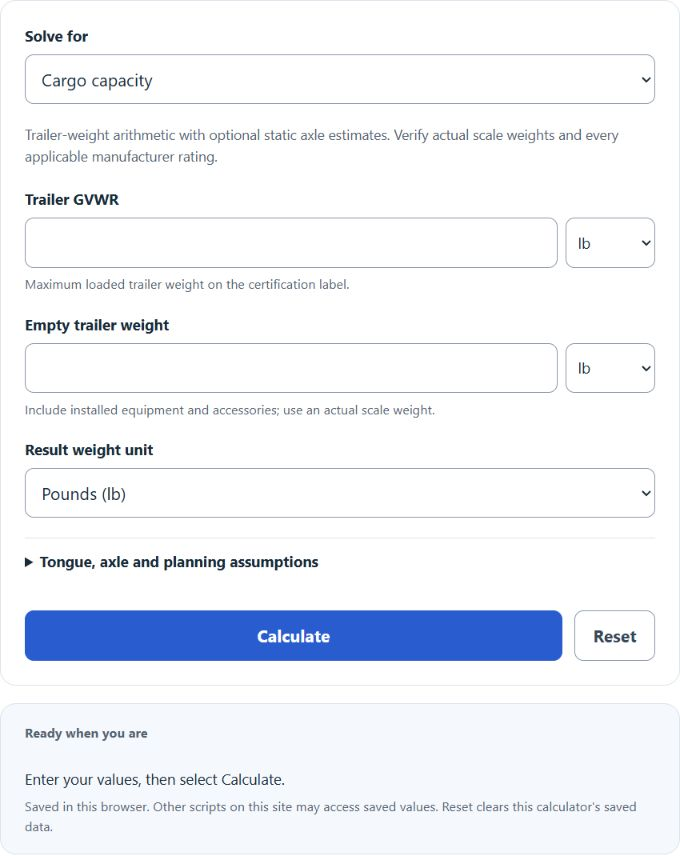
Calculate trailer load capacity from GVWR and empty weight, check a planned load, or find the GVWR you need, with tongue weight estimates in lb or kg.
- All Automotive Calculators
- GVWR Gross Vehicle Weight Rating Calculator
- Dump Trailer Capacity Calculator
- Weight Distribution Calculator
- Trailer Tire Pressure Calculator
- Load Per Square Foot Calculator
- Trailer Tongue Length Calculator
- Weight Distribution Hitch Calculator
Calculator Functions
| Function | What it does | What it requires |
|---|---|---|
| Cargo capacity | Finds how much cargo a trailer can carry | Requires the trailer GVWR and the empty trailer weight |
| Check a proposed load | Finds whether a planned load fits and how much allowance is left or exceeded | Requires the trailer GVWR, the empty trailer weight and the cargo weight |
| Minimum GVWR | Finds the lowest trailer rating that can carry a load | Requires the empty trailer weight and the cargo weight |
| Tow vehicle check | Compares a loaded trailer with the tow vehicle’s payload, combined weight and tow rating | Requires the vehicle GVWR, curb weight, weight of people and gear, GCWR, tow rating, loaded trailer weight and tongue weight share |
Weights can be entered in pounds or kilograms, and results can be shown in either. The first three functions have optional settings: an empty-weight preset by trailer type, a tongue weight share that is 12% when left blank, and a combined trailer axle rating. Minimum GVWR also takes a planning margin, 15% when left blank.
Trailer Load Capacity Formulas
| R | Trailer GVWR, the gross vehicle weight rating: the loaded weight of the trailer set by its manufacturer [1] |
| We | Empty trailer weight, including installed equipment and accessories |
How to Calculate Trailer Load Capacity
Find the GVWR on the trailer’s certification label, weigh the empty trailer on a scale, and subtract. A trailer with a 5,000 lb GVWR that weighs 2,000 lb empty can carry 5,000 − 2,000 = 3,000 lb of cargo. Water, fuel and gear loaded onto the trailer all count as cargo.
Cargo capacity
The main formula applies directly. If a combined trailer axle rating is entered, the calculator also works out the heaviest trailer the axles can carry, because the hitch carries part of the weight:
A is the combined axle rating, the sum of the gross axle weight ratings [1], and p is the tongue weight share as a decimal. The lower of this limit and the GVWR is used. For a 7,000 lb GVWR trailer that weighs 2,000 lb empty, with 6,000 lb of axle rating and a 12% tongue share, the axle limit is 6,000 ÷ 0.88 = 6,818.18 lb, so the capacity is 4,818.18 lb, not 5,000 lb.
The Empty-weight reference preset fills in an average empty weight for a trailer type [3] when no scale weight is available. For a boat trailer the preset covers the trailer only, and the boat is cargo.
| Trailer type | Preset (lb) | Range (lb) |
|---|---|---|
| Small open utility | 700 | 300 to 1,100 |
| Small enclosed utility | 1,000 | 400 to 1,800 |
| Car hauler | 1,900 | 1,500 to 2,800 |
| Fishing boat trailer | 600 | 200 to 1,100 |
| Large boat trailer | 2,200 | 1,100 to 4,400 |
| Small travel trailer | 2,800 | 1,200 to 3,900 |
| Large travel trailer | 6,700 | 4,500 to 8,700 |
Check a proposed load
Left = limit − loaded
The limit is the GVWR, or the axle limit when that is lower. A 2,000 lb trailer with 2,500 lb of cargo weighs 4,500 lb, which leaves 500 lb under a 5,000 lb GVWR. With 3,500 lb of cargo it weighs 5,500 lb and is 500 lb over.
Minimum GVWR
A 2,000 lb trailer carrying 3,000 lb needs a GVWR of at least 5,000 lb. The result also shows that figure with the planning margin added, which is 5,000 × 1.15 = 5,750 lb at 15%. The margin is a planning choice and does not change any rating.
Tow vehicle check
Payload left = Rv −
(curb + load + tongue)
T is the whole loaded trailer weight, Rv is the tow vehicle’s GVWR, and load is the people, gear and added equipment in the vehicle. Tongue weight is commonly kept at 10 to 15% of the loaded trailer weight [2]. The calculator also compares curb + load + T with the gross combination weight rating (GCWR), the manufacturer’s loaded weight for the vehicle and trailer together [1], and compares T with the vehicle’s tow rating.
For a vehicle with a 7,000 lb GVWR, 5,000 lb curb weight and 600 lb of people and gear, towing a 6,000 lb trailer at a 12% tongue share: the tongue weight is 720 lb and the payload left is 7,000 − 6,320 = 680 lb. The combined weight is 11,600 lb, which is 1,400 lb under a 13,000 lb GCWR, and the trailer is 1,000 lb under a 7,000 lb tow rating.
Limits of This Estimate
- This is weight arithmetic on the numbers entered, not approval to tow. Each axle, the tires, the hitch and the brakes have their own limits, and the lowest-rated part of the combination sets the real limit [3].
- Empty-weight presets are averages for a trailer type, and each type covers a wide range [3]. Length alone does not set a trailer’s weight. Use a scale weight for the actual trailer.
- The tongue share is assumed to stay the same as the load changes. How the cargo is placed changes it, and a weight-distribution hitch moves load between axles in a way the calculator does not model.
- The 12% tongue share and 15% planning margin are starting values, not recommendations.
Sources
- 49 CFR 571.3, Definitions (Cornell Legal Information Institute): GVWR, GAWR and GCWR
- U.S. Environmental Protection Agency, Trailer – Truck – Hitch Weight and Rating Survey and Compatibility Analysis: tongue weight as 10 to 15% of loaded trailer weight
- CURT Manufacturing, Trailer Weight Chart: empty weights by trailer type and the lowest-rated component rule