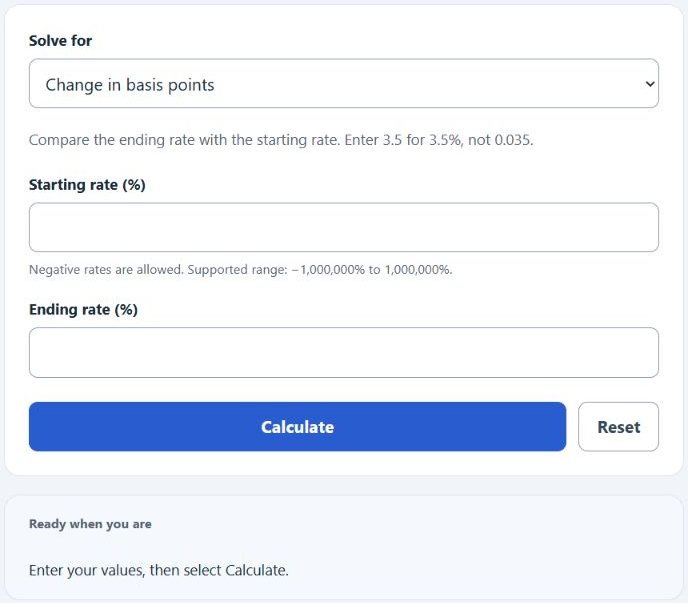
Calculate the basis points difference between two percentage rates, or find one rate when the other rate and basis points change are known.
Related Calculators
- Appraisal Hike Percentage Calculator
- Cost Basis Calculator
- Indirect Cost Rate Calculator
- Cost Recovery Ratio Calculator
- Distributor Margin Calculator
- All Business Calculators
Basis Points Difference Formula
The following equation is used to calculate the Basis Points Difference.
- Where BPD is the basis points difference (bps)
- R₁ is the starting rate in percent (enter 3.5 for 3.5%)
- R₂ is the ending rate in percent
Subtract the starting percentage rate from the ending percentage rate, then multiply by 100. A positive result means an increase; a negative result means a decrease.
What is a Basis Points Difference Calculator?
Definition:
A Basis Points Difference Calculator is a tool used to convert two percentage-based financial rates into basis points and compute the difference between them, offering a precise measurement of small percentage changes.
How to Calculate Basis Points Difference?
Example Problem:
The following example outlines the steps and information needed to calculate the basis points difference.
First, determine the two rates. In this example, let’s say the first rate is 3.50% (0.035 in decimal form) and the second rate is 4.00% (0.04 in decimal form).
Next, subtract the starting percentage rate from the ending percentage rate and multiply by 100.
BPD = (4.00 – 3.50) * 100
BPD = 0.50 * 100
BPD = 50 bps
FAQ
Why are basis points used instead of percentages?
Basis points are used to precisely measure small changes in percentage-based rates, which is crucial for financial products where even slight shifts can have significant impacts over time.
How do I convert basis points to a percentage?
One basis point is 0.01 percentage points. Divide a basis-point change by 100 to express the change in percentage points: 50 bps is 0.50 percentage points. This is not a relative percentage change.
Are basis points only used for interest rates?
No, basis points are used across various financial metrics, including bond yields, mortgage rates, and additional scenarios where small differences in rates can be substantial.