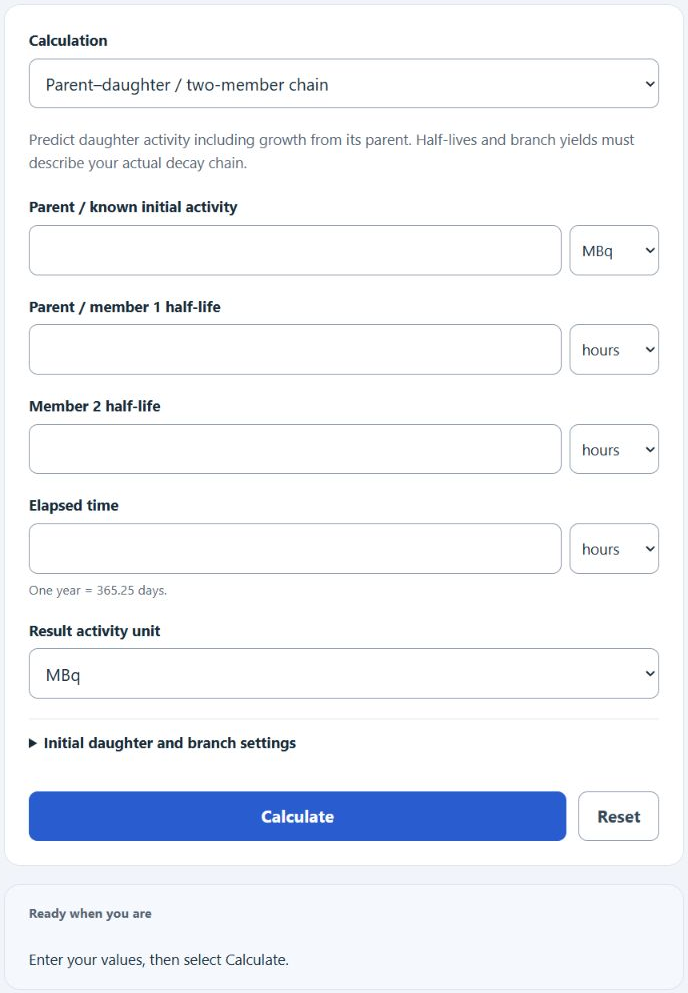
Calculate radioactive decay activities with the Bateman equation for parent-daughter pairs, single isotopes, or linear chains over time.
- All Physics Calculators
- Decay Percentage Calculator
- Decay Factor Calculator
- Decay Constant Calculator
Bateman Equation Formula
Bateman equations describe decay and growth in radioactive chains. The single-isotope special case is shown below; this calculator uses activity A rather than atom count N, with λ = ln(2) / half-life.
Variables:
- A(t) is the activity after elapsed time
- A0 is the initial activity
- λ (lambda) is the decay constant, which is the probability per unit time that a particle will decay
- t is the time elapsed
For a parent-daughter pair: AD(t) = AD0 exp(−λD t) + b AP0 λD [exp(−λP t) − exp(−λD t)] / (λD − λP). Here b is the branching fraction. If rates are equal, AD(t) = [AD0 + b AP0 λt] exp(−λt). Linear-chain modes include up to four radioactive members with constant rates, no external source and no physical removal.
What is the Bateman Equation?
The Bateman equation is a fundamental equation in nuclear physics and chemistry that describes the behavior of radioactive decay chains. It is also applicable to any process that can be described by first-order kinetics, such as certain chemical reactions or biological processes. The equation provides a way to predict the quantity of a substance that remains after a period of time, assuming that the decay process is the only significant factor affecting the quantity.
How to Calculate Using the Bateman Equation?
The following steps describe single-isotope forward decay. Select the parent–daughter or linear-chain calculation for daughter ingrowth; supply every included half-life and any nonzero initial daughter activities.
- First, select Single isotope: forward decay and enter initial activity with its unit.
- Next, enter the half-life; the calculator obtains λ = ln(2) / half-life.
- Then, determine the time elapsed (t).
- Use the single-isotope relation A(t) = A0 × exp(−λt).
- Select Calculate to obtain the activity at the end of the interval.
- After inserting the variables and calculating the result, check your answer with the calculator above.
Example Problem :
Use the following variables as an example problem to test your knowledge.
Initial activity A0 = 100 MBq
Decay constant λ = 0.1 per minute, equivalent to a half-life of ln(2)/0.1 ≈ 6.931471806 minutes
Time elapsed t = 5 minutes. Activity = 100 × exp(−0.5) ≈ 60.653066 MBq.