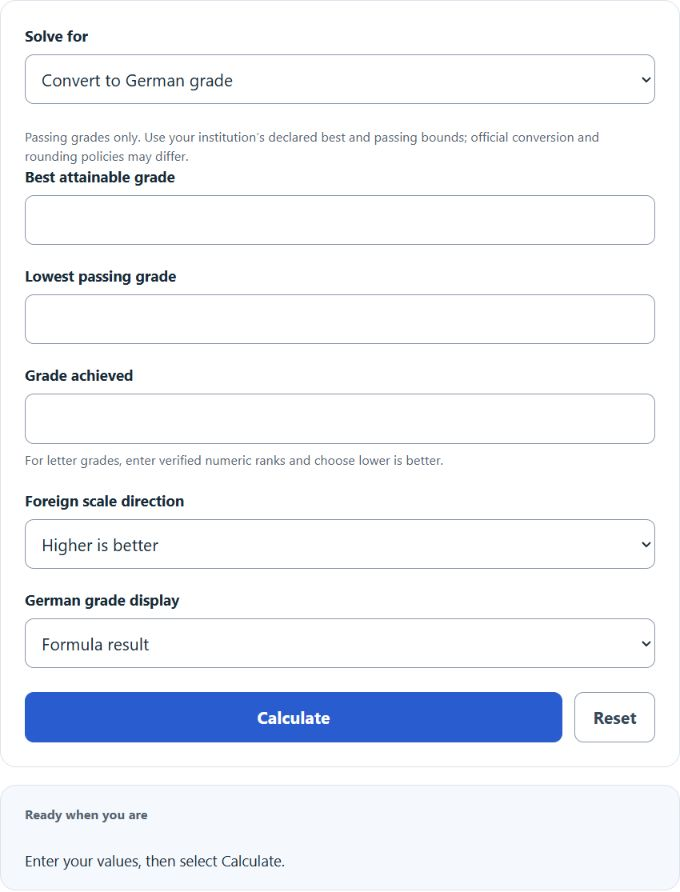
Enter your original grade or score, the best possible grade, and the minimum passing grade into the calculator to convert it to a German grade using the Bavarian formula.

Bavarian Formula Calculator

Enter your grading scale and current grade.

Number grades
Letter grades
Show calculation steps

Bavarian Formula

The following formula is used to calculate the converted German grade (using the Bavarian formula):

BG = 3 * (MG - OG) / (MG - MPG) + 1

Variables:

  • BG is the converted German grade (1.0 is best; 4.0 is typically the lowest passing grade; values above 4.0 indicate a failing result in many implementations)
  • OG is the original grade/score in your original grading system
  • MG is the best possible grade/score achievable in the original grading system
  • MPG is the minimum passing grade/score in the original grading system

To calculate BG, subtract the original grade from the best possible grade, divide by the difference between the best possible grade and the minimum passing grade, multiply by three, and then add one.

What is the Bavarian Formula?

The Modified Bavarian Formula (Modifizierte Bayerische Formel) is the official mathematical conversion method mandated by the Kultusministerkonferenz (KMK), the Standing Conference of the Ministers of Education and Cultural Affairs of the German federal states. It provides a standardized way to translate grades from any foreign educational system onto the German university grading scale of 1.0 to 5.0. The formula is used across nearly all German universities for evaluating international applicants, processing credit transfers, and determining eligibility for admission to degree programs.

The formula works by mapping the linear distance between a student’s achieved grade and the top of their grading scale, proportional to the distance between the top grade and the minimum passing threshold. This proportional relationship is then scaled onto a 3.0 range (from 1.0 to 4.0 on the German scale), producing a direct numeric equivalent. A key mathematical property of the formula: scoring at the maximum (OG = MG) always yields BG = 1.0, and scoring exactly at the minimum pass (OG = MPG) always yields BG = 4.0, regardless of the source grading system.

German Grading Scale Reference

The German university grading scale uses numeric grades from 1.0 (best) to 5.0 (fail), with intermediate values in 0.3 or 0.7 increments. Understanding where your converted grade falls is essential for interpreting your result:

Grade RangeGerman TermEnglish TranslationECTS Equivalent
1.0 to 1.5Sehr gutVery GoodA
1.6 to 2.5GutGoodB
2.6 to 3.5BefriedigendSatisfactoryC
3.6 to 4.0AusreichendSufficient (Pass)D
4.1 to 5.0Nicht bestandenFailF

German universities typically allow grades in 0.3 increments (1.0, 1.3, 1.7, 2.0, 2.3, 2.7, 3.0, 3.3, 3.7, 4.0), though the Bavarian formula output is continuous. Rounding rules vary by institution: some truncate to one decimal place without rounding (favoring the student), while others round to the nearest 0.1 or to the nearest valid 0.3-increment grade.

Country-Specific Conversion Parameters

The Bavarian formula requires knowing the maximum grade (MG) and minimum passing grade (MPG) for your specific grading system. These values differ significantly across countries. The table below provides reference parameters for common systems. If your institution uses a nonstandard scale, consult the anabin database maintained by the Zentralstelle fur auslandisches Bildungswesen (ZAB) for official scale definitions.

Country / SystemScaleMG (Best)MPG (Min. Pass)Notes
United States (GPA)0.0 to 4.04.02.0Some institutions pass at 1.0; confirm with your school
India (Percentage)0 to 10010040 or 50Engineering colleges often use 40; central universities use 50
India (CGPA 10-point)0 to 10104.0 or 5.0Varies by university; IITs typically use 4.0 as pass
United Kingdom0 to 100%10040Scottish universities may use 40% or 50% as pass
France0 to 202010Scores above 16 are rare; practical MG may be 18 or 19
China0 to 10010060Standard across most Chinese universities
Russia2 to 553Grade of 2 is unsatisfactory (fail)
Brazil0 to 10105Some institutions pass at 6 or 7
Netherlands1 to 10106Grades of 9 or 10 are extremely rare
Italy18 to 30 (+ lode)301830 e lode (30L) is the highest; use 30 as MG

Admission Grade Thresholds at German Universities

Converted grades directly determine admission eligibility. German universities set Numerus Clausus (NC) cutoffs that vary by program and semester. The following ranges reflect typical thresholds based on publicly available admission data:

Program CategoryTypical NC RangeExample Institutions
Medicine, Dentistry, Pharmacy1.0 to 1.2Charite Berlin, LMU Munich, Heidelberg
Computer Science, Engineering (top tier)1.3 to 2.0TU Munich, RWTH Aachen, KIT Karlsruhe
Business, Economics1.5 to 2.5Mannheim, WHU, Frankfurt School
Natural Sciences2.0 to 3.0LMU Munich, TU Berlin, Gottingen
Humanities, Social Sciences2.5 to 3.5FU Berlin, Hamburg, Freiburg
Open Admission ProgramsNo NCVaries by university and semester

These thresholds shift each semester based on applicant pool size. International applicants should note that some programs apply a separate quota (typically 5% to 8% of seats) for non-EU applicants, which may have different effective cutoffs than the general NC.

Rounding and Institutional Variations

The raw output of the Bavarian formula is a continuous decimal value, but German universities record grades at specific intervals. How the result is rounded can affect whether a student meets an NC cutoff. Three common rounding practices exist across German institutions:

Truncation without rounding (used by TU Munich and others): only the first decimal digit is kept, and all subsequent digits are dropped. For example, 2.38 becomes 2.3 rather than 2.4. This method favors the student. Some universities round to the nearest 0.1 using standard arithmetic rounding (2.35 becomes 2.4). A third approach rounds to the nearest valid grade in the 0.3-increment system (1.0, 1.3, 1.7, 2.0, 2.3, 2.7, 3.0, 3.3, 3.7, 4.0), where a result that falls exactly between two grades is assigned the better mark. Always confirm the specific rounding convention with your target institution, as the difference of 0.1 can determine admission or rejection.

Limitations and When the Formula Does Not Apply

The Bavarian formula assumes a linear relationship between grade performance and the converted result, which does not account for grade distribution differences between countries. A 70% in the UK (First Class Honours) represents top-tier performance since most students score between 50% and 70%, while a 70% in China is below average on a scale where scores above 85% are common. The formula treats both identically if the same MG and MPG values are used, producing a converted grade that may underrepresent UK students and overrepresent students from systems with higher typical scores.

Several situations fall outside the formula’s scope. Pass/fail courses without numeric grades cannot be converted. Letter-grade systems without an official numeric mapping (such as some Canadian provinces) require the institution to assign numeric equivalents before the formula can be applied. Degrees from unaccredited institutions or systems not listed in the anabin database may not be accepted regardless of the converted grade. Additionally, some German universities use fixed conversion tables for specific countries (notably the Bavarian State Ministry tables for China and India) rather than applying the formula, meaning the formula result and the official conversion may differ.

For graduate admissions, many programs consider the converted grade alongside other factors: GRE/GMAT scores, language proficiency (typically TestDaF 4×4 or DSH-2 for German-taught programs, or IELTS 6.5+/TOEFL 90+ for English-taught programs), research experience, and letters of recommendation. The converted grade is necessary but rarely the sole determinant.