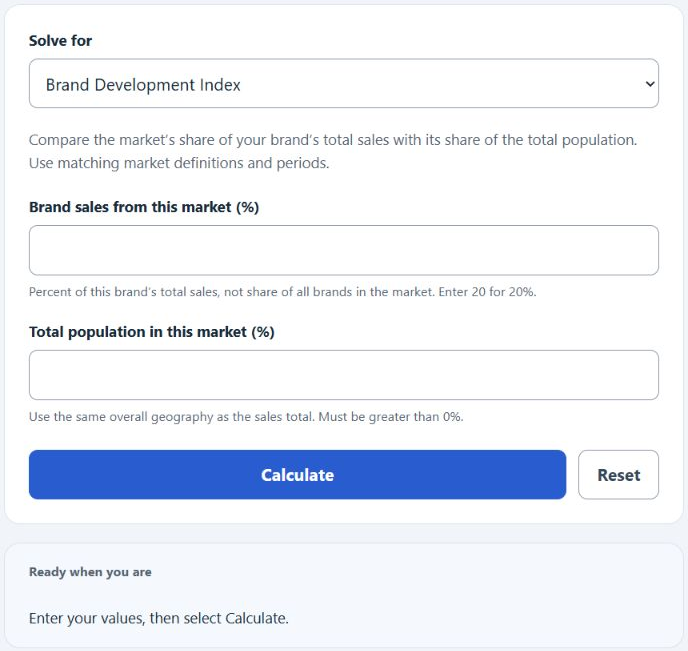
Choose BDI, brand sales share or population share, then enter the two known values. Shares use percentages; BDI uses index points.
- All Business Calculators
- CDI (Category Development Index) Calculator
- Cost Per View Calculator
- Cost Per Lead (CPL) Calculator
- Concentration Ratio Calculator
BDI Formula
BDI stands for Brand Development Index. It compares a brand’s sales in a market to that market’s share of the total population. A BDI of 100 means the brand is performing in line with the market’s population share. Above 100 means stronger-than-average performance, and below 100 means weaker-than-average performance.
- BDI = Brand Development Index
- PBS = percent of the brand’s total sales that come from the market
- PPM = percent of the total population that is in the market
If you are solving for the brand sales percentage instead, the formula is rearranged as:
If you are solving for the market population percentage, the formula is rearranged as:
- Calculate BDI: Enter the percent of brand sales from the market and the percent of total population in the market.
- Calculate percent of brand sales: Enter BDI and the percent of total population in the market.
- Calculate percent of total population: Enter BDI and the percent of brand sales from the market.
BDI Result Interpretation
Use the table below as a general guide for reading a BDI result.
| BDI Range | Meaning | Basic Interpretation |
|---|---|---|
| Less than 100 | Underdeveloped market | The brand’s sales share is lower than the market’s population share. |
| 100 | Average development | The brand’s sales share matches the market’s population share. |
| Greater than 100 | Strong market | The brand’s sales share is higher than the market’s population share. |
Common BDI Inputs
BDI is based on percentages, not raw counts. The sales and population inputs should use the same market definition.
| Input | Example | How to Enter It |
|---|---|---|
| Percent of brand’s total sales from the market | A region produces 18% of total brand sales | Enter 18 |
| Percent of total population in the market | The same region has 12% of the total population | Enter 12 |
| BDI | The calculated index is 150 | Enter 150 if solving for a missing percentage |
Example
Example 1: Calculate BDI
A market accounts for 20% of a brand’s total sales and 10% of the total population.
The BDI is 200. This means the brand performs twice as strongly in that market as the population share would suggest.
Example 2: Calculate Percent of Brand Sales
A market has 15% of the total population, and the brand has a BDI of 120 in that market.
The market accounts for 18% of the brand’s total sales.
FAQ
What does a BDI over 100 mean?
A BDI over 100 means the brand is selling better in that market than expected based on the market’s population share. For example, if a market has 10% of the population but produces 15% of the brand’s sales, the BDI is 150.
What does a BDI below 100 mean?
A BDI below 100 means the market contributes a smaller share of brand sales than its share of the population. This can indicate weaker brand performance, lower awareness, less distribution, different customer preferences, or other market-specific issues.
Is BDI the same as market share?
No. Market share compares a brand’s sales to total category sales in the same market. BDI compares the brand’s sales concentration in a market to that market’s population concentration. BDI is useful for seeing where a brand is overdeveloped or underdeveloped geographically.