Calculate cost per lead, estimate leads from campaign cost and conversion rate, or plan budget, targets, and lead goals for marketing campaigns.
- All Business Calculators
- Cost Per Result Calculator
- CPO Cost Per Order Calculator
- Traffic to Lead Ratio Calculator
- Cost Per Conversion Calculator
- Click-Through Rate (CTR) Calculator
- Conversion Rate Calculator
Cost Per Lead Formula
The calculator uses one core formula and rearranges it for each mode.
- CPL = cost per lead, in dollars per lead
- Total Marketing Cost = all spend tied to the campaign (ad spend, agency fees, creative, tools)
- Total Leads = qualified or raw leads attributed to that spend
Assumptions: spend and leads cover the same date range and the same campaign scope. If you only count “qualified” leads, use that same definition every time you compare results. The formula does not account for lead quality, close rate, or customer value on its own.
The calculator tasks use this formula in different ways:
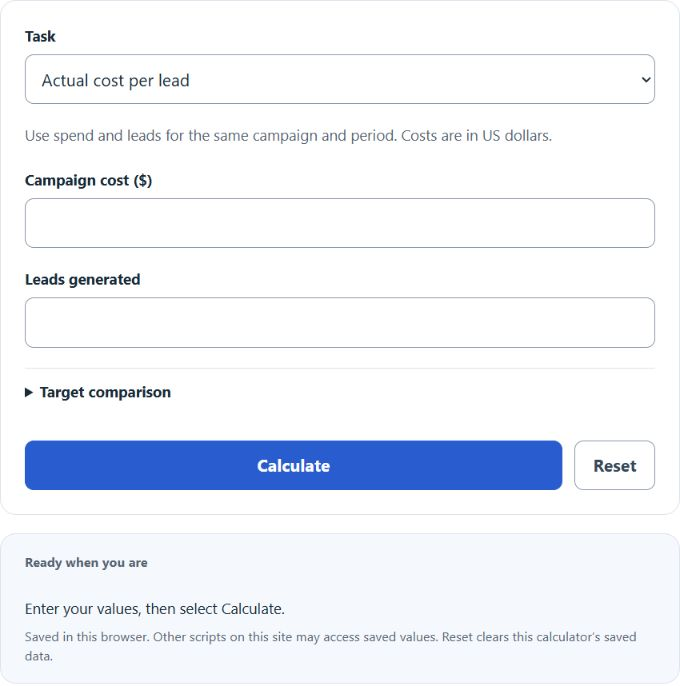
- Actual CPL divides spend by leads you already have. Optional target CPL flags whether the result is over or under goal.
- Estimate Leads first projects leads from traffic and a conversion rate (Leads = Visitors × Rate), then applies the CPL formula.
- Leads needed, maximum budget, and budget comparison rearrange the formula. Maximum budget = Target × Leads. Assuming the full budget is spent, divide Budget by Target and round up to find the minimum whole lead count. A zero budget predicts no leads; one or more actual leads at zero spend would have zero CPL, while zero leads leaves CPL undefined.
Illustrative Cost Per Lead Ranges
CPL varies widely by industry and channel. These unsourced ranges are illustrative, not current market benchmarks or performance standards. Compare with your own lead quality and economics.
| Industry | Illustrative CPL Range |
|---|---|
| B2B SaaS | $200 – $600 |
| Legal services | $100 – $700 |
| Home services | $25 – $200 |
| Insurance | $40 – $300 |
| Higher education | $50 – $250 |
| Ecommerce (email signup) | $1 – $15 |
| Real estate | $30 – $200 |
The unsourced conversion-rate ranges below are illustrative. Use a measured or justified rate for your own traffic and lead definition; suggested rates in the calculator are examples.
| Traffic Source | Illustrative Lead Conversion Rate |
|---|---|
| Cold paid social | 1% – 3% |
| Paid search | 2% – 5% |
| Dedicated landing page | 4% – 8% |
| High-intent quote form | 8% – 15% |
| Retargeting / warm referral | 15% – 25% |
Worked Examples and FAQ
Example 1: Actual CPL. You spent $4,800 on a Google Ads campaign last month and recorded 96 form submissions. CPL = $4,800 ÷ 96 = $50 per lead.
Example 2: Estimate leads first. Your campaign budget is $2,000. You expect 5,000 clicks at a 3% conversion rate. Estimated leads = 5,000 × 0.03 = 150. CPL = $2,000 ÷ 150 = $13.33 per lead.
Example 3: Plan a target. Your target CPL is $75 and you need 200 leads. Maximum spend to meet the target with 200 leads = 200 × $75 = $15,000. If you only have $9,000, you can afford 9,000 ÷ 75 = 120 leads at that CPL.
What counts as marketing cost? Include ad spend, paid placements, agency or freelancer fees, creative production, software tied to the campaign, and any incentive offers. Salaries are sometimes included for fully loaded CPL but often left out for channel-level reporting. Keep the rule consistent.
Should I use raw leads or qualified leads? Both have a place. Raw CPL shows channel efficiency. Marketing-qualified or sales-qualified CPL shows lead quality. Track them separately rather than mixing them.
Is a lower CPL always better? No. A $10 lead that never closes costs more than a $200 lead that becomes a $5,000 customer. Compare CPL against close rate and average customer value before judging a channel.
How does CPL relate to CAC? For the same lead/customer cohort and cost scope, CPL divided by the lead-to-customer close rate estimates cost per acquired customer. It equals full CAC only when all acquisition costs are included. If CPL is $50 and 10% of those leads become customers, the same-scope estimate is $500 per customer; a zero close rate is undefined.