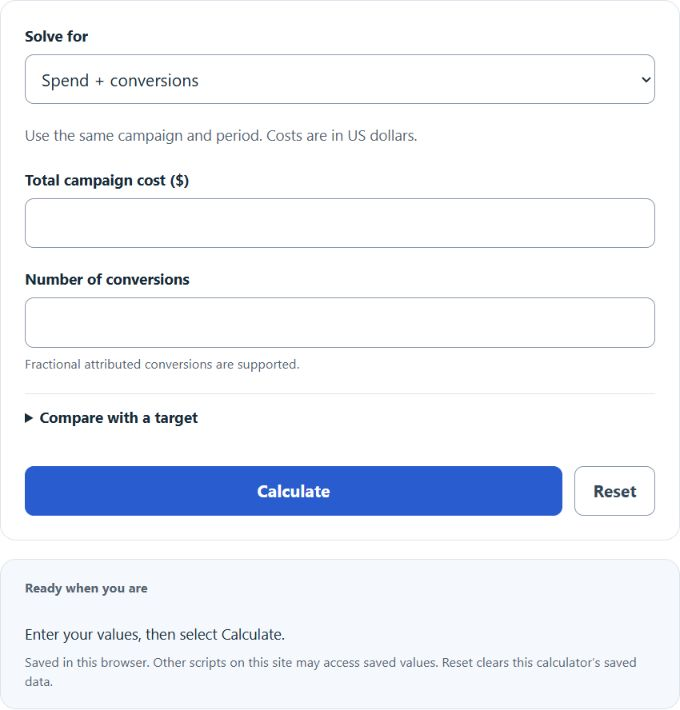
Calculate cost per conversion, budget needed, and conversions affordable from campaign spend, click cost, conversion rate, and target CPA.
Related Calculators
Cost Per Conversion Formula
The calculator uses one core formula and rearranges it for each mode.
- Cost Per Conversion (CPA): the average amount paid for each conversion
- Total Spend: the money spent on the campaign over the period measured
- Conversions: the count of completed actions (sales, leads, signups)
When you only know click-level data, the formula becomes:
Enter conversion rate as a percentage in the calculator (enter 5 for 5%); the formula uses the decimal 0.05. Rates may exceed 100% when multiple conversion actions are counted per click. Rearranged forms used by the other modes:
Assumptions: spend, clicks, and conversions all come from the same campaign and time window. The cost-per-click mode assumes the conversion rate stays constant as click volume scales, which is rarely exactly true at large changes in spend. A “conversion” must be defined the same way every time you compare results, otherwise the number is not useful.
Mode notes:
- Spend + conversions: reports actual CPA from a finished or in-flight campaign.
- Cost per click + rate: projects CPA before you have conversion data, using paid search or paid social click metrics.
- Budget needed: sizes the spend required to hit a conversion goal at a target CPA.
- Conversions affordable: tells you how many conversions a fixed budget should produce at a target CPA.
Illustrative Cost Scenarios
Average cost per conversion varies by campaign and conversion definition. The supplied ranges below are hypothetical illustrations, not verified current industry benchmarks or recommendations.
| Industry | Search CPA (USD) | Social CPA (USD) |
|---|---|---|
| Ecommerce | $45 – $70 | $20 – $40 |
| B2B / SaaS | $110 – $400 | $80 – $250 |
| Legal services | $90 – $250 | $50 – $150 |
| Home services | $50 – $130 | $25 – $80 |
| Education | $60 – $150 | $30 – $90 |
| Health and fitness | $40 – $100 | $15 – $50 |
Compare CPA with conversion value and contribution margin. The following cost-share examples do not establish profitability or a safe scaling threshold.
| CPA / Customer Value | Reading |
|---|---|
| Below 25% | Acquisition cost is under one quarter of the stated value; other costs still apply |
| 25% – 50% | Acquisition cost consumes one quarter to one half of the stated value |
| 50% – 100% | Acquisition cost consumes one half to all of the stated value |
| Above 100% | Acquisition cost exceeds the stated value; assess all revenues and costs |
Example Problems
Example 1: Actual CPA from a campaign. You spent $5,000 and got 100 conversions. CPA = 5000 / 100 = $50 per conversion. If your target was $40, you are 25% above your target; this comparison alone does not identify the cause.
Example 2: Projected CPA from CPC and rate. Average cost per click is $2.50 and the conversion rate is 5%. CPA = 2.50 / 0.05 = $50. If click cost stays at $2.50, a 10% rate gives a modeled CPA of $25.
Example 3: Budget needed. You need 250 leads at a $50 target CPA. Budget = 50 × 250 = $12,500.
Example 4: Conversions affordable. You have $10,000 and a $50 target CPA. Conversions = 10000 / 50 = 200.
FAQ
Is cost per conversion the same as cost per acquisition? In most ad platforms, yes. CPA and cost per conversion are used interchangeably. Some teams reserve “acquisition” for paying customers and use “conversion” for any tracked action (lead, signup, sale).
Should I include creative or agency fees? If you want a true CPA, include every cost tied to producing those conversions: media spend, production, tools, and fees. Platform-reported CPA only counts media spend.
Why is my CPA higher than the benchmark? Common causes are broad keyword or audience targeting, weak landing pages, mismatched offers, and counting low-intent conversions like newsletter signups alongside high-intent ones like demo requests. Segment by campaign before drawing conclusions.
How often should I recalculate? Weekly for active paid campaigns. Monthly is fine for low-volume channels where weekly numbers are too noisy to act on.