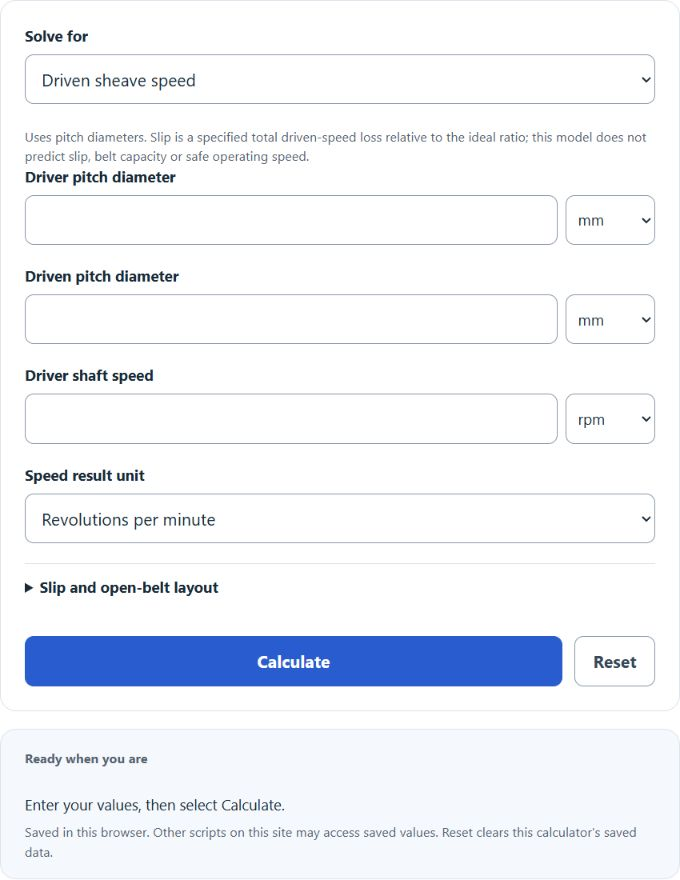
Solve driver or driven shaft speed and pitch diameter with units and specified slip, then review driver pitch-line speed, ratio, approximate open-belt length and small-sheave wrap.
Related Calculators
- Alternator Pulley Ratio Calculator
- Motion Ratio Calculator
- Winch Capacity Calculator
- Shock Force Calculator
- All Automotive Calculators
Belt Sheave Speed Formula
The following no-slip formula relates pitch diameters and shaft speeds. With specified driven-speed loss s = slip%/100, use D₁N₁(1 − s) = D₂N₂. This input describes a speed loss; it does not predict slip.
Variables:
- D1 is the driver sheave diameter
- D2 is the driven sheave diameter
- N1 is the driver speed
- N2 is the driven speed
Choose the value to solve for and enter the displayed known quantities. Unit changes convert entered quantities. In Slip and open-belt layout, blank slip means zero; blank center distance omits layout results. Entered optional values remain active when that section is closed.
What is a Belt Sheave?
A belt sheave, also known as a pulley, is a wheel on an axle or shaft that is designed to support the movement and change of direction of a belt or cable. In mechanical systems, belt sheaves are used to transfer power between shafts, change the speed of rotation, or alter the direction of motion. The diameter of the sheave and the speed at which it rotates are critical factors in determining the performance of the belt drive system. Belt sheaves are commonly used in various applications, including automotive engines, industrial machinery, and HVAC systems.
How to Calculate Belt Sheave Speed?
The following steps outline how to calculate the Belt Sheave Speed.
- First, determine the driver sheave diameter (D1).
- Next, determine the driven sheave diameter (D2).
- Next, determine the driver speed (N1).
- For a reverse solve, determine the driven speed (N2); omit the selected unknown.
- Finally, select Calculate. The model uses D1 * N1 * (1 − slip%/100) = D2 * N2.
- After inserting the values and calculating the result, check your answer with the calculator above.
Example Problem :
Use the following variables as an example problem to test your knowledge.
Driver Sheave Diameter (D1) = 10 cm
Driven Sheave Diameter (D2) = 20 cm
Driver Speed (N1) = 1500 RPM
Driven Speed (N2) = 750 RPM at 0% slip, or 712.5 RPM at 5% specified driven-speed loss.