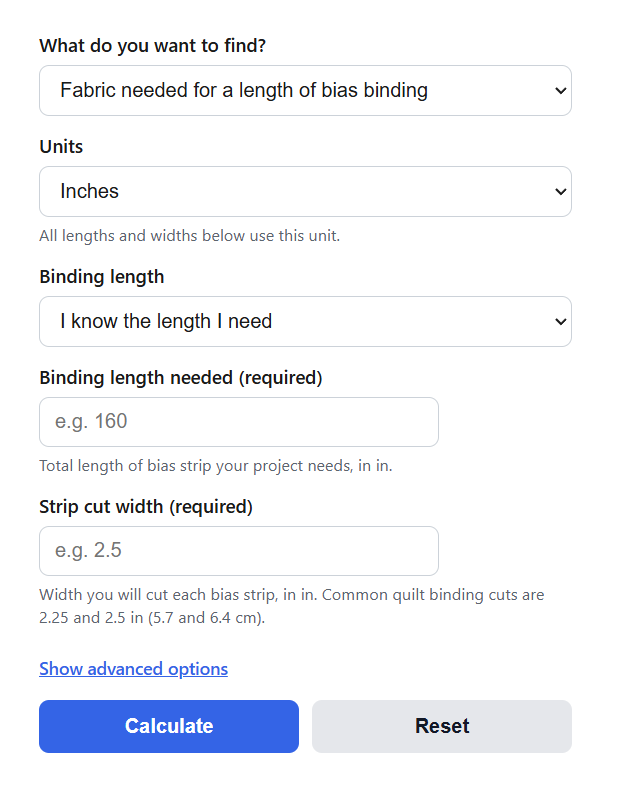
Calculate how much fabric you need for continuous bias binding, including starting square size and yardage, plus how much bias tape your fabric will yield.
Bias Binding Fabric Formula
To find the size of the starting square needed to make a given length of continuous bias binding, use the following formula:
S = sqrt(L * W * (1 + m/100))
To find how much fabric to cut off the bolt instead of cutting a square, divide the same fabric area by the usable width of the fabric:
F = L * W * (1 + m/100) / WOF
To work in the other direction and find how much binding a piece of fabric you already own will make, use:
Y = FW * FL * (1 - m/100) / W
To find the strip cut width from a desired finished tape size, use C = 2 * f for single fold bias tape, C = 4 * f for double fold bias tape, and the following for quilt binding that is folded double before it is attached:
C = 4 * f + 2 * SA + t
Variables:
- S is the side length of the starting square of fabric
- L is the total length of bias binding needed
- W is the cut width of each bias strip
- m is the seam and waste allowance in percent (10% is typical)
- F is the length of fabric to cut off the bolt
- WOF is the usable width of fabric on the bolt (42 inches is standard quilting cotton)
- FW and FL are the width and length of a fabric piece you already own
- Y is the length of binding that piece will yield
- C is the strip cut width, f is the finished width, SA is the seam allowance, and t is a thickness allowance for the quilt sandwich
- All lengths use the same unit, either inches or centimeters
The calculator runs these formulas in three modes. The default mode takes the binding length you need, or works it out from your project dimensions as the perimeter plus extra for corners and joining, then returns the starting square size, the equivalent cut off the bolt, and how far a fat quarter would get you. The second mode reverses the math and tells you how much binding a fabric piece you already have will produce. The third mode converts a finished tape or binding width into the strip cut width, and points you to the closest standard bias tape maker size.
Bias Tape Maker Sizes and Starting Square Reference
Bias tape makers are labeled by the width of the single fold tape they produce, and each one needs strips cut to twice that width. The table below connects the standard maker sizes to the strip width you should cut and the tape each produces.
| Tape maker size | Cut strip width | Single fold tape | Double fold tape |
|---|---|---|---|
| 6 mm (1/4 in) | 1/2 in (1.2 cm) | 1/4 in | 1/8 in |
| 12 mm (1/2 in) | 1 in (2.5 cm) | 1/2 in | 1/4 in |
| 18 mm (3/4 in) | 1 1/2 in (3.8 cm) | 3/4 in | 3/8 in |
| 25 mm (1 in) | 2 in (5 cm) | 1 in | 1/2 in |
| 50 mm (2 in) | 4 in (10 cm) | 2 in | 1 in |
The next table shows the starting square needed to bind common quilt sizes, using the perimeter plus 12 inches of extra length and a 10% seam and waste allowance.
| Quilt size | Binding length | Square for 2 1/4 in strips | Square for 2 1/2 in strips |
|---|---|---|---|
| Crib (36 x 52 in) | 188 in | 22 in | 23 in |
| Lap (54 x 65 in) | 250 in | 25 in | 27 in |
| Twin (70 x 90 in) | 332 in | 29 in | 31 in |
| Queen (90 x 95 in) | 382 in | 31 in | 33 in |
| King (110 x 108 in) | 448 in | 34 in | 36 in |
Example Problems
Example 1: fabric needed for an apron and placemat set. You need 160 inches of bias binding cut 2.5 inches wide. The fabric area required is 160 * 2.5 * 1.10 = 440 square inches. The square root of 440 is about 20.98, so you cut a 21 x 21 inch starting square. If you would rather cut off the bolt, 440 / 42 = 10.5, so an 11 inch cut of standard quilting cotton covers it, which is about 3/8 yard.
Example 2: binding from a fat quarter. You have an 18 x 22 inch fat quarter and want 2.5 inch strips. The theoretical maximum is 18 * 22 / 2.5 = 158.4 inches. Deducting 10% for joining seams and trimming leaves about 142 inches of usable binding. That is plenty for placemats or a garment edge, but short of the 188 inches a crib quilt needs, so plan on two fat quarters or a 23 inch square for that project.
Bias Binding Fabric Calculator FAQs
Why cut binding on the bias instead of on the straight grain? Strips cut at 45 degrees to the selvage stretch, which lets the binding curve smoothly around scalloped edges, necklines, and rounded corners without puckering. Bias binding also wears better on quilts, because the threads cross the edge at an angle and the abrasion is spread across many threads instead of running along a single one. For a straight-sided quilt, straight grain binding works and uses slightly less fabric, so bias is a choice, not a requirement.
Do you need to add seam allowance to the strip cut width? No. The strip cut width you enter is the full width of the strip as cut, and the seam and waste allowance percentage covers the fabric consumed by the diagonal joining seams. What the cut width must already include is the folding structure of the tape itself: a 1/2 inch double fold tape needs a 2 inch strip, and a French quilt binding with a 3/8 inch finished width and 1/4 inch seams needs a strip around 2 1/8 to 2 1/4 inches wide. The third calculator mode does that conversion for you.
How much bias binding does a fat quarter make? Divide the fat quarter area, 18 x 22 = 396 square inches, by your strip width, then take off about 10%. That gives roughly 158 inches of 2 1/4 inch binding or 142 inches of 2 1/2 inch binding per fat quarter. Two fat quarters will bind most lap quilts, and the yield mode of the calculator will confirm the number for any piece in your stash.