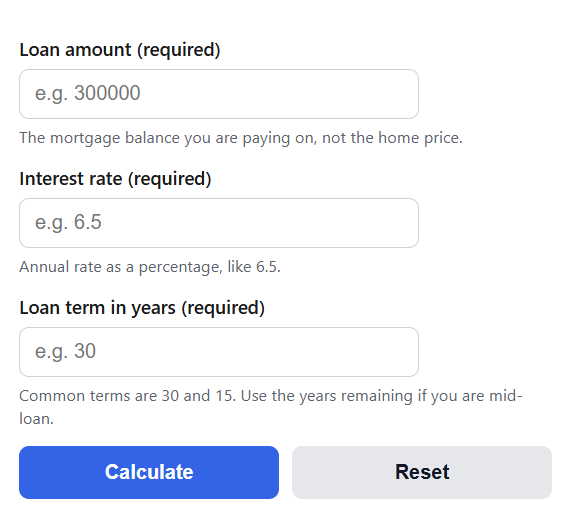
This biweekly mortgage payment calculator shows your payment every two weeks, total interest saved, and how many years sooner you pay off your home loan.
Biweekly Mortgage Payment Formula
The calculator starts with the standard monthly principal and interest payment, then splits it in half:
M = L * r / (1 - (1 + r)^-n)
  B = M / 2
Because there are 52 weeks in a year, paying B every two weeks means 26 half-payments — the equivalent of 13 full monthly payments instead of 12. The calculator models that extra payment using the standard approximation of 1/12 of a payment added every month:
P_eff = M * 13 / 12
Variables:
- M is the standard monthly principal and interest payment
- B is the biweekly payment, half the monthly payment, paid every two weeks
- L is the loan amount
- r is the monthly interest rate, the annual percentage divided by 1200
- n is the number of monthly payments in the original term (years * 12)
- P_eff is the effective monthly payment used to simulate the accelerated payoff
Enter the loan amount, annual interest rate, and term. The calculator returns your biweekly payment, then amortizes the balance month by month at the effective payment to find the new payoff date, the total interest under both plans, and the interest and time you save. The savings come entirely from that one extra payment per year going straight to principal — not from any change in how interest is charged.
Interest Saved with Biweekly Payments (30-Year Loans)
This table shows what switching to biweekly payments does to common 30-year loan amounts at today’s typical rates, using the same math as the calculator.
| Loan | Rate | Biweekly payment | Interest saved | Time saved |
|---|---|---|---|---|
| $250,000 | 6.0% | $749.44 | $61,387.80 | 5 yr 5 mo |
| $250,000 | 6.5% | $790.09 | $72,713.57 | 5 yr 10 mo |
| $250,000 | 7.0% | $831.63 | $85,353.72 | 6 yr 3 mo |
| $300,000 | 6.0% | $899.33 | $73,665.36 | 5 yr 5 mo |
| $300,000 | 6.5% | $948.10 | $87,256.29 | 5 yr 10 mo |
| $300,000 | 7.0% | $997.95 | $102,424.46 | 6 yr 3 mo |
| $400,000 | 6.0% | $1,199.10 | $98,220.48 | 5 yr 5 mo |
| $400,000 | 6.5% | $1,264.14 | $116,341.72 | 5 yr 10 mo |
| $400,000 | 7.0% | $1,330.60 | $136,565.95 | 6 yr 3 mo |
Example Problems
Example 1: Biweekly payments on a $300,000 loan.
You have a $300,000 mortgage at 6.5% for 30 years. The monthly payment is M = 300,000 * 0.00541667 / (1 – 1.00541667^-360) = $1,896.20, so the biweekly payment is B = 1,896.20 / 2 = $948.10 every two weeks.
Simulating the payoff with the effective payment of 1,896.20 * 13 / 12 = $2,054.22 per month, the loan is gone in 24 yr 2 mo instead of 30 yr — 5 yr 10 mo sooner — and total interest falls from $382,633.47 to $295,377.18, saving $87,256.29.
Example 2: Larger loan at a higher rate.
On a $400,000 loan at 7.0% for 30 years, the monthly payment is $2,661.21 and the biweekly payment is $1,330.60. Biweekly payments cut the payoff to 23 yr 9 mo, saving 6 yr 3 mo of payments and $136,565.95 in interest.
Frequently Asked Questions
How do biweekly mortgage payments save money?
Paying half your mortgage payment every two weeks lines up with the 52-week year, so you make 26 half-payments — 13 full payments instead of 12. That extra payment goes entirely to principal, which shrinks the balance faster and cuts the interest charged every month afterward. On a typical 30-year loan at today’s rates, that alone removes roughly five to six years of payments and tens of thousands of dollars of interest.
Do I need my lender’s biweekly program?
No, and you should be wary of third-party biweekly services that charge setup or per-transaction fees for something you can do free. Many servicers simply hold the first half-payment until the second arrives, which by itself saves nothing. You get the identical result by adding 1/12 of your payment (about $158 on a $1,896 payment) as an extra principal payment each month, or by making one extra full payment per year — just confirm it is applied to principal.
Will biweekly payments lower my monthly payment or my rate?
Neither. Your interest rate and required payment stay exactly the same — you are simply prepaying principal on a schedule. The benefit shows up as a shorter payoff and less total interest, not smaller bills. If your budget is tight, the same dollars are more flexible as voluntary extra principal payments, since you can skip a month without missing a required payment.