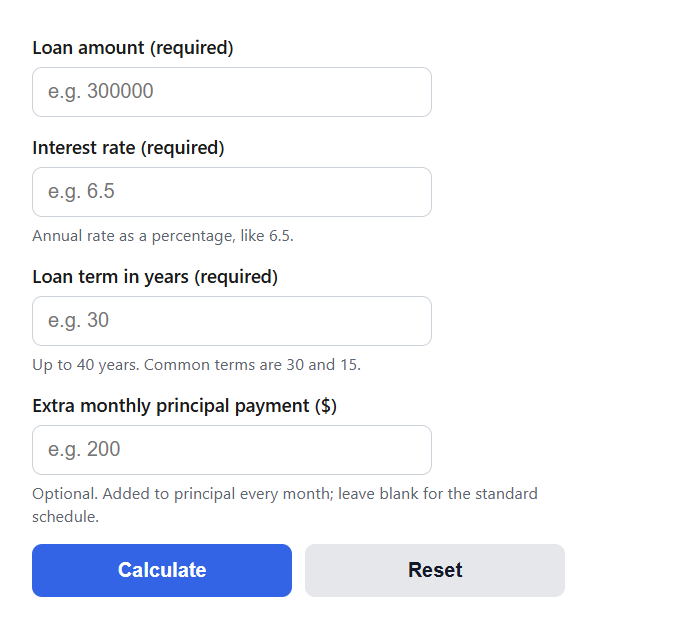
Free mortgage amortization calculator with a yearly schedule of principal, interest, and balance, plus payoff time and interest saved from extra payments.
Mortgage Amortization Formula
The calculator first finds the fixed monthly payment for the loan:
M = L * r / (1 - (1 + r)^-n)
It then builds the amortization schedule month by month. Each month, part of the payment covers interest on the remaining balance and the rest reduces principal:
I_m = B * r
  P_m = M + E - I_m
  B_new = B - P_m
Variables:
- M is the monthly principal and interest payment
- L is the starting loan amount
- r is the monthly interest rate, the annual percentage divided by 1200
- n is the number of monthly payments (years * 12)
- B is the loan balance at the start of a month and B_new is the balance after the payment
- I_m is the interest portion and P_m is the principal portion of that month’s payment
- E is the optional extra monthly principal payment (0 if none)
Enter the loan amount, annual interest rate, and term in years. The calculator returns your monthly principal and interest payment, the total interest over the life of the loan, and a year-by-year amortization table showing how much principal and interest you pay each year and the balance remaining at the end of each year.
Add an optional extra monthly principal payment to see how prepaying changes the schedule. Because every extra dollar goes straight to the balance, interest stops accruing on it immediately — the calculator shows your new payoff date, the interest you save compared with the standard schedule, and a shorter amortization table that ends at the early payoff.
Interest vs Principal by Year: $300,000 Loan at 6.5% (30-Year)
Early payments on a mortgage are mostly interest. This table shows how the split inside the same $1,896.20 monthly payment shifts over time on a $300,000 loan at 6.5% for 30 years, exactly as the calculator’s schedule reports it.
| Year | Principal paid | Interest paid | Interest share | Ending balance |
|---|---|---|---|---|
| 1 | $3,353.18 | $19,401.27 | 85.3% | $296,646.82 |
| 5 | $4,345.79 | $18,408.66 | 80.9% | $280,832.93 |
| 10 | $6,009.43 | $16,745.02 | 73.6% | $254,328.38 |
| 15 | $8,309.94 | $14,444.51 | 63.5% | $217,677.42 |
| 20 | $11,491.13 | $11,263.32 | 49.5% | $166,995.85 |
| 25 | $15,890.13 | $6,864.32 | 30.2% | $96,912.49 |
| 30 | $21,973.15 | $781.30 | 3.4% | $0.00 |
Example Problems
Example 1: Standard amortization schedule.
You borrow $300,000 at 6.5% for 30 years. With r = 6.5 / 1200 = 0.00541667 and n = 360:
M = 300,000 * 0.00541667 / (1 – 1.00541667^-360) = $1,896.20 per month. In year 1 the schedule shows $19,401.27 of interest and only $3,353.18 of principal. Over the full 30 years you pay $382,633.47 in interest.
Example 2: Adding an extra $200 per month.
Same loan, but you pay $200 extra toward principal every month, for $2,096.20 total. The loan is paid off in 23 yr 1 mo instead of 30 yr — 6 yr 11 mo sooner — and total interest drops to $279,184.67, saving $103,448.79 compared with the standard schedule.
Frequently Asked Questions
Why does so little of my payment go to principal at first?
Interest each month is charged on the entire remaining balance, and at the start of a mortgage that balance is at its largest. On a $300,000 loan at 6.5%, the first month’s interest alone is 300,000 * 0.00541667 = $1,625, leaving only about $271 of the $1,896.20 payment for principal. As the balance falls, the interest charge shrinks and an ever-larger share of the same fixed payment reduces principal — the crossover point on this loan comes around year 20.
Do extra payments lower my monthly payment?
No. On a standard fixed-rate mortgage, extra principal payments shorten the payoff time and cut total interest, but the required monthly payment stays the same. If you want a lower required payment instead, you would need to refinance, or ask your servicer about recasting — a lump-sum principal payment after which the lender re-amortizes the loan over the remaining term, usually for a small fee.
Is there a penalty for paying off a mortgage early?
Most U.S. mortgages today have no prepayment penalty — conforming loans backed by Fannie Mae and Freddie Mac, plus FHA and VA loans, cannot charge one. Some non-qualified or portfolio loans still can, typically only during the first few years. Check your loan estimate or promissory note, and make sure any extra payment is applied to principal rather than treated as an early next payment.