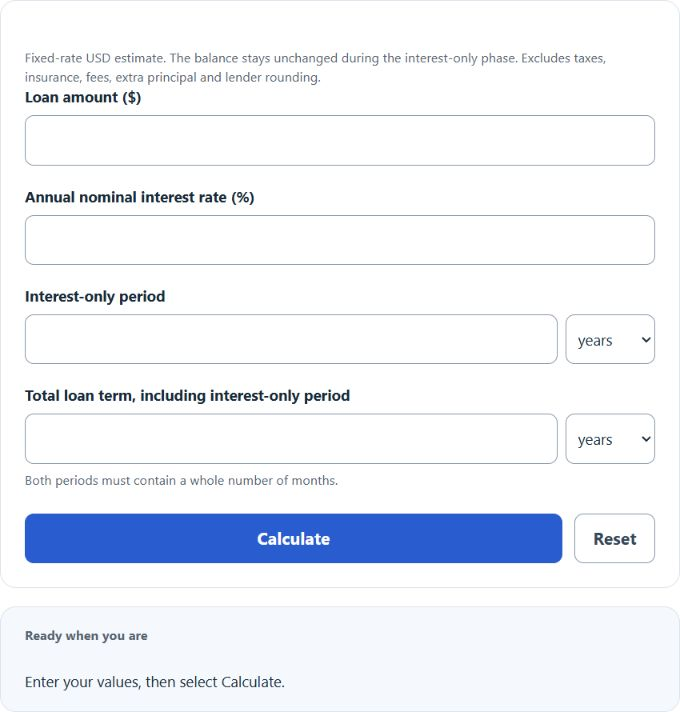
Use this interest only mortgage calculator to find your IO monthly payment, the higher payment after the IO period, and the extra interest cost you take on.
Interest Only Mortgage Formula
During the interest-only period the payment covers interest alone, so it is simply the balance times the monthly rate:
M_io = L * r / 1200
When the interest-only period ends, the full balance must be paid off over the years that remain, so the payment switches to the standard amortization formula with a shortened schedule:
M = L * (r / 1200) / (1 - (1 + r / 1200)^-n)
At r = 0: M = L / n
Variables:
- M_io is the monthly payment during the interest-only period
- M is the monthly principal and interest payment after the interest-only period ends
- L is the loan amount, which is unchanged at the end of the IO period because no principal has been paid
- r is the annual interest rate as a percentage
- n is the number of monthly payments remaining after the IO period ((term – IO years) * 12)
Enter the loan amount, the rate, the interest-only period, and the total term. The calculator returns the interest-only payment, the higher payment that kicks in when the IO period ends, and the jump between them in dollars and percent (undefined when the initial payment is zero). It also totals the interest paid under the interest-only structure and compares it with a standard fully amortizing loan of the same amount, rate, and term, so you can see the extra interest the IO structure costs.
The comparison assumes you pay only the required interest during the IO period. Paying optional principal during those years shrinks both the payment jump and the extra interest cost.
Interest-Only vs Standard Payments on a $400,000 Loan
This table compares a $400,000 loan with a 10-year interest-only period and a 30-year term against a standard fully amortizing 30-year loan at the same rate. The last column is the payment required after the IO period, when the balance amortizes over the remaining 20 years.
| Rate | Interest-only payment | Standard P&I payment | Payment after IO period |
|---|---|---|---|
| 5.50% | $1,833.33 | $2,271.16 | $2,751.55 |
| 5.75% | $1,916.67 | $2,334.29 | $2,808.33 |
| 6.00% | $2,000.00 | $2,398.20 | $2,865.72 |
| 6.25% | $2,083.33 | $2,462.87 | $2,923.71 |
| 6.50% | $2,166.67 | $2,528.27 | $2,982.29 |
| 6.75% | $2,250.00 | $2,594.39 | $3,041.46 |
| 7.00% | $2,333.33 | $2,661.21 | $3,101.20 |
| 7.25% | $2,416.67 | $2,728.71 | $3,161.50 |
| 7.50% | $2,500.00 | $2,796.86 | $3,222.37 |
Example Problems
Example 1: You borrow $400,000 at 6.5% with a 10-year interest-only period and a 30-year term.
Interest-only payment: M_io = 400,000 * 6.5 / 1200 = $2,166.67. After 10 years the untouched $400,000 balance amortizes over the remaining 240 months: M = 400,000 * (6.5 / 1200) / (1 – (1 + 6.5 / 1200)^-240) = $2,982.29, a jump of $815.63 per month (+37.64%). Total interest under the IO structure is $575,750.21, versus $510,177.95 on a standard 30-year loan at the same rate, so the interest-only structure costs an extra $65,572.26.
Example 2: You borrow $300,000 at 6.0% with a 5-year interest-only period and a 30-year term.
Interest-only payment: M_io = 300,000 * 6 / 1200 = $1,500.00. After 5 years the balance amortizes over 300 months: M = $1,932.90, a jump of $432.90 per month (+28.86%). Total interest is $369,871.26 with the IO structure versus $347,514.57 on a standard loan, an extra cost of $22,356.69.
Frequently Asked Questions
Do I build equity during the interest-only period?
Not from your payments. Because every dollar goes to interest, the loan balance is exactly the same at the end of the IO period as on day one. Any equity you gain during those years comes only from your down payment, home price appreciation, or voluntary extra principal payments, when permitted by the mortgage contract.
Why is the payment after the interest-only period higher than a standard loan payment?
A standard 30-year loan spreads principal repayment across all 360 months, but a 10-year IO loan defers all principal into the final 20 years. Repaying the full balance over 240 months instead of 360 requires a larger payment; on a $400,000 loan at 6.5%, the payment after the IO period is $2,982.29 versus $2,528.27 for a standard loan. The later the principal starts, the bigger both the jump and the total interest cost.
Are interest-only mortgages hard to get?
An interest-only feature does not meet the General Qualified Mortgage product requirements. Eligibility, down payment, reserves, pricing, rate adjustments and prepayment rules depend on the lender and the actual contract. This calculator does not assess qualification.