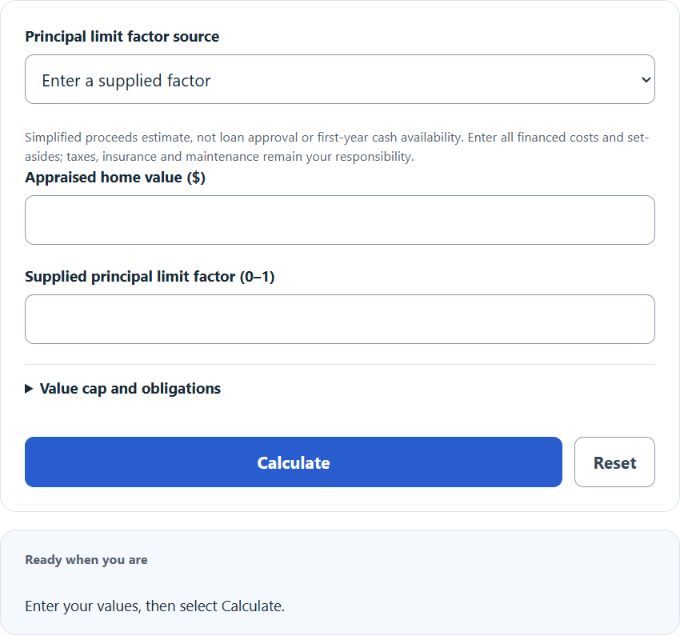
Estimate reverse mortgage principal limit and net available proceeds from home value, mortgage balance, obligations, PLF, age, and rate.
Reverse Mortgage Formula
Reverse mortgages (such as U.S. HECM loans) are commonly described using a principal limit and then a net available proceeds calculation. A simplified representation is:
- Where PL is the Principal Limit ($)
- HV is the Appraised Home Value ($)
- MCA here denotes the applicable program value cap. For HECM, the maximum claim amount itself is the lesser of the appraised value and national limit; a purchase is also limited by the sales price ($).
- PLF is the Principal Limit Factor (unitless multiplier from HUD tables; depends on the age of the youngest borrower or eligible non-borrowing spouse and the expected rate)
- MO is Mandatory Obligations (e.g., existing mortgage payoff and other required liens/set-asides/financed costs) ($)
- NAP is Net Available Proceeds (an estimate of what may be available after mandatory obligations) ($)
In words: estimate the principal limit by multiplying the applicable value (the lesser of the appraised value and the program cap) by the principal limit factor, then subtract mandatory obligations to estimate net available proceeds. Include closing costs, mortgage insurance premiums and required set-asides among the entered obligations. This simplified estimate does not determine first-year cash availability, eligibility or loan approval. HUD mode uses the official on/after October 2, 2017 PLF table and requires the applicable program cap and an already-rounded table rate.
What is a Reverse Mortgage?
Definition:
A reverse mortgage is a loan available to eligible homeowners (often seniors) that allows them to convert part of their home equity into cash. Repayment is generally deferred until the borrower no longer occupies the home as a primary residence, sells the home, passes away, or otherwise fails to meet loan obligations (such as paying property taxes and insurance).
How to Calculate Reverse Mortgage?
Example Problem:
The following example outlines the steps and information needed to estimate reverse mortgage proceeds.
First, determine the home value. In this example, the property is appraised at $300,000.
Next, obtain the principal limit factor (PLF) from the applicable lender or HUD table. The factor 0.5 is assumed solely for this arithmetic example; it is not a quoted age/rate factor.
Then, find the mandatory obligations. Here, assume the current mortgage balance that must be paid off is $50,000 (and assume $0 in other required obligations/financed costs for simplicity).
Finally, calculate the principal limit and net available proceeds using the formulas above (and assuming the home value is below any applicable maximum claim amount cap):
PL = min(HV, MCA) × PLF
PL = $300,000 × 0.5 = $150,000
NAP ≈ PL − MO
NAP ≈ $150,000 − $50,000 = $100,000
FAQ
What factors can affect how much money I can borrow with a reverse mortgage?
Key factors include the appraised value of your home, the program’s maximum claim amount cap (if applicable), your current mortgage balance and other mandatory obligations, interest rates, and your age (the youngest borrower or eligible non-borrowing spouse’s age for HECM). Generally, older homeowners may qualify for higher principal limit factors, and interest-rate conditions can influence available funds.
Do I still own my home with a reverse mortgage?
Yes, you maintain homeownership as long as you fulfill the loan obligations, including keeping up with property taxes, homeowner’s insurance, and maintenance. The debt is typically repaid when the last borrower moves out, sells the home, or passes away (or if loan obligations are not met); qualifying non-borrowing spouses may have repayment deferral protections subject to HECM rules.
Is a reverse mortgage right for me?
A reverse mortgage can be a tool for generating retirement income by leveraging home equity, but it can reduce remaining equity for heirs and may include significant fees and ongoing obligations. It’s best to speak with a qualified reverse-mortgage counselor and/or financial advisor to understand how it fits into your financial plan.
HUD sources checked October 20, 2026: HECM principal limit factors and calendar-year maximum claim amounts. The official page still lists the on/after October 2, 2017 factor table, and lists a 2026 HECM maximum claim amount of $1,249,125. Enter the applicable cap; no 2027 cap is assumed.