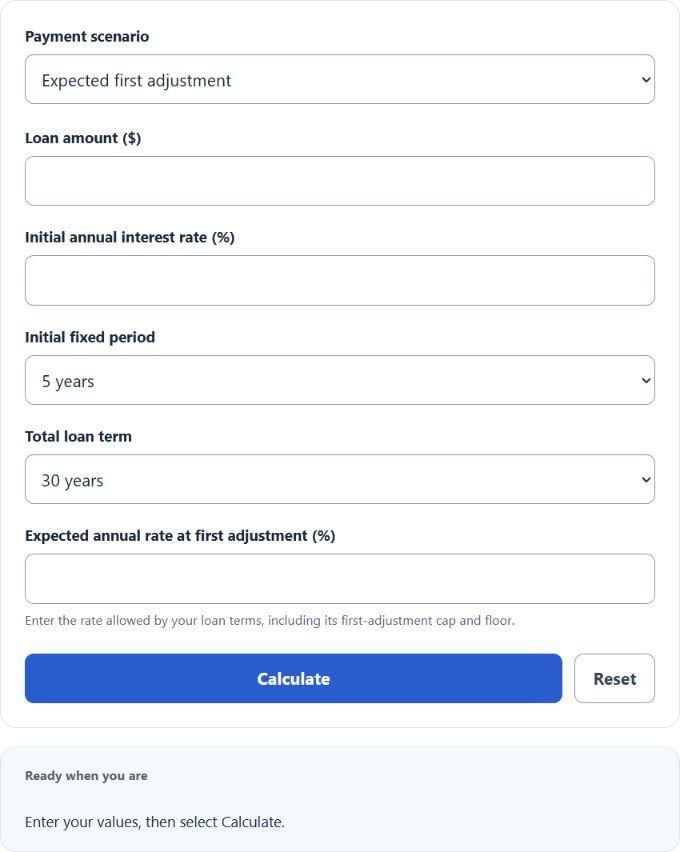
Use this ARM mortgage calculator to estimate your initial payment, the balance at first adjustment, your new adjusted payment, and a same-balance scenario at the lifetime cap.
ARM Mortgage Formula
An adjustable-rate mortgage starts with a fixed intro rate, so the initial payment uses the standard amortization formula over the full term:
M = L * (r / 1200) / (1 - (1 + r / 1200)^-n)
At the end of the fixed period the calculator finds the remaining balance with the closed-form amortization equation, then re-amortizes that balance at the adjusted rate over the years that are left:
B = L * (1 + i)^m - M * ((1 + i)^m - 1) / i
  M_adj = B * (j / 1200) / (1 - (1 + j / 1200)^-k)
Variables:
- M is the initial monthly principal and interest payment
- L is the loan amount and r is the intro rate as an annual percentage
- n is the total number of monthly payments (term * 12)
- i is the monthly intro rate (r / 1200) and m is the number of months in the fixed period
- B is the balance remaining at the first adjustment
- j is the annual rate after the first adjustment, k is the number of months remaining, and M_adj is the adjusted payment
Enter the loan amount, the intro rate, the fixed period (the first number in 5/1 or 5/6), the total term, and the rate you expect once the loan starts adjusting. The calculator returns the initial payment, the balance at the first adjustment, the new payment at the adjusted rate, and the change in dollars and percent. Select Include a lifetime-cap scenario and enter the absolute lifetime maximum rate to estimate a payment on the same first-adjustment balance. This is a comparison scenario, not the largest payment guaranteed by your loan contract.
The projection assumes the rate moves once at the end of the fixed period and then holds steady. Real ARMs keep adjusting every year or every six months based on an index (usually SOFR) plus a margin, so treat the adjusted payment as a scenario, not a schedule.
At a zero annual rate, monthly principal and interest equals balance divided by remaining months. Estimates exclude taxes, insurance, mortgage insurance and fees. For rate-adjustment and cap definitions, see the CFPB Consumer Handbook on Adjustable-Rate Mortgages; use the caps and floors in your own loan agreement.
Adjusted Payments on a $350,000 5/1 ARM
This table shows a $350,000 5/1 ARM with a 6.0% intro rate and a 30-year term. The initial payment is $2,098.43, and the balance after the 60-month fixed period is $325,690.25. Each row re-amortizes that balance over the remaining 25 years at a different post-adjustment rate.
| Rate after adjustment | New payment | Monthly change | Change (%) |
|---|---|---|---|
| 6.50% | $2,199.08 | +$100.66 | +4.80% |
| 6.75% | $2,250.23 | +$151.80 | +7.23% |
| 7.00% | $2,301.91 | +$203.48 | +9.70% |
| 7.25% | $2,354.11 | +$255.68 | +12.18% |
| 7.50% | $2,406.82 | +$308.40 | +14.70% |
| 7.75% | $2,460.03 | +$361.61 | +17.23% |
| 8.00% | $2,513.73 | +$415.30 | +19.79% |
| 8.50% | $2,622.55 | +$524.12 | +24.98% |
| 9.00% | $2,733.18 | +$634.75 | +30.25% |
Example Problems
Example 1: You take a $350,000 5/1 ARM with a 6.0% intro rate and a 30-year term, and you assume the rate rises to 8.0% at the first adjustment (a typical 2-point first-adjustment cap).
Initial payment: M = 350,000 * (6 / 1200) / (1 - (1 + 6 / 1200)^-360) = $2,098.43. Balance after 60 payments: B = 350,000 * (1.005)^60 - M * ((1.005)^60 - 1) / 0.005 = $325,690.25, using the unrounded payment M. Adjusted payment over the remaining 300 months at 8.0%: M_adj = $2,513.73, an increase of $415.30 per month, or +19.79%.
Example 2: You take a $400,000 7/1 ARM at a 5.75% intro rate for 30 years, expect 7.75% after the first adjustment, and want the worst case at a 10.75% lifetime cap.
Initial payment: $2,334.29. Balance after 84 payments: $356,934.07. Adjusted payment over the remaining 276 months at 7.75%: $2,774.62, an increase of $440.33 per month (+18.86%). Applying the 10.75% lifetime maximum to that same first-adjustment balance and 276-month remaining term gives a cap-rate scenario of $3,495.75 per month.
Frequently Asked Questions
What do the numbers in a 5/1 or 5/6 ARM mean?
The first number is how many years the intro rate stays fixed, and the second is how often the rate adjusts after that. A 5/1 ARM is fixed for 5 years and then adjusts once a year, while a 5/6 ARM adjusts every six months. The rate is based on the index and margin specified in the loan agreement, subject to its caps and floors.
What are ARM rate caps?
Caps limit how far the rate can move and are usually quoted as three numbers, such as 2/1/5 or 5/2/5. The first is the maximum increase at the first adjustment (commonly 2 or 5 points), the second is the maximum change at each later adjustment (commonly 1 or 2 points), and the third is the lifetime cap, often 5 points above the start rate. Enter the absolute lifetime maximum rate to compare a cap-rate payment on the first-adjustment balance and remaining term. A complete maximum-payment schedule also depends on when rates can change and the other loan terms.
Is an ARM cheaper than a fixed-rate mortgage?
During the intro period it usually is, because ARM teaser rates typically price below 30-year fixed rates for the same borrower. The risk is what happens afterward: if rates rise, your payment can jump substantially at the first adjustment. ARMs tend to suit buyers who expect to sell or refinance before the fixed period ends, and anyone keeping the loan longer should make sure the worst-case payment at the lifetime cap still fits their budget.