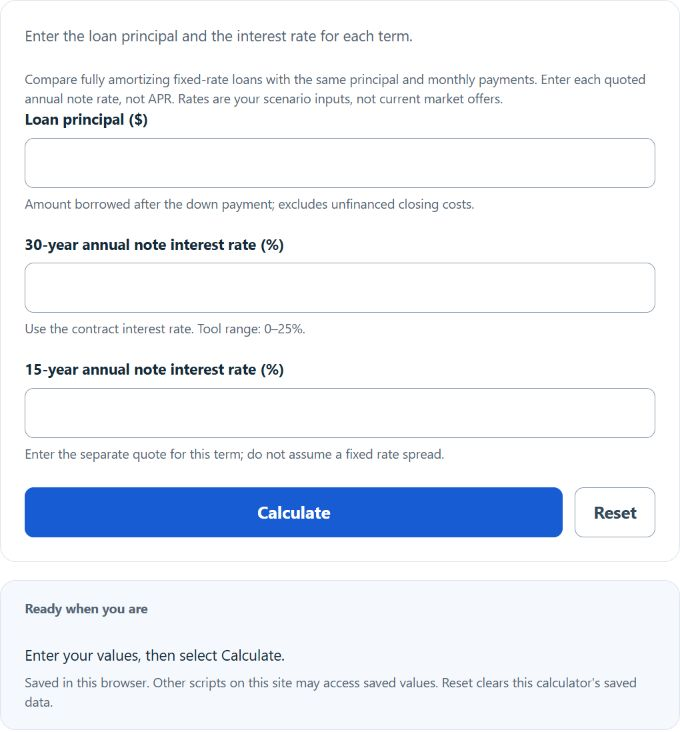
Compare monthly principal and interest, total interest and total principal-and-interest payments for 15-year and 30-year fixed-rate scenarios using your own rate quotes.
15- vs. 30-Year Mortgage Formula
The calculator computes the fixed monthly principal and interest payment for the same loan amount over each term:
For r > 0:
M = L * r / (1 - (1 + r)^-n)
For r = 0: M = L / n
It then compares the lifetime cost of the two loans:
Interest = M * n - L
Savings = Interest30 - Interest15
Variables:
- M is the monthly principal and interest payment (M30 for the 30-year loan, M15 for the 15-year loan)
- L is the loan amount, the same for both terms
- r is the monthly interest rate for that term, the annual percentage divided by 1200
- n is the number of payments: 360 for the 30-year term, 180 for the 15-year term
- Savings is 30-year interest minus 15-year interest; a negative value means the 15-year scenario costs more interest
Enter the same principal and the annual contract interest rate for each term. Use the note rate, not APR: APR includes additional financing charges. No current market rate or fixed spread between terms is assumed.
The calculator shows the monthly payment difference and a side-by-side principal-and-interest table. Which scenario costs less depends on the entered rates. Actual housing payments can also include taxes and insurance. Mortgage insurance, HOA charges, points and closing costs are excluded and may differ between loans.
15- vs. 30-Year Cost of a $300,000 Loan
This illustrative table assumes a $300,000 principal and a 15-year rate 0.625 percentage points below each 30-year rate. These are scenario assumptions, not current offers or a guaranteed rate spread. Totals and differences use unrounded theoretical payments before rounding dollars to cents. Lender payment rounding can change totals slightly.
| Rates (30yr / 15yr) | 30-yr payment | 15-yr payment | 30-yr interest | 15-yr interest | Interest saved |
|---|---|---|---|---|---|
| 5.500% / 4.875% | $1,703.37 | $2,352.89 | $313,212.12 | $123,520.61 | $189,691.51 |
| 6.000% / 5.375% | $1,798.65 | $2,431.40 | $347,514.57 | $137,651.33 | $209,863.24 |
| 6.500% / 5.875% | $1,896.20 | $2,511.36 | $382,633.47 | $152,043.99 | $230,589.48 |
| 7.000% / 6.375% | $1,995.91 | $2,592.75 | $418,526.69 | $166,695.20 | $251,831.50 |
| 7.500% / 6.875% | $2,097.64 | $2,675.56 | $455,151.67 | $181,601.34 | $273,550.33 |
Example Problems
Example 1: Comparing terms on a $300,000 loan.
You are quoted 6.5% for a 30-year loan and 5.875% for a 15-year loan on $300,000. The 30-year payment is M30 = 300,000 * (6.5/1200) / (1 – (1 + 6.5/1200)^-360) = $1,896.20, and the 15-year payment is M15 = 300,000 * (5.875/1200) / (1 – (1 + 5.875/1200)^-180) = $2,511.36 — a difference of $615.15 per month.
Using unrounded monthly payments, total interest is $382,633.47 on the 30-year and $152,043.99 on the 15-year. Under these assumptions, the 15-year scenario has $230,589.48 less interest and finishes 15 years sooner. Multiplying the displayed rounded monthly payment can give a slightly different total.
Example 2: The same comparison at 7.0% / 6.375%.
On the same $300,000 loan, the payments are $1,995.91 (30-year) and $2,592.75 (15-year), a $596.84 monthly difference, and choosing the 15-year term saves $251,831.50 in interest.
Frequently Asked Questions
How should I compare rates for the two terms?
Get quotes for both terms on comparable dates and compare the complete Loan Estimates, including interest rates, APR, points, closing costs and other terms. This calculator models the rate and repayment term only; it does not guarantee that a shorter term receives a lower rate or is the best choice for your budget.
Is it better to take a 30-year loan and pay it like a 15-year?
Extra principal can reduce future interest and shorten payoff time while the original required payment remains in place. The outcome depends on the existing rate, payment amount, timing and loan terms; this calculator does not model that strategy. Confirm with the servicer how extra payments are applied and check any prepayment penalty. Compare a separate amortization schedule and your full budget rather than relying on a single income percentage.
Can I refinance from a 30-year to a 15-year mortgage?
A qualifying borrower may refinance into a 15-year loan, but the new rate, balance, fees and payment must be evaluated. Compare actual closing costs and expected time in the home. A no-closing-cost offer may recover costs through a higher rate or larger loan balance. Extra principal on an existing loan is a separate strategy; check its terms and any penalty. This calculator compares two new full-term scenarios and does not calculate refinancing savings.