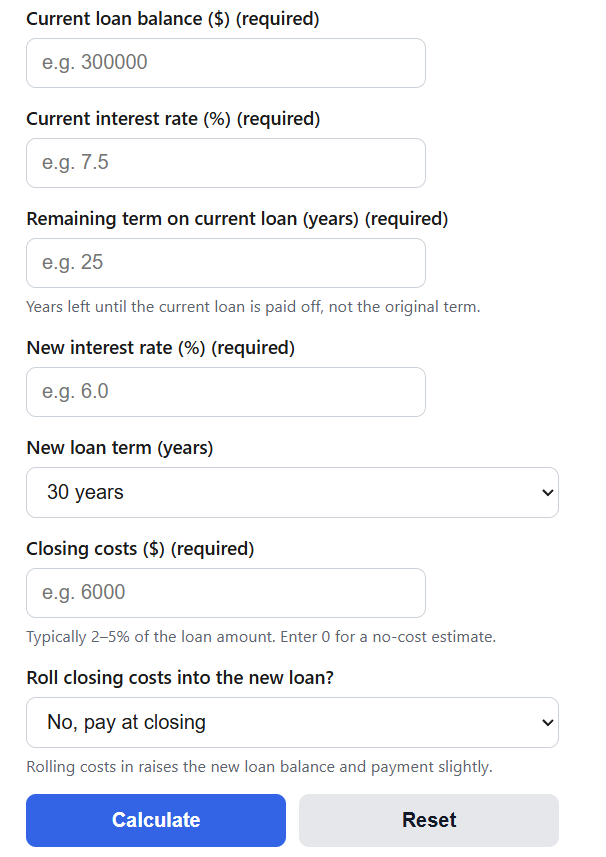
Use this mortgage refinance calculator to compare your current and new payments, find the break-even point on closing costs, and see your net lifetime savings.
Mortgage Refinance Formula
The calculator first finds the monthly principal and interest payment for both your current loan and the proposed new loan using the standard amortization formula:
M = L * (r / 1200) / (1 - (1 + r / 1200)^-n)
It then compares the two payments and weighs the monthly savings against your closing costs to find the break-even point:
S = M_current - M_new
  BE = CC / S
Variables:
- M is the monthly principal and interest payment
- L is the loan amount (the current balance, plus closing costs if you roll them into the new loan)
- r is the annual interest rate as a percentage
- n is the number of monthly payments (years * 12)
- S is the monthly savings from refinancing
- CC is the total closing costs and BE is the break-even point in months
Enter your current balance, current rate, and the years remaining on the loan, then the new rate, the new term, and your estimated closing costs. The calculator returns the monthly savings, the break-even point, and the total interest remaining on the current loan versus the total interest on the new loan. If you choose to roll closing costs into the new loan, they are added to the new balance instead of being paid up front.
Watch the net lifetime savings figure, not just the monthly savings. Resetting a loan that has 20 or 25 years remaining to a fresh 30-year term lowers the payment partly by stretching the debt over more years, so a refinance can cut your payment while saving far less over the full term than the monthly number suggests.
Monthly Savings on a $300,000 Refinance
The table below shows the monthly savings when refinancing a $300,000 balance with 25 years remaining into a new 30-year loan at a lower rate, before closing costs. Payments are principal and interest only.
| Current rate | New rate | Current payment | New payment | Monthly savings |
|---|---|---|---|---|
| 7.50% | 6.50% | $2,216.97 | $1,896.20 | $320.77 |
| 7.50% | 6.00% | $2,216.97 | $1,798.65 | $418.32 |
| 7.50% | 5.50% | $2,216.97 | $1,703.37 | $513.61 |
| 7.00% | 6.00% | $2,120.34 | $1,798.65 | $321.69 |
| 7.00% | 5.50% | $2,120.34 | $1,703.37 | $416.97 |
| 7.00% | 5.00% | $2,120.34 | $1,610.46 | $509.87 |
| 6.50% | 5.50% | $2,025.62 | $1,703.37 | $322.25 |
| 6.50% | 5.00% | $2,025.62 | $1,610.46 | $415.16 |
Example Problems
Example 1: You owe $300,000 at 7.5% with 25 years remaining and are quoted 6.0% on a new 30-year loan with $6,000 in closing costs paid at closing.
Current payment: M = 300,000 * (7.5 / 1200) / (1 – (1 + 7.5 / 1200)^-300) = $2,216.97. New payment: M = 300,000 * (6 / 1200) / (1 – (1 + 6 / 1200)^-360) = $1,798.65. Monthly savings: S = 2,216.97 – 1,798.65 = $418.32. Break-even: BE = 6,000 / 418.32 = 14.3 months (1.2 years). Remaining interest on the current loan is $365,092.06 versus $347,514.57 on the new loan, so after subtracting the $6,000 in costs the net lifetime savings come to $11,577.49.
Example 2: You owe $200,000 at 6.5% with 20 years remaining and refinance into a 15-year loan at 5.5%, rolling $5,000 of closing costs into the balance, so the new loan is $205,000.
Current payment: $1,491.15. New payment: M = 205,000 * (5.5 / 1200) / (1 – (1 + 5.5 / 1200)^-180) = $1,675.02, which is $183.87 more per month, so there is no break-even point on payment alone. The shorter term still wins over the life of the loan: remaining interest falls from $157,875.11 to $96,503.79, and total remaining payments fall from $357,875.11 to $301,503.79, a net lifetime savings of $56,371.31.
Frequently Asked Questions
How much does it cost to refinance a mortgage?
Refinance closing costs typically run 2% to 5% of the loan amount, or $6,000 to $15,000 on a $300,000 loan. The total usually includes lender origination fees, an appraisal, title insurance and settlement fees, recording charges, and any discount points you choose to buy. A “no-closing-cost” refinance simply moves those costs into a higher rate or a larger balance rather than eliminating them.
When is refinancing worth it?
A common rule of thumb is that a refinance starts to make sense when you can cut your rate by about 0.75 to 1 percentage point, but the better test is the break-even point: divide closing costs by monthly savings and compare the result to how long you plan to keep the home. If you expect to move or refinance again before the break-even month, you will likely lose money on the deal. Also check the net lifetime savings, since stretching back out to 30 years can offset much of the rate benefit.
Does refinancing restart my loan term?
Yes, a refinance replaces your old loan with a brand-new one, so taking a 30-year loan when you had 25 years left adds five years of payments. You can avoid the reset by choosing a 20-, 15-, or 10-year term, or by keeping the 30-year loan and paying extra principal each month to stay on your original payoff schedule.