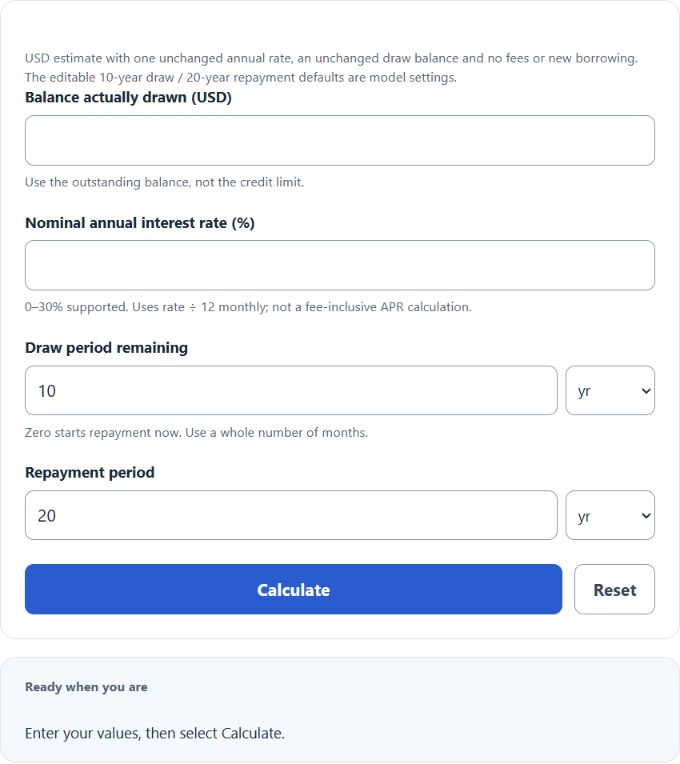
This HELOC payment calculator estimates an interest-only draw payment, a level amortized repayment payment, the phase difference and future interest under one unchanged nominal rate. It is a scenario estimate, not a lender minimum-payment quote.
HELOC Payment Formula
This model assumes two phases. During the remaining draw period it assumes interest-only payments on the unchanged drawn balance; your agreement may require principal as well. Its monthly-interest approximation is:
Pdraw = B * r / 1200
The model then amortizes the balance over the repayment period in level end-of-month installments at the same constant rate. Actual contracts may instead have different terms or a balloon payment. The modeled payment is:
Prepay = B * i / (1 - (1 + i)^-n)
  i = r / 1200
  n = Y * 12
  If i = 0, Prepay = B / n
Variables:
- B is the HELOC balance (the amount actually drawn, not the credit limit)
- r is the annual interest rate as a percent
- Pdraw is the interest-only monthly payment during the draw period
- Prepay is the fully amortized monthly payment during the repayment phase
- i is the monthly interest rate as a decimal
- Y is the length of the repayment period in years and n is that length in months
Enter your drawn balance and nominal annual rate, then the remaining draw and repayment terms in years or months. Terms must contain whole months. The editable 10/20-year defaults are model settings, not a claim about your contract. A zero draw term starts repayment now; a zero rate uses balance divided by repayment months. Results compare modeled interest-only and amortized payments and total future modeled interest.
Under the model’s interest-only payments, with no new draws or principal reductions, the principal remains unchanged until repayment. The rate is held constant, fees are excluded, and interest is approximated monthly rather than using a lender’s actual daily accrual. Amounts are independently rounded to cents for display; totals use unrounded modeled payments, not a lender’s cent-rounded schedule and adjusted final installment. Variable-rate changes can materially alter the result.
Interest-Only vs Repayment Payments at 8.5%
This illustrative table uses a constant 8.5% nominal rate, 10 remaining interest-only draw years and 20 amortizing repayment years. Total interest uses full-precision modeled payments; this does not establish any lender’s minimum payment or the prevalence of this structure.
| Balance drawn | Interest-only payment | Repayment payment | Payment jump | Total interest |
|---|---|---|---|---|
| $25,000 | $177.08 | $216.96 | +$39.87 | $48,319.39 |
| $50,000 | $354.17 | $433.91 | +$79.74 | $96,638.79 |
| $75,000 | $531.25 | $650.87 | +$119.62 | $144,958.18 |
| $100,000 | $708.33 | $867.82 | +$159.49 | $193,277.58 |
| $125,000 | $885.42 | $1,084.78 | +$199.36 | $241,596.97 |
| $150,000 | $1,062.50 | $1,301.73 | +$239.23 | $289,916.36 |
Example Problems
Example 1: Find both payments on a $50,000 draw.
You have drawn $50,000 on a HELOC at 8.5% with 10 years left in the draw period and a 20-year repayment period. The interest-only payment is:
Pdraw = 50,000 * 8.5 / 1200 = $354.17 per month. Amortizing $50,000 over 240 months at 8.5% gives Prepay = $433.91, a jump of $79.74 per month. Under these unchanged-rate assumptions, modeled interest is $42,500.00 during the draw period and $54,138.79 during repayment, totaling $96,638.79.
Example 2: A larger draw at a higher rate with a shorter schedule.
You have drawn $100,000 at 9% with 5 years left in the draw period and a 15-year repayment period. Pdraw = 100,000 * 9 / 1200 = $750.00 per month, and the repayment-phase payment is $1,014.27, a jump of $264.27. Interest comes to $45,000.00 during the draw phase plus $82,567.99 during repayment, for total interest of $127,567.99.
Frequently Asked Questions
Why does my HELOC payment jump after the draw period?
Under this modeled structure, you pay interest only during the draw period, so nothing goes toward the balance. When the draw period ends, the loan converts to fully amortizing payments that must retire the entire balance over the repayment period, so principal is added on top of interest. The jump is largest when the repayment period is short relative to the balance, and it can be substantial if you carried a large draw the whole time.
What determines a HELOC’s interest rate?
HELOCs commonly have variable rates tied to a named index plus a margin; the contract sets the index, reset timing, caps and any introductory terms. Individual banks set their prime rates, so a Federal Reserve move does not itself guarantee a particular next-cycle change in your HELOC rate. Some products offer fixed-rate options. Check your agreement.
Can I pay down principal during the draw period?
Your agreement may allow additional principal payments, which can reduce future interest relative to this unchanged-balance model. Check payment rules and fees. Further advances depend on the draw period and contract and may be frozen or reduced; repaid principal is not an unconditional promise that you can borrow it again.