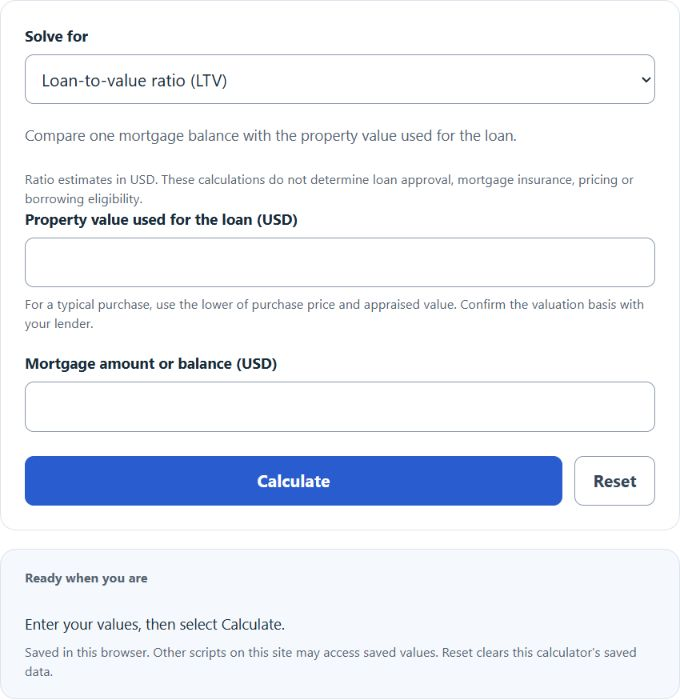
Find your LTV from loan and home value, combined CLTV with a second lien, or the max loan amount at any target ratio.
Loan to Value Formula
The loan-to-value ratio compares what you borrow against a home to what the home is worth. The basic formula divides the loan amount by the value:
LTV = L / V * 100
The calculator can also work the formula in two other directions: combining all liens into a combined loan-to-value ratio, or solving for the largest loan that fits a target ratio:
CLTV = (L1 + L2) / V * 100
  Lmax = V * (LTVt / 100)
Variables:
- LTV is the loan-to-value ratio as a percentage
- L is the loan amount (or current mortgage balance)
- V is the home value; on a purchase, lenders use the lower of the purchase price and the appraised value
- CLTV is the combined loan-to-value ratio across all liens
- L1 is the first mortgage balance and L2 is any second mortgage or HELOC balance
- Lmax is the maximum loan amount at the target ratio
- LTVt is the target LTV percentage
Pick what you want to find at the top of the calculator. The first mode returns your LTV from a loan amount and home value. The second mode solves for the biggest loan you can take at a target LTV, which is useful for sizing a purchase, a refinance, or a cash-out. The third mode computes CLTV when a second mortgage or HELOC sits behind the first mortgage, which is the number home equity lenders actually underwrite to.
LTV is a ratio, not an approval or pricing decision. On conventional purchases, a down payment of at least 20% generally avoids required PMI; cancellation on an existing loan has separate conditions. Some eligible conventional programs allow 97% LTV. FHA purchase loans can allow down payments as low as 3.5% and require mortgage insurance. Program, borrower, property and lender requirements apply.
LTV on a $400,000 Home at Common Loan Amounts
This table shows the loan-to-value ratio for a $400,000 home at a range of loan amounts, along with what each LTV band typically means for a US borrower.
| Loan amount | LTV | What it means |
|---|---|---|
| $240,000 | 60.00% | 40% of the entered value remains after this loan |
| $280,000 | 70.00% | 30% of value remains; pricing depends on other factors |
| $300,000 | 75.00% | 25% of value remains; further borrowing is subject to underwriting |
| $320,000 | 80.00% | 20% of value remains; insurance and refinance rules vary |
| $340,000 | 85.00% | 15% of value remains; conventional PMI is generally required at origination |
| $360,000 | 90.00% | 10% of value remains; insurance and pricing depend on program |
| $380,000 | 95.00% | 5% down if price equals this value; eligibility varies |
| $386,000 | 96.50% | 3.5% down on this value; FHA eligibility and mortgage insurance apply |
| $388,000 | 97.00% | 3% down on this value; only eligible programs and transactions |
Example Problems
Example 1: Find the LTV on a purchase.
You are borrowing $340,000 to buy a home appraised at $425,000. Divide the loan by the value:
LTV = 340,000 / 425,000 * 100 = 80.00%. Assuming the purchase price is at least the appraisal, this leaves $85,000.00 (20.00% of value) after the modeled loan. Conventional purchase PMI is generally not required with 20% down, but existing PMI cancellation and other programs have separate rules.
Example 2: Find the combined LTV with a HELOC.
Your home is worth $450,000, your first mortgage balance is $280,000, and you carry a $35,000 HELOC balance. Add the liens and divide by the value:
CLTV = (280,000 + 35,000) / 450,000 * 100 = 70.00%, while the first-lien LTV alone is 280,000 / 450,000 * 100 = 62.22%. Remaining equity is $135,000.00.
Frequently Asked Questions
What is a good loan-to-value ratio?
A lower ratio means more value remains after the modeled debt. Conventional purchases with 20% down generally avoid required PMI, but rates, insurance, refinance limits and equity borrowing depend on the loan program, transaction, credit, income, property and lender. A ratio alone does not establish eligibility or cancel existing PMI.
How do I lower my LTV?
You can lower LTV from either side of the fraction: pay down the loan balance with regular or extra principal payments, or wait for the home's value to rise. Buyers lower it up front with a larger down payment. If your home has appreciated since you bought it, a new appraisal can establish a lower ratio, which is a common route to removing PMI early.
What is the difference between LTV and CLTV?
LTV counts the first mortgage. CLTV adds outstanding subordinate mortgage balances and the drawn balance of a HELOC. HCLTV instead includes the full HELOC credit limit, even if undrawn. Lenders may evaluate both ratios; limits and valuation rules vary by program and transaction.