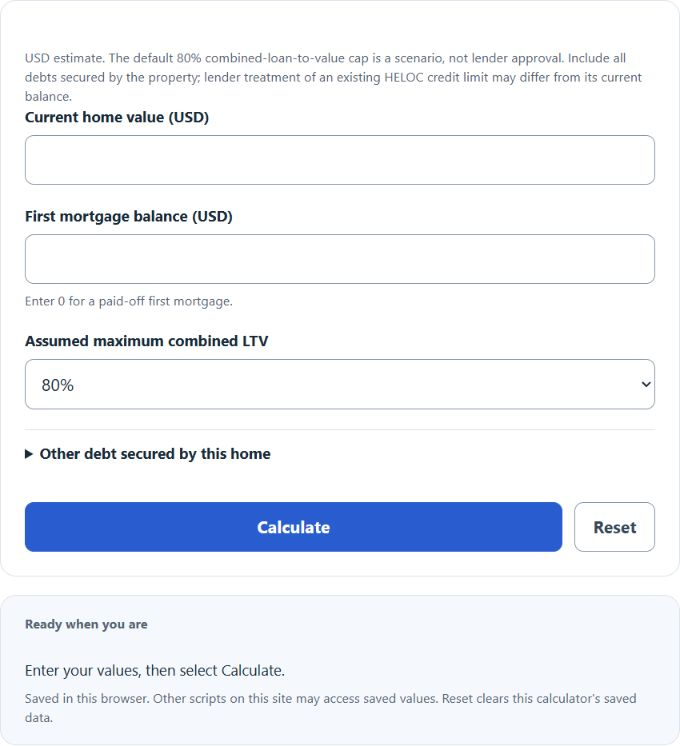
Use this home equity calculator to estimate equity in USD and percent, current combined LTV, and additional borrowing room at an assumed cap. The default 80% cap is adjustable; it does not establish lender approval.
Home Equity Formula
Home equity is the portion of your home's value that you actually own. The calculator subtracts everything you owe against the home from its current market value:
HE = V - (M + S)
It then expresses equity as a percentage of the home's value and models collateral-based borrowing room at a chosen combined loan-to-value cap, before fees and lender eligibility checks:
E% = HE / V * 100
  TE = max(V * (LTVmax / 100) - (M + S), 0)
Variables:
- HE is your home equity in dollars
- V is the current market value of the home
- M is the remaining balance on your first mortgage
- S is any second mortgage or HELOC balance (0 if none)
- E% is your equity as a percentage of the home's value
- LTVmax is the maximum combined loan-to-value ratio your lender allows, typically 80–85%
- TE is the tappable (borrowable) equity, floored at zero
Enter current home value and first-mortgage balance. Open “Other debt secured by this home” to include second mortgages, drawn HELOC balances and other liens; blank means zero. Choose 80%, 85%, 90% or a custom combined LTV cap. Existing HELOC credit limits may be treated differently by a lender. The calculator rounds the modeled debt ceiling down to a whole cent before subtracting entered balances.
The results show equity, equity percentage, combined LTV and nonnegative additional borrowing room. Negative equity remains negative, while borrowing room floors at zero. A cap below 100% leaves part of positive equity outside the modeled borrowing room. This is not sale proceeds or a loan approval. Borrowing against the home can put it at risk if you cannot repay. CFPB: What is a HELOC?
Home Equity and Borrowable Equity by Value and Balance
This table shows total equity and borrowable (tappable) equity at the common 80% combined LTV cap for typical combinations of home value and total mortgage debt.
| Home value | Mortgage debt | Home equity | Equity % | Borrowable at 80% CLTV |
|---|---|---|---|---|
| $300,000 | $200,000 | $100,000 | 33.33% | $40,000 |
| $350,000 | $250,000 | $100,000 | 28.57% | $30,000 |
| $400,000 | $250,000 | $150,000 | 37.50% | $70,000 |
| $400,000 | $300,000 | $100,000 | 25.00% | $20,000 |
| $500,000 | $300,000 | $200,000 | 40.00% | $100,000 |
| $500,000 | $350,000 | $150,000 | 30.00% | $50,000 |
| $600,000 | $400,000 | $200,000 | 33.33% | $80,000 |
| $750,000 | $450,000 | $300,000 | 40.00% | $150,000 |
Example Problems
Example 1: Find home equity and borrowable equity with a single mortgage.
Your home is worth $450,000 and you owe $280,000 on your mortgage, with no other liens, and your lender caps combined LTV at 80%. Subtract the debt from the value:
HE = 450,000 - 280,000 = $170,000.00 of equity, which is 37.78% of the home's value, so your current LTV is 62.22%. Tappable equity = 450,000 * 0.80 - 280,000 = $80,000.00.
Example 2: Find borrowable equity with a HELOC already in place.
Your home is worth $380,000, you owe $240,000 on the first mortgage and $20,000 on a HELOC, and your lender allows an 85% combined LTV. Total debt is 240,000 + 20,000 = $260,000.
HE = 380,000 - 260,000 = $120,000.00, which is 31.58% equity with a current combined LTV of 68.42%. Tappable equity = 380,000 * 0.85 - 260,000 = $63,000.00.
Frequently Asked Questions
How much of my home equity can I actually borrow?
Most lenders let your total mortgage debt reach 80% to 85% of your home's value across all liens, so your borrowable amount is that cap minus what you already owe, not your full equity. A few lenders go to 90% combined LTV, usually at higher rates. You must also qualify on credit score, income, and debt-to-income ratio, so the cap is a ceiling rather than a guarantee.
How do lenders determine my home's value?
For a home equity loan or HELOC, the lender typically orders an appraisal or uses an automated valuation model (AVM) to set the value used in the LTV math. That figure can come in above or below your own estimate, which directly changes how much you can borrow. If you believe the valuation is too low, you can usually supply comparable sales or request a full appraisal.
What is the difference between a home equity loan and a HELOC?
A home equity loan generally provides a lump sum, often with a fixed rate. A HELOC is a revolving line that commonly has a variable rate; payment requirements depend on the agreement and can change after the draw period. Both use the home as collateral and affect lender debt calculations. They need not always be second liens. CFPB explanation of home equity loans and HELOCs.