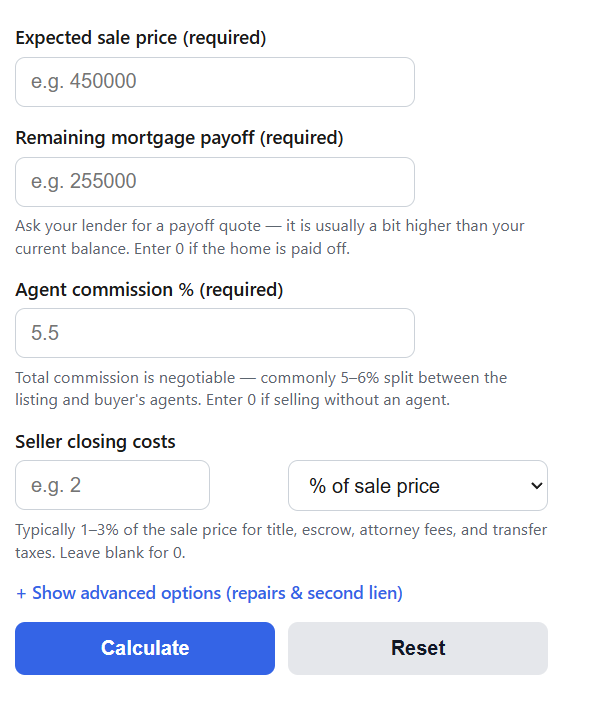
Estimate your net with this home sale proceeds calculator: sale price minus agent commission, closing costs, repairs, and mortgage payoff, computed instantly.
Home Sale Proceeds Formula
Net proceeds are what is left of the sale price after paying off every loan on the home and covering all of the costs of selling it:
SC = SP * c / 100 + CC + R
  NP = SP - (M + L) - SC
Variables:
- NP is the estimated net proceeds — the cash you walk away with at closing
- SP is the expected sale price
- c is the total agent commission percent
- CC is seller closing costs, entered as a dollar amount or as a percent of the sale price
- R is repairs and seller concessions
- M is the remaining mortgage payoff and L is any second mortgage or HELOC payoff
- SC is total selling costs
Enter your expected sale price, your mortgage payoff, and the total agent commission percent, then add seller closing costs as either dollars or a percent of the price. Open the advanced options to include pre-sale repairs, credits to the buyer, or a second lien that must be paid at closing. The calculator totals your selling costs and loan payoffs and shows the estimated cash you would take away from the sale.
Watch the sign of the result: a negative number means the sale price would not cover your loans and costs, so you would need to bring cash to closing or negotiate with your lender before selling.
Net Proceeds by Sale Price
This table estimates net proceeds for a range of sale prices, assuming a 5.5% total commission, seller closing costs of 2% of the price, and a mortgage payoff equal to 60% of the sale price. Your own numbers will differ, but the pattern shows how quickly costs scale with price.
| Sale price | Mortgage payoff (60%) | Commission (5.5%) | Closing costs (2%) | Net proceeds |
|---|---|---|---|---|
| $300,000 | $180,000 | $16,500 | $6,000 | $97,500 |
| $350,000 | $210,000 | $19,250 | $7,000 | $113,750 |
| $400,000 | $240,000 | $22,000 | $8,000 | $130,000 |
| $450,000 | $270,000 | $24,750 | $9,000 | $146,250 |
| $500,000 | $300,000 | $27,500 | $10,000 | $162,500 |
| $600,000 | $360,000 | $33,000 | $12,000 | $195,000 |
| $700,000 | $420,000 | $38,500 | $14,000 | $227,500 |
Example Problems
Example 1: A straightforward sale.
You expect to sell for $450,000 with a $255,000 mortgage payoff, a 5.5% total commission, and closing costs of 2% of the price. First total the selling costs:
SC = 450,000 * 5.5 / 100 + 450,000 * 2 / 100 = 24,750 + 9,000 = $33,750.00. Then NP = 450,000 – 255,000 – 33,750 = $161,250.00 in estimated net proceeds.
Example 2: A sale with repairs and a second lien.
You expect $500,000 with a $280,000 mortgage payoff, a 5% commission, $7,500 in closing costs entered as dollars, $4,000 in repairs, and a $25,000 HELOC payoff:
SC = 500,000 * 5 / 100 + 7,500 + 4,000 = $36,500.00 and total payoffs are 280,000 + 25,000 = $305,000.00. NP = 500,000 – 305,000 – 36,500 = $158,500.00.
Frequently Asked Questions
How much does it cost to sell a house?
Agent commissions have historically totaled about 5%–6% of the sale price, and since the 2024 NAR settlement they are explicitly negotiable, with buyer-agent compensation agreed separately. Seller closing costs typically add another 1%–3% for title, escrow, attorney fees, and transfer taxes. With repairs, concessions, and moving costs included, many sellers spend roughly 7%–10% of the sale price all-in.
Do I pay taxes on my home sale proceeds?
Often not. If the home was your primary residence for at least two of the last five years, the IRS lets you exclude up to $250,000 of capital gain, or $500,000 for married couples filing jointly. Note that tax is based on your gain — sale price minus selling costs and what you paid plus improvements — not on the cash proceeds this calculator shows, so a large payoff does not reduce your taxable gain.
What if I owe more than my home will sell for?
If the calculator shows negative proceeds, the sale would not cover your loans and costs. Your options are to bring cash to closing, wait and build more equity, or ask your lender about a short sale, where the lender agrees to accept less than the full balance. Also request a formal payoff quote before listing — it includes per-diem interest and any fees, so it usually runs slightly higher than the balance on your statement.