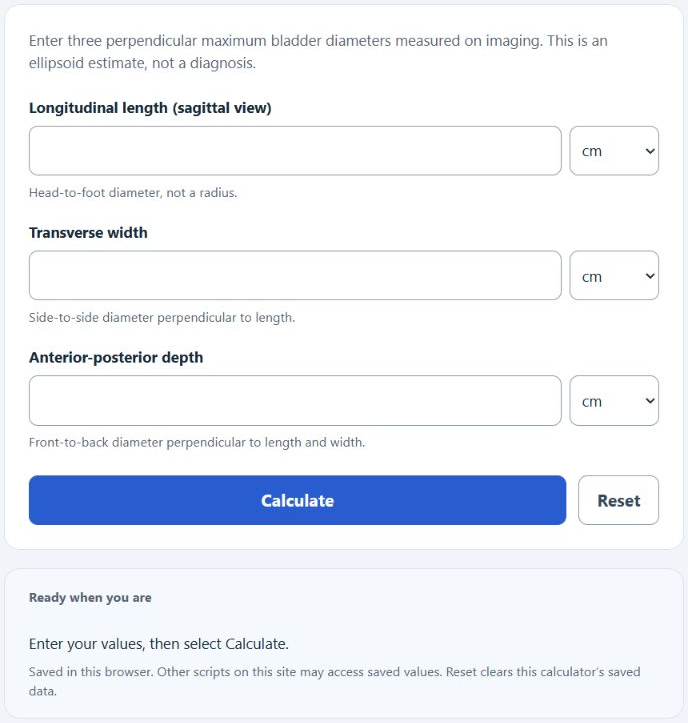
Calculate estimated bladder volume from sagittal, transverse, and anterior-posterior diameters using an ellipsoid formula in mL or liters.
Bladder Volume Formula
The bladder volume calculator estimates urinary bladder volume using an ellipsoid approximation. This is commonly used when the bladder is measured in three perpendicular directions on ultrasound or another imaging method.
- BV = estimated bladder volume, in mL when the diameters are in cm
- D1 = maximum longitudinal (head-to-foot) diameter in the sagittal view
- D2 = maximum transverse (side-to-side) diameter
- D3 = maximum anterior-posterior (front-to-back) diameter
- pi = approximately 3.14159
The calculator first converts all three diameter inputs to centimeters. It then applies the ellipsoid formula. Because 1 cubic centimeter equals 1 milliliter, the result in cm³ is the same numeric value in mL.
The result shows mL and liters together; liters equal mL divided by 1000. If you enter any diameter in mm or inches, it converts that measurement to cm before calculating volume. Changing a unit converts the entered quantity. Select Calculate to update the result.
Common Unit Conversions for Bladder Measurements
| Measurement | Conversion | Use in the calculator |
|---|---|---|
| 1 mm | 0.1 cm | Diameter inputs can be entered in mm |
| 1 inch | 2.54 cm | Diameter inputs can be entered in inches |
| 1 cm³ | 1 mL | Base volume result |
| 1000 mL | 1 liter | Optional output unit |
How to Use This Estimate
This result is a geometric estimate from three measured diameters, not a universal clinical category. Bladder shape, the imaging plane, the device, and the volume formula can all affect the result, so small differences should not be overinterpreted.
An estimated bladder volume is not automatically a post-void residual (PVR) or a measure of maximum bladder capacity. It represents PVR only when the measurements were obtained promptly after voiding. A clinician should interpret the estimate with the measurement timing, symptoms, and the original imaging report.
Example
Example 1: You measure the bladder as 10 cm in the sagittal plane, 8 cm in the transverse plane, and 6 cm in the anterior-posterior plane.
The estimated bladder volume is about 251 mL.
Example 2: You enter diameters of 90 mm, 70 mm, and 50 mm. First convert each value to centimeters: 90 mm = 9 cm, 70 mm = 7 cm, and 50 mm = 5 cm.
The estimated bladder volume is about 165 mL, or 0.165 liters.
FAQ
Why does the bladder volume formula use pi divided by 6?
The formula treats the bladder as an ellipsoid, which is a rounded three-dimensional shape. The volume of an ellipsoid can be written as pi divided by 6 times its three diameters. The bladder is not a perfect ellipsoid, so the result is an estimate rather than an exact measurement.
Is bladder volume the same as post-void residual volume?
Not always. Bladder volume is the estimated amount of urine in the bladder at the time of measurement. Post-void residual volume is the amount left after urinating. To estimate post-void residual, the bladder should be measured shortly after the person voids.
Why might the calculated bladder volume seem too high or too low?
The most common reasons are unit mistakes, measuring the wrong axis, or using diameters that do not represent the maximum bladder dimensions. A result can also differ from a scanner reading because different devices and formulas may use different correction factors. If the result is being used for medical decisions, it should be interpreted by a qualified clinician.