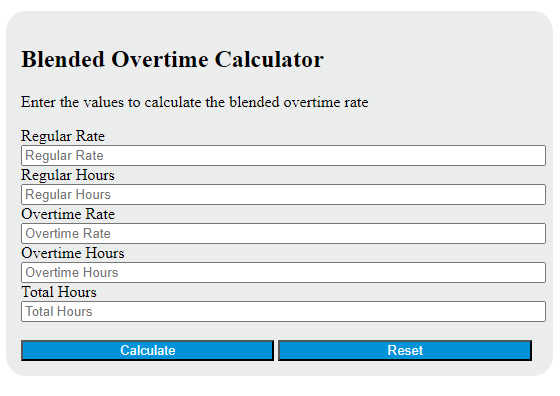
Blended Overtime Calculator for weighted regular rate, included bonus, weekly overtime premium, gross-pay audit, and target-bonus reverse planning.
Blended Overtime Formula
The following formula is used to calculate the blended overtime rate (the average hourly earnings rate across regular-paid and overtime-paid hours):
Variables:
- Blended Overtime Rate is the average hourly earnings rate across all hours worked (regular and overtime)
- RR (Regular Rate) is the hourly pay rate for regular hours
- RH (Regular Hours) is the total number of regular hours worked
- OR (Overtime Rate) is the hourly pay rate paid for overtime hours
- OH (Overtime Hours) is the total number of overtime hours worked
- Total Hours is the sum of regular hours and overtime hours (RH + OH)
To calculate the blended overtime rate, multiply the regular rate by the number of regular hours worked, and multiply the overtime rate by the number of overtime hours worked. Add the two earnings amounts together, then divide by the total hours worked (regular hours + overtime hours).
What Is a Blended Overtime Rate?
In general usage, a blended overtime rate (also called a blended average rate) is the overall average hourly earnings rate across a period when some hours are paid at a regular rate and some hours are paid at an overtime rate. It is found by dividing total earnings by total hours worked.
Under the U.S. Fair Labor Standards Act (FLSA), non-exempt employees must generally receive overtime pay at least 1.5× their regular rate of pay for hours worked over 40 in a workweek. When an employee works at different straight-time rates in the same week, the FLSA “weighted average” method determines the regular rate as total straight-time earnings ÷ total hours, and overtime is then based on that regular rate. That compliance calculation is different from simply averaging already-paid regular and overtime earnings into one blended average rate.
How to Calculate Blended Overtime?
The following steps outline how to calculate the blended overtime rate (average hourly earnings across regular and overtime hours).
- Determine the regular hours worked (RH).
- Determine the overtime hours worked (OH).
- Determine the regular hourly rate (RR).
- Determine the overtime hourly rate (OR).
- Calculate total earnings: (RR × RH) + (OR × OH).
- Calculate total hours: RH + OH.
- Calculate the blended overtime rate by dividing total earnings by total hours.
Example Problem:
Use the following variables as an example problem to test your knowledge.
regular hours worked (RH) = 40
overtime hours worked (OH) = 10
regular hourly rate (RR) = $15/hr
overtime hourly rate (OR) = $22/hr
Calculate the blended overtime rate.
Solution: Total earnings = (15×40) + (22×10) = 600 + 220 = $820. Total hours = 40 + 10 = 50. Blended overtime rate = 820 ÷ 50 = $16.40/hr.