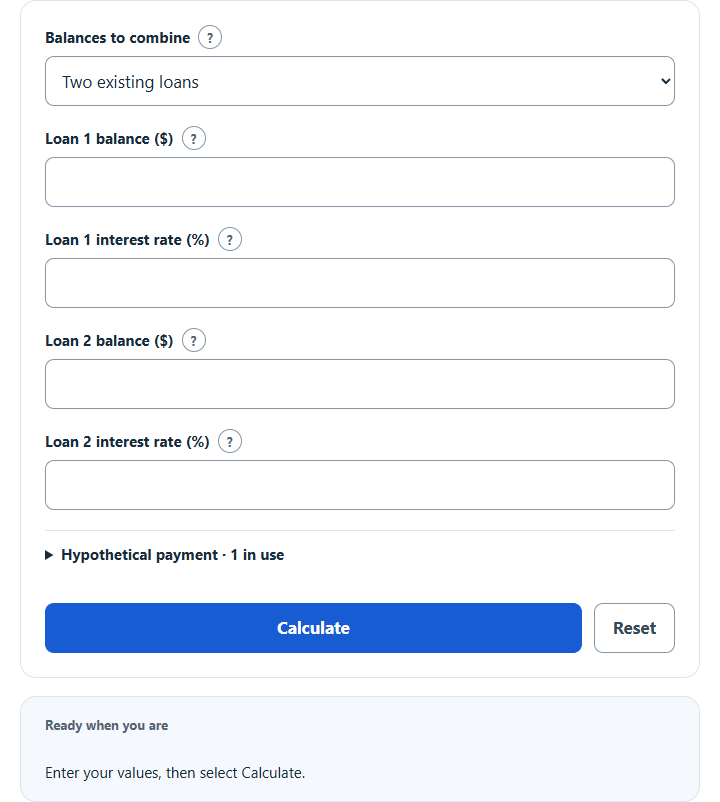
Calculate a blended interest rate for two mortgages or loans, or a current loan plus new borrowing, weighted by balance, with an optional monthly payment.
Calculator Functions
| Function | What it does | What it requires |
|---|---|---|
| Two existing loans | Finds the balance-weighted average interest rate of two mortgages or loans | Requires the balance and annual interest rate of each loan |
| Current loan plus new borrowing | Finds the weighted rate after new principal at a different rate is added to a current loan | Requires the current loan balance and rate, the new borrowing amount and its rate |
Balances are outstanding principal in dollars, without fees. Rates are annual nominal rates in percent, not APR. The optional Hypothetical amortization period, from 10 to 30 years, adds a monthly principal and interest payment and the total interest for one fixed-rate loan at the blended rate. Every result also lists the combined principal and the weight of each balance.
Blended Rate Mortgage Formulas
(L₁ + L₂)
| BR | Blended interest rate (%) |
| L₁, L₂ | Balance of each loan ($) |
| R₁, R₂ | Annual interest rate of each loan (%) |
Each rate counts in proportion to its share of the combined balance. The result always falls between the two rates and sits closer to the rate on the larger balance.
Two existing loans
A $200,000 loan at 4% and a $100,000 loan at 5% blend to (200,000 × 4 + 100,000 × 5) ÷ 300,000 = 4.3333%. The weights are 66.6667% and 33.3333%.
Current loan plus new borrowing
The same formula applies, with L₁ as the current loan balance and L₂ as the new borrowing. A $250,000 balance at 3.5% plus $50,000 of new borrowing at 7% blends to 4.0833%.
A lender’s blend-and-extend offer is usually worked out another way. Canada’s financial consumer agency illustrates it by weighting each rate by time instead of balance: 5.5% with 24 months left on the term and 4% for the other 36 months of a new 60-month term gives 4.6% [1]. That method ignores the balances, so it will not match this function.
Hypothetical monthly payment
P is the combined principal, i is the blended rate ÷ 1200 and n is the number of monthly payments, years × 12. Total interest is M × n − P. At a blended rate of zero the payment is P ÷ n. For $300,000 at 4.3333% over 30 years, the payment is $1,490.49 a month and the total interest is $236,577.16.
Limits of This Estimate
- The blended rate is a snapshot. It changes as the two balances are paid down at different speeds.
- It is not APR, a refinance offer or a lender’s blend-and-extend quote. Lenders set their own blending method and may charge administrative fees [1].
- A weighted rate does not merge the loans or show savings. Whether new financing costs less depends on the actual offer, its fees, penalties and repayment schedule.
- The hypothetical payment assumes one fixed-rate loan for the full period with monthly compounding. It leaves out taxes, insurance, fees and penalties, and it is not the sum of the existing payments.
Sources
- Financial Consumer Agency of Canada, Breaking your mortgage contract: how a lender’s blend-and-extend rate is worked out