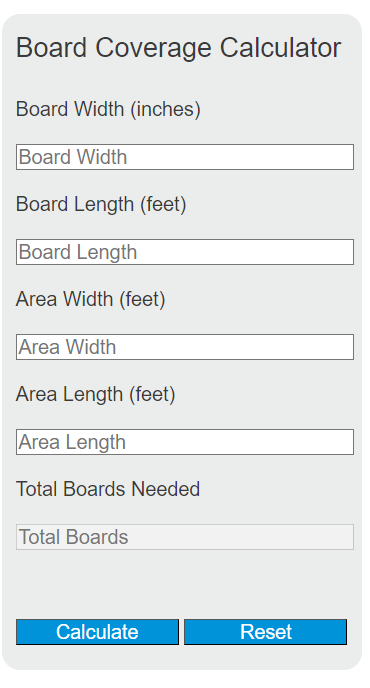
Calculate board coverage, linear feet to square feet, and board feet for lumber projects with waste allowances and mixed unit inputs.
Related Calculators
- Board And Batten Calculator
- Board Spacing Calculator
- Coverage Area Calculator
- Wall Area Calculator
- Shiplap Calculator
- Flooring Waste Calculator
- Gable Roof Area Calculator
- Hip Roof Calculator
- Soffit Calculator
- 2X6 Calculator
- All Construction Calculators
Board Coverage Formula
The following formula is used to calculate the total number of boards needed to cover an area:
Variables:
- TB is the total number of boards needed
- AW is the width of the area to be covered (feet)
- AL is the length of the area to be covered (feet)
- BW is the width of the board (inches)
- BL is the length of the board (feet)
To calculate the total number of boards needed, first convert the board width from inches to feet, then multiply the width and length of the area to be covered. Divide the total area by the area of one board to find the number of boards needed, rounding up to the nearest whole number.
What is Board Coverage?
Board coverage refers to the amount of surface area that can be covered by a certain number of boards. It is a crucial measurement in construction and woodworking projects where precise material estimates are necessary to minimize waste and control costs. The width and length of the boards, as well as the total area to be covered, are taken into account to determine the quantity of material needed.
How to Calculate Board Coverage?
The following steps outline how to calculate the total number of boards needed to cover an area:
- Measure the width (BW) of the board in inches and the length (BL) of the board in feet.
- Measure the width (AW) and length (AL) of the area to be covered in feet.
- Convert the board width from inches to feet by dividing by 12.
- Multiply the width and length of the area to get the total area (AW * AL).
- Multiply the width and length of the board to get the board area (BW / 12 * BL).
- Divide the total area by the board area to get the number of boards needed (TB).
- Round up to the nearest whole number to ensure full coverage.
- Use the calculator above to verify your calculations.
Example Problem:
Use the following variables as an example problem to test your knowledge.
Board width (BW) = 6 inches
Board length (BL) = 8 feet
Area width (AW) = 10 feet
Area length (AL) = 12 feet