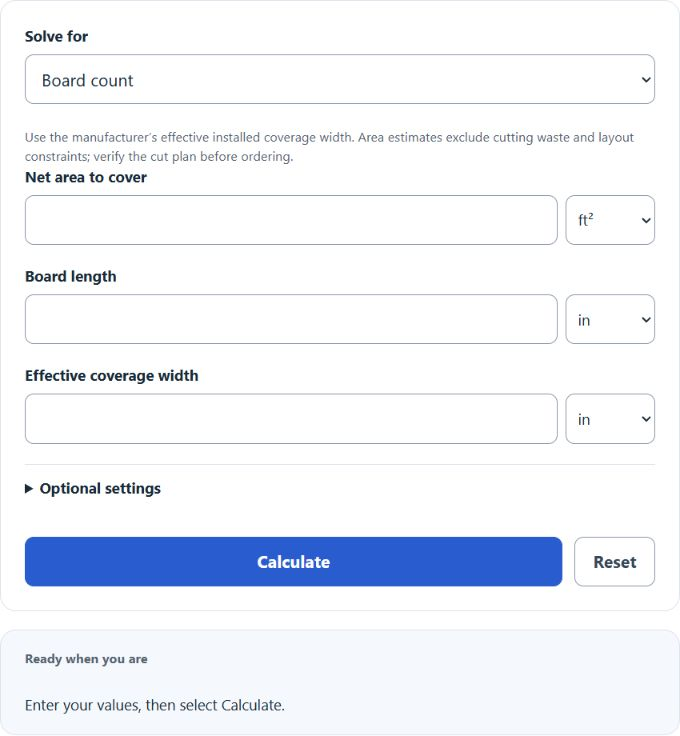
Select board count, an inverse dimension, wall coverage or cost. Use the manufacturer’s effective installed coverage width and enter project-specific dimensions and prices; waste is excluded.
- All Construction Calculators
- House Wrap Calculator
- Cost Per Square Foot Calculator
- Angle Cut Calculator
- Door Header Size Calculator
- Paint Ratio Calculator
Shiplap Formula
The core formula for estimating shiplap boards is:
The calculator rounds the area-equivalent count up to whole boards, then whole packs where applicable. It excludes cutting waste. Choose extra material from the actual cut plan and manufacturer’s guidance; a fixed percentage does not guarantee adequate stock.
Shiplap Board Dimensions and Coverage Reference
Shiplap lumber uses nominal sizing, meaning the label on the board does not match the actual finished dimensions. The milling process (drying and planing) removes material, and the rabbet joint cut into each edge further reduces the exposed face width. The table below gives illustrative dimensions; actual profiles and installed exposure vary. Verify the product’s stated effective coverage before using the calculator.
| Nominal Size | Actual Thickness | Actual Board Width | Exposed Face (with overlap) | Coverage per 8 ft Board |
|---|---|---|---|---|
| 1×4 | 0.75 in (19 mm) | 3.5 in | 3.0 to 3.25 in | 2.00 to 2.17 sq ft |
| 1×6 | 0.625 in (16 mm) | 5.37 in | 4.875 to 5.125 in | 3.25 to 3.42 sq ft |
| 1×8 | 0.75 in (19 mm) | 7.25 in | 6.625 to 6.875 in | 4.42 to 4.58 sq ft |
| 1×10 | 0.75 in (19 mm) | 9.25 in | 8.625 to 8.875 in | 5.75 to 5.92 sq ft |
| 1×12 | 0.75 in (19 mm) | 11.25 in | 10.625 to 10.875 in | 7.08 to 7.25 sq ft |
The exposed face width varies by manufacturer and gap style. A visible nickel gap is not automatically a deduction from board width. Use the manufacturer’s installed coverage, which may already account for the joint and gap. Standard lengths available at most home centers are 8, 10, 12, and 16 feet. The 1×6 profile at 8 feet is the highest volume product in the U.S. residential market, followed by the 1×8 in 8 foot lengths.
Shiplap Material Types and Cost Data
Shiplap pricing varies significantly by material. Below is a breakdown of material cost per square foot (materials only, not including labor) as illustrative planning ranges rather than verified current national averages; use actual product quotes in the calculator.
| Material | Cost per Sq Ft | Best Use | Durability Notes |
|---|---|---|---|
| Pine (SPF) | $2 to $4 | Interior walls, accent walls | Soft, dents easily, takes paint and stain well |
| Plywood shiplap panels | $2 to $3 | Budget interior projects | Lightweight, less rigid than solid wood |
| MDF shiplap | $1.50 to $3 | Painted interior walls only | Cannot tolerate moisture, swells if wet |
| Cedar | $4 to $7 | Exterior siding, bathrooms | Naturally rot and insect resistant, weathers to gray |
| Cypress | $5 to $8 | Exterior, high humidity areas | Exceptional moisture resistance, very durable |
| PVC/composite | $4 to $7 | Exterior, wet areas | Zero rot risk, does not need sealing or painting |
| Reclaimed wood | $9 to $15 | Feature walls, high end interiors | Variable quality, character and patina, often limited supply |
Labor for professional installation adds $1 to $4 per square foot depending on wall complexity, ceiling work, and regional rates. Total installed cost for a typical 100 square foot accent wall in pine runs $300 to $800. A full room (400 sq ft of wall area) in cedar with professional installation can reach $4,400 or more.
Waste Factor and Ordering Guide
Every shiplap project generates waste from end cuts, fitting around outlets and fixtures, and occasional board defects. The calculator does not add a waste allowance. The required extra quantity depends on board lengths, orientation, seams, defects and the cut plan; confirm an allowance for the actual project.
When boards are sold in packs (commonly 4, 6, or 8 boards per pack), always round up to the next full pack. It is far cheaper to return an unopened pack than to halt a project for a single missing board, especially with stained or specialty products that may not be restocked quickly. If buying individual boards, inspect each one at the store for warping, twist, and knots near the rabbet edge, as these defects make installation significantly harder.
Shiplap vs Tongue and Groove vs Board and Batten
Shiplap is one of three common wall paneling systems. Each uses a different joint method that affects appearance, performance, and cost.
| Feature | Shiplap | Tongue and Groove | Board and Batten |
|---|---|---|---|
| Joint type | Overlapping rabbet | Interlocking tongue/groove | Flat boards with covering battens |
| Visible gap | Yes (shadow line or nickel gap) | Optional (depends on profile) | None (battens cover seams) |
| Moisture resistance | Good (allows wood movement) | Better (tighter seal) | Fair (seams rely on battens) |
| DIY difficulty | Easier (overlap is forgiving) | Moderate (tongue must align) | Easiest (no precision joint) |
| Installed cost (per sq ft) | $3 to $11 | $5 to $15 | $4 to $12 |
| Best climate | Hot, dry (handles shrinkage) | Cold (better insulation) | Any |
| Typical orientation | Horizontal or vertical | Horizontal, vertical, or diagonal | Vertical only |
Shiplap’s overlapping rabbet joint accommodates seasonal wood expansion and contraction better than tongue and groove, making it the preferred choice in climates with large humidity swings. In cold climates where insulation value matters, tongue and groove provides a tighter air seal. Board and batten offers the boldest visual lines and is the simplest to install but cannot be run horizontally.
Interior vs Exterior Shiplap
Interior and exterior shiplap installations differ in material requirements, fastening methods, and prep work. Interior shiplap in pine or MDF is typically nailed to studs with 15 or 18 gauge brad nails at 16 inch intervals. No vapor barrier or flashing is needed. Primed MDF and finger jointed pine boards come ready to paint and are the most cost effective option for interior accent walls.
Exterior shiplap siding requires a weather resistant barrier (house wrap) behind the boards, stainless steel or hot dipped galvanized ring shank nails (standard brads will corrode and fail), and a minimum 1/4 inch gap at the bottom of each wall section for drainage. Cedar and cypress are the traditional exterior species because of their natural resistance to rot and insects without chemical treatment. PVC shiplap has gained market share for exterior use because it is completely impervious to moisture and requires no maintenance, though it expands and contracts more with temperature changes than wood and must be installed with appropriate spacing.
Choosing the Right Shiplap Width for Your Space
Board width has a significant visual impact on the finished wall. Narrower boards (1×4 and 1×6) create more shadow lines and horizontal rhythm, making them well suited to small and medium rooms where they add texture without overwhelming the space. The 1×6 is the most popular residential profile for this reason. Wider boards (1×8 and 1×10) cover area faster, reduce the number of visible seams, and work best in large rooms, open floor plans, and exterior siding where a cleaner, more modern look is desired. For ceilings, 1×6 is standard because it balances weight, flexibility during installation, and visual proportion when viewed from below.