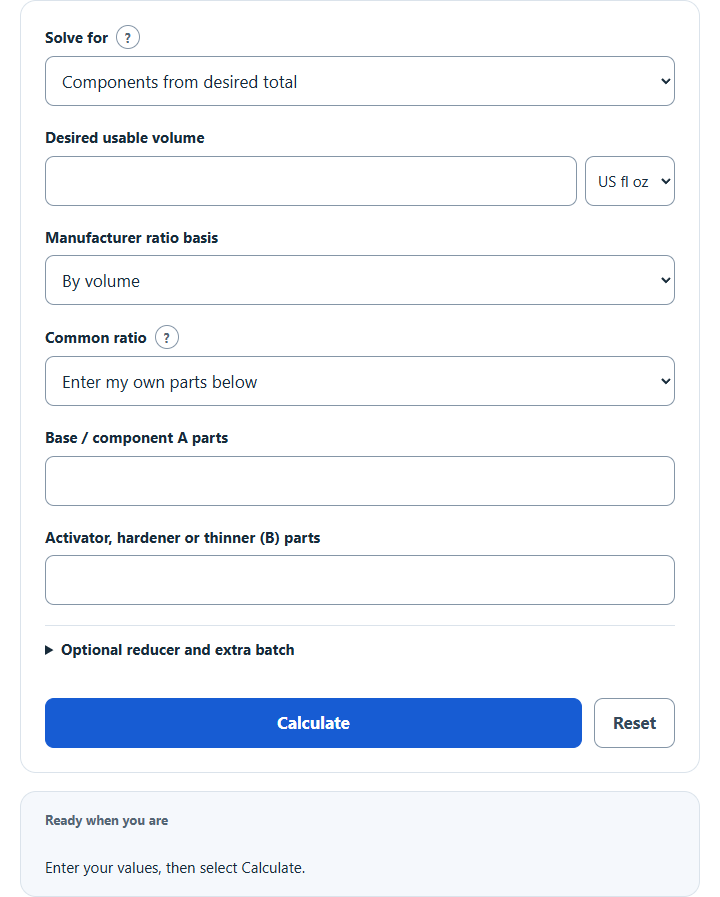
Calculate paint mixing ratios: enter parts such as 4:1 or 4:1:1 and a batch size to get base, activator or hardener, and reducer or thinner amounts.
- All Construction Calculators
- Shiplap Calculator
- Paint Usage Calculator
- Automotive Paint Coverage Calculator
- Wall Area Calculator
- Exterior Square Footage Calculator
- Wallpaper Yardage Calculator
Calculator Functions
| Function | What it does | What it requires |
|---|---|---|
| Components from desired total | Splits a finished batch size into the amount of each component | Requires the desired usable volume or weight, the ratio basis, and the parts of base and of activator, hardener or thinner |
| Batch from known base amount | Finds how much of the other components to add to a measured amount of base, and the batch that makes | Requires the base volume or weight, the ratio basis, and the parts of base and of activator, hardener or thinner |
A ratio can be typed in as parts or picked from the common ratios 4:1, 2:1, 3:1, 5:1, 1:1, 4:1:1 and 2:1:1. Volumes are entered in US fl oz, mL, L, cups, pints, quarts or gallons, and weights in g, kg, oz or lb. Optional settings add a third component such as a reducer, and an extra batch percentage on the desired total. Each result lists every component, the size of one ratio part and the running total after each addition.
Paint Ratio Formulas
(A + B + C)
| T | Total prepared batch, in any volume or weight unit |
| p | Parts of the component being measured |
| A | Parts of base |
| B | Parts of activator, hardener or thinner |
| C | Parts of reducer, or 0 when there is none |
A paint ratio such as 4:1 means 4 parts of base to 1 part of the second component, 5 parts in all. A part is any measure, as long as the same one is used for every component. Parts are relative, so 4:1 and 8:2 are the same mix. To turn two measured amounts into a ratio, divide the base by the other component: 20 parts base and 5 parts thinner is 20 ÷ 5 = 4, written 4:1. One litre of paint mixed with 0.25 L of thinner is also 4:1.
Components from desired total
The main formula applies directly. For 32 US fl oz at 4:1, one part is 32 ÷ 5 = 6.4 fl oz, so the batch is 25.6 fl oz of base and 6.4 fl oz of activator. One litre at 4:1:1 is 0.6667 L of base, 0.1667 L of activator and 0.1667 L of reducer. A 40 mL batch at 3:1 is 30 mL and 10 mL.
With an extra batch percentage, the total is raised first: T = desired amount × (1 + extra ÷ 100). A desired 1,000 mL with 10% extra at 2:1 becomes 1,100 mL, made of 733.33 mL of base and 366.67 mL of the second component.
Batch from known base amount
Component = one part × p
With 20 fl oz of base at 4:1, one part is 20 ÷ 4 = 5 fl oz, so 5 fl oz of activator is added and the batch is 25 fl oz. One litre of base at 4:1:1 takes 0.25 L of activator and 0.25 L of reducer and makes 1.5 L.
Paint Mixing Ratio Chart for 1 Litre
Each row adds up to 1,000 mL of mixed paint. For another batch size, every amount scales in proportion: for 500 mL, halve each figure.
| Ratio | Base (A) | Component B | Component C |
|---|---|---|---|
| 1:1 | 500 mL | 500 mL | None |
| 2:1 | 666.7 mL | 333.3 mL | None |
| 3:1 | 750 mL | 250 mL | None |
| 4:1 | 800 mL | 200 mL | None |
| 5:1 | 833.3 mL | 166.7 mL | None |
| 2:1:1 | 500 mL | 250 mL | 250 mL |
| 4:1:1 | 666.7 mL | 166.7 mL | 166.7 mL |
Limits of This Estimate
- The calculator only does the arithmetic. The right ratio, the order of the components and whether the ratio is by volume or by weight come from the product’s technical data sheet.
- Volume and weight are not converted into each other. A ratio by weight measured out by volume gives the wrong mix, because the components have different densities.
- A reducer or thinner given as a percentage has to be turned into parts before it is entered, and products differ on whether the percentage is taken of the base alone or of the activated paint.