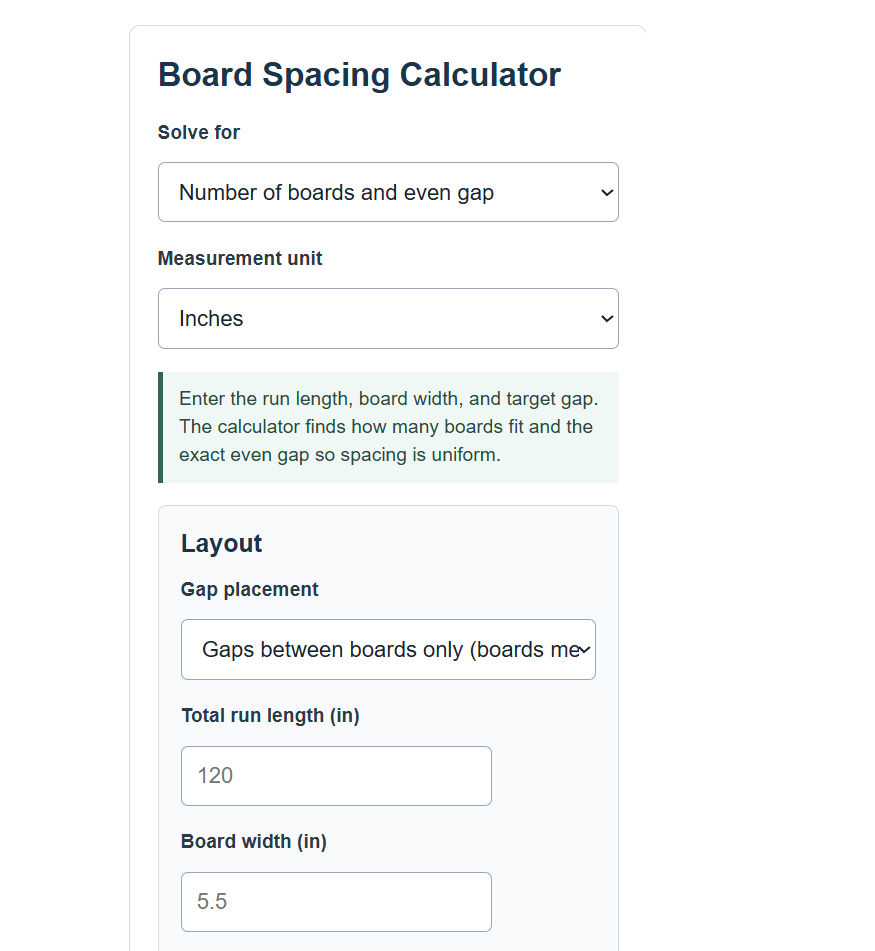
Calculate even board spacing and the exact gap between deck boards, fence pickets, or battens for a uniform layout with full-width end boards.
- All Construction Calculators
- Construction Material Estimator Calculator
- Fractional Ruler Layout Calculator
Board Spacing Formula
The calculator works in three modes. To find how many boards fit in a run and the even gap between them, it first estimates the board count from your target gap, then recalculates the exact gap once the count is rounded to a whole number. With gaps between the boards only, where the first and last boards meet the ends, there are N minus 1 gaps:
N = (L + g) / (w + g) g_even = (L - N*w) / (N - 1)
With equal gaps on both ends, as you would use for fence pickets or board and batten, there are N plus 1 gaps:
N = (L - g) / (w + g) g_even = (L - N*w) / (N + 1)
To find the even gap for a fixed number of boards, or the total run length a layout occupies, it rearranges the same relationship:
g_even = (L - N*w) / G L = N*w + G*g
- L = total run length you are filling
- w = actual face width of one board
- g = gap between boards (your target, or the exact even gap)
- N = number of boards
- G = number of gaps, which is N minus 1 for gaps between boards only or N plus 1 for equal end gaps
The board count from a target gap rarely comes out to a whole number, so you round it. The fit method controls that rounding: round to the closest whole board, round up for more boards and smaller gaps, or round down for fewer boards and larger gaps. Once the count is fixed, the calculator spreads the leftover space evenly across every gap so all boards stay full width and the spacing looks uniform. Choosing the gap placement tells it whether to leave a gap at each end of the run.
Deck Board Gap Recommendations
The first table lists common gap sizes by decking material. The second shows how the number of gaps depends on the layout you pick in the calculator.
| Material | Suggested gap | Notes |
|---|---|---|
| Pressure-treated, still wet | 1/16 in or butt tight | Boards shrink as they dry to about 1/4 in |
| Pressure-treated, dry | 3/16 to 1/4 in | Already dried, so set the final gap now |
| Cedar or redwood | 1/8 to 3/16 in | Stable softwoods, minor movement |
| Composite (side gap) | 1/8 to 3/16 in | Follow the maker’s spec for your product |
| Layout | Number of gaps | Typical use |
|---|---|---|
| Gaps between boards only | N minus 1 | Deck boards that meet both ends |
| Equal gaps including both ends | N plus 1 | Fence pickets, balusters, battens |
Example Problems
Example 1. You are laying deck boards across a 120 in run with 5.5 in boards and want a gap close to 1/4 in, with gaps between the boards only. The estimated count is (120 + 0.25) / (5.5 + 0.25) = 20.9, which rounds to 21 boards. With 21 boards there are 20 gaps, so the even gap is (120 – 21 x 5.5) / 20 = 4.5 / 20 = 0.225 in. You get 21 boards spaced 0.225 in apart, and every board stays full width.
Example 2. You are spacing fence pickets across a 96 in section with 3.5 in pickets and want about a 2 in gap, with equal gaps at both ends. The estimated count is (96 – 2) / (3.5 + 2) = 17.1, which rounds to 17 pickets. Equal end gaps mean 17 plus 1 = 18 gaps, so the even gap is (96 – 17 x 3.5) / 18 = 36.5 / 18 = 2.03 in. You get 17 pickets with about a 2.03 in gap at every position, including the two ends.
Frequently Asked Questions
What gap should I leave between deck boards? For most dry lumber and composite, 1/8 in to 1/4 in works well and allows drainage and airflow. Wet pressure-treated boards can be installed nearly tight because they shrink as they dry to roughly a 1/4 in gap. Check the gap your decking maker specifies, since composite products often call for a set side gap and a separate end gap.
Why does even spacing matter? If you set a fixed gap and start at one end, the last board usually lands at an odd width or the final gap looks different from the rest. Spreading the leftover space evenly across every gap keeps all boards full width and makes the spacing consistent, which is what people notice when they look down a deck or fence.
Should I count gaps at the ends? That depends on the layout. Deck boards normally run flush to the edge, so you only have gaps between boards, which is N minus 1 gaps. Fence pickets, balusters, and board and batten usually look best with a matching gap at each end, which adds two more gaps for N plus 1 total. Pick the gap placement that matches your project so the math distributes the space correctly.