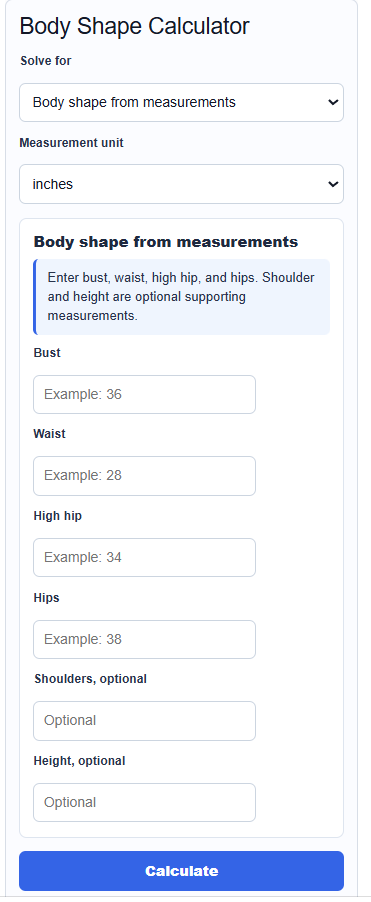
Calculate your body shape from your bust, waist, and hip measurements. This calculator compares the differences between your measurements to sort you into a standard figure type, reports your waist-to-hip and waist-to-height ratios, and can solve for a target waist or hip measurement from a chosen waist-to-hip ratio.
Body Shape Formula
Body shape is decided by the size differences between your bust, waist, and hips, measured in the same unit (inches or centimeters). The calculator checks these differences against fixed thresholds based on the Female Figure Identification Technique (FFIT) system.
Bust difference = Bust - Hips
 Waist drop (bust) = Bust - Waist
 Waist drop (hips) = Hips - Waist
The shape is then assigned with rules like these:
Hourglass = |Bust - Hips| <= 1 AND (Bust - Waist >= 9 OR Hips - Waist >= 10)
 Pear / Triangle = (Hips - Bust) >= 3.6 AND (Hips - Waist) < 9
 Inverted triangle = (Bust - Hips) >= 3.6 AND (Bust - Waist) < 9
 Rectangle = all of Bust, Waist, Hips within about 3.6 of each other
The ratio mode reports two common figures:
WHR = Waist / Hips
WHtR = Waist / Height
The target mode rearranges the waist-to-hip ratio so you can solve for one missing measurement:
Waist = WHR * Hips
 Hips = Waist / WHR
- Bust: the circumference around the fullest part of your chest.
- Waist: the circumference around the narrowest part of your torso, usually just above the navel.
- High hip: the circumference around the upper hip and lower stomach, used to spot a fuller upper hip.
- Hips: the circumference around the fullest part of your seat and hips.
- Shoulders and Height: optional inputs used to describe shoulder-to-hip balance and the waist-to-height ratio.
- WHR: waist-to-hip ratio, your waist divided by your hips.
- WHtR: waist-to-height ratio, your waist divided by your height.
The shape mode reads your four core measurements and returns a figure type such as hourglass, pear, inverted triangle, or rectangle. The ratio mode turns the same measurements into WHR and WHtR values plus a shoulder-to-hip note. The target mode works backward: give it a hip measurement and a goal WHR and it returns the matching waist, or give it a waist and a goal WHR and it returns the matching hips.
Shape Types and Ratio Bands
The first table shows the measurement pattern behind each common figure type. The second shows how the waist-to-hip and waist-to-height ratios are grouped.
| Shape | Measurement pattern |
|---|---|
| Hourglass | Bust and hips close in size, waist clearly smaller than both. |
| Pear / Triangle | Hips larger than bust, waist not sharply defined. |
| Inverted triangle | Bust larger than hips, waist not sharply defined. |
| Rectangle | Bust, waist, and hips all close in size. |
| Ratio | Band | Meaning |
|---|---|---|
| Waist-to-hip | Below 0.75 | Lower ratio, waist much smaller than hips. |
| Waist-to-hip | 0.75 to 0.85 | Mid-range ratio. |
| Waist-to-hip | Above 0.85 | Higher ratio, waist closer to hip size. |
| Waist-to-height | 0.40 to 0.50 | Common middle band for this ratio. |
Examples
Example 1: Shape from measurements. Suppose your bust is 38 inches, waist is 28 inches, and hips are 39 inches. The bust difference is 38 minus 39, which is -1, so bust and hips are within 1 inch. The hip-to-waist difference is 39 minus 28, which is 11 inches, above the 10-inch threshold. Bust and hips are close in size and the waist is clearly smaller, so the shape is hourglass.
Example 2: Target waist from a ratio. Suppose your hips are 40 inches and you want a waist-to-hip ratio of 0.75. Using Waist = WHR * Hips, the target waist is 0.75 times 40, which is 30 inches.
FAQ
How do I measure correctly? Use a flexible tape held level and snug but not tight. Measure your bust around the fullest part of your chest, your waist around the narrowest part of your torso, and your hips around the fullest part of your seat. Keep the tape parallel to the floor and use the same unit for every measurement.
Does it matter whether I use inches or centimeters? The shape thresholds in this calculator are set in inches, so the calculator converts your entries when you choose centimeters. Just pick one unit in the calculator and enter all of your measurements in that unit so the comparisons stay consistent.
What is a good waist-to-hip ratio? The ratio is descriptive, not a grade. A lower waist-to-hip ratio means your waist is smaller relative to your hips, which is the pattern behind an hourglass figure. The calculator groups the ratio into bands so you can see where your number falls without treating any single value as a goal.