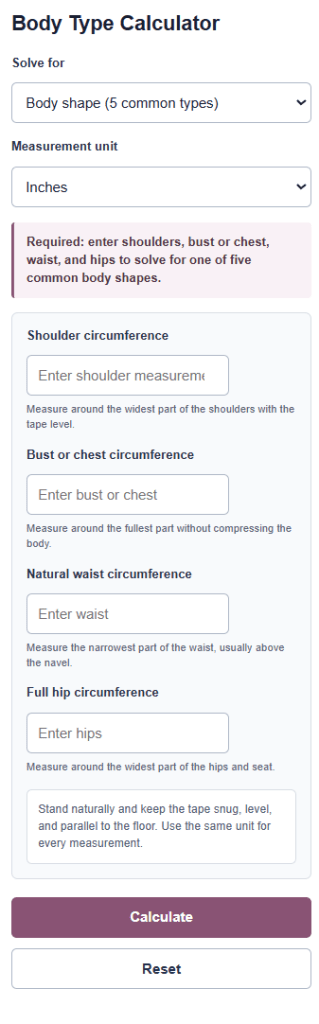
Calculate your body type from your shoulder, bust, waist, high-hip, and hip measurements.
Body Type Formula
This calculator does not use a single equation. It compares your circumference measurements to one another using a few ratios and differences, then matches the result to a body-shape category. Two modes are available.
The five-shape mode uses your shoulder, bust or chest, waist, and hip measurements. The key comparisons are:
Upper = max(Shoulders, Bust)
Upper-to-Hip difference = |Upper - Hips| / max(Upper, Hips)
Waist definition = (1 - Waist / max(Bust, Hips)) * 100
The detailed seven-category mode uses your bust or chest, waist, high-hip, and full-hip measurements. It works from plain differences and one ratio:
Bust - Hips, Hips - Bust, Bust - Waist, Hips - Waist
High-hip ratio = High hip / Waist
Two general proportion ratios are also reported with every result:
Waist-to-Hip ratio = Waist / Hips
Waist-to-Bust ratio = Waist / Bust
- Shoulders: the circumference around the fullest part of your shoulders. Used only in the five-shape mode.
- Bust or chest: the circumference around the fullest part of your bust or chest.
- Waist: the circumference at your natural waist, the narrowest point of your torso.
- High hip: the circumference across the upper hip and upper belly, above the widest hip line. Used only in the seven-category mode.
- Hips: the circumference around the fullest part of your hips and seat.
The waist-to-hip and waist-to-bust ratios show how much smaller your waist is than your hips and bust. The bust/hip difference shows whether you are wider on top or bottom. The waist definition value is the percent your waist is smaller than your larger circumference, so a higher number means a more defined waist. The high-hip ratio separates a smooth pear (triangle) from a spoon, where the upper hip flares out above the waist. All measurements are converted to inches internally, so you can enter either inches or centimeters.
How the categories are decided
The table below shows the proportion rules each mode uses. Bust and hips being within about an inch of each other points to a balanced shape, while a difference of roughly 3.6 inches or more makes a shape clearly top-heavy or bottom-heavy.
| Body type | Mode | Main rule of thumb |
|---|---|---|
| Hourglass | Both | Bust and hips nearly equal, with a clearly smaller waist |
| Top hourglass | Detailed | Bust larger than hips by 1 to 10 in, with a defined waist |
| Bottom hourglass | Detailed | Hips larger than bust by 3.6 to 10 in, with a defined waist and smooth high hip |
| Spoon | Detailed | Hips fuller than bust with a high hip that flares out above the waist |
| Triangle / Pear | Both | Hips fuller than the upper body |
| Inverted triangle | Both | Upper body broader or fuller than the hips |
| Rectangle | Both | Upper body and hips balanced, with little waist difference |
| Round / Apple | Common | Waist close to or larger than the bust and hips |
The five most common shapes are not evenly distributed. The table below gives the rough share of women in each, based on a North Carolina State University study of body scans.
| Body type | Approximate share |
|---|---|
| Rectangle | 46% |
| Triangle / Pear | 20% |
| Round / Apple | 14% |
| Inverted triangle | 12% |
| Hourglass | 8% |
Examples
Example 1: five-shape mode. You measure shoulders 39 in, bust 38 in, waist 28 in, and hips 39 in. The upper body value is the larger of shoulders and bust, so 39 in, which matches the hips almost exactly. The waist is 28 in, which is about 72 percent of 39 in, below the 75 percent cutoff for a defined waist. With balanced top and bottom and a clearly smaller waist, the result is Hourglass. The waist-to-hip ratio is 28 / 39 = 0.718.
Example 2: seven-category mode. You measure bust 36 in, waist 30 in, high hip 40 in, and hips 44 in. Hips exceed bust by 8 in, which is in the 3.6 to 10 in range. Hips exceed waist by 14 in, well over the cutoff for a defined waist. The high-hip ratio is 40 / 30 = 1.33, above the 1.193 line that flags a flared upper hip, so the result is Spoon rather than a plain Triangle / Pear.
FAQ
Where do I measure my natural waist? Your natural waist is the narrowest part of your torso, usually about an inch above the belly button and below the rib cage. Stand relaxed, keep the tape level all the way around, and do not pull it tight or hold your breath. Using the true narrowest point, rather than where your pants sit, gives the most accurate shape.
What is the difference between the five-shape and seven-category modes? The five-shape mode uses shoulders, bust, waist, and hips and returns one of five common shapes. The seven-category mode drops shoulders and adds a high-hip measurement, which lets it separate the hourglass into top and bottom hourglass and tell a smooth pear apart from a spoon. Use the seven-category mode when you want a finer result and you can measure your high hip; use the five-shape mode for a quick read.
Can my body type change? Your underlying frame, including shoulder and hip bone width, stays fairly fixed, but the soft-tissue measurements that drive this result can shift with weight change, muscle gain, pregnancy, and age. Because the categories are based on proportions rather than size, a change that affects your waist, bust, or hips unevenly can move you from one shape to another. The result describes measurement proportions only and is not a health or fitness assessment.