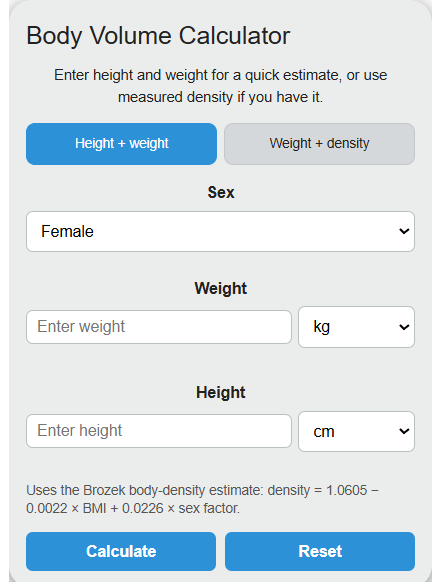
Estimate body volume from height and weight using the Brozek BMI method, or from weight and body density, in liters and US gallons.
Related Calculators
- Belly Size Calculator
- BAI – Body Adiposity Index Calculator
- Hamwi Equation Calculator
- BMI Calculator
- All Health and Medical Calculators
Body Volume Formula
Body volume is weight divided by body density. The calculator uses one of two formulas depending on the mode you pick.
Mode 1 — Height and weight (Brozek estimate):
Mode 2 — Weight and measured density:
- V = body volume in liters
- W = body weight in kilograms
- D = body density in kg/L
- BMI = weight (kg) ÷ height (m)²
- S = sex factor (1 for male, 0 for female)
In the height-and-weight mode, the calculator computes BMI from your inputs, plugs it into the Brozek density equation, then divides weight by that density to get volume. In the density mode, it skips the estimate and divides weight directly by the density value you enter from a hydrostatic weighing test, BOD POD report, or similar measurement. Results are shown in liters with equivalents in US gallons, cubic meters, and cubic inches.
Typical Values and Conversions
Body density for healthy adults usually falls between about 1.02 and 1.10 kg/L. Higher lean mass pushes density up; higher fat mass pulls it down toward water (1.00 kg/L). Volume in liters is close to weight in kilograms because the body is mostly water.
| Body composition | Approx. density (kg/L) | Volume per 70 kg |
|---|---|---|
| Very lean / athletic | 1.080 – 1.100 | 63.6 – 64.8 L |
| Average adult | 1.040 – 1.070 | 65.4 – 67.3 L |
| Higher body fat | 1.000 – 1.030 | 68.0 – 70.0 L |
| Pure water reference | 1.000 | 70.0 L |
| From | To | Multiply by |
|---|---|---|
| Liters | US gallons | 0.26417 |
| Liters | Cubic meters | 0.001 |
| Liters | Cubic inches | 61.024 |
| Liters | Cubic feet | 0.03531 |
Example Problem
Female, 65 kg, 165 cm.
BMI = 65 ÷ (1.65)² = 23.88. Density = 1.0605 − 0.0022 × 23.88 + 0.0226 × 0 = 1.0080 kg/L. Volume = 65 ÷ 1.0080 = 64.5 L, or about 17.0 US gallons.
Male, 80 kg, measured density 1.062 kg/L.
Volume = 80 ÷ 1.062 = 75.3 L, or about 19.9 US gallons.
FAQ
Why is body volume close to body weight? Because the body’s density sits near 1 kg/L. A 70 kg person occupies roughly 65 to 70 liters.
Which mode is more accurate? The density mode, if your density value comes from underwater weighing, air displacement plethysmography (BOD POD), or DXA-derived data. The height-and-weight mode is an estimate only.
Does this give body fat percentage? No. It gives volume. You can feed the density value into a separate Siri or Brozek body-fat formula.
Why did I get a warning about density? The result fell outside the typical 0.98 to 1.12 kg/L range. Check that you used the correct unit and that height and weight were entered correctly.