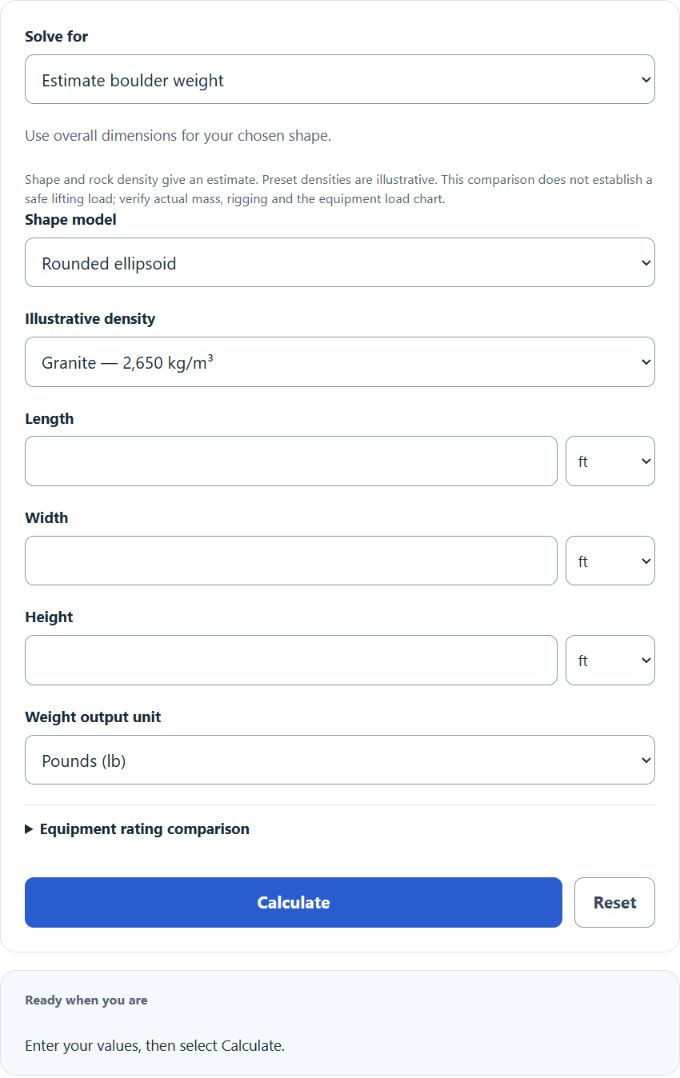
Estimate boulder weight by measured shape and rock density, compare an entered lift rating, or reverse-calculate the diameter of an equivalent sphere.
- Rubber Sheet Weight Calculator
- Plywood Weight Calculator
- Steel Tank Calculator
- All Construction Calculators
Boulder Weight Formula
The following equation estimates a rectangular enclosing block. For a rounded ellipsoid measured along its full length, width and height, multiply L × W × H by π/6 before applying density.
- Where Wb is the Boulder Weight (lbs)
- L is the boulder length (ft)
- W is the boulder width (ft)
- H is the boulder height (ft)
- d is the density (lbs/ft^3)
- Illustrative sandstone density = 2,300 kg/m³ (about 143.58 lb/ft³); actual rock varies.
- Illustrative limestone density = 2,400 kg/m³ (about 149.83 lb/ft³); actual rock varies.
For the rectangular block model, multiply length, width and height, then multiply by density in matching units. The ellipsoid and sphere models use their respective shape formulas.
What is the weight of a boulder?
A boulder’s weight is determined by its total volume and the density of the type of rock. Not all boulders have the same density.
How to Calculate Boulder Weight?
Example Problem:
The following example outlines how to estimate the weight of a boulder.
First, determine the length, width and height of the boulder.
In this case, the boulder is measured to be 5 ft, 6ft, and 4 ft respectively for the length, width, and height.
Next, determine the density of the rock material.
For this rectangular-block example, use the illustrative limestone density of 2,400 kg/m³ (about 149.8271 lb/ft³). This is an assumption, not a measurement of the rock.
Finally, calculate the boulder weight using the formula above:
Wb = L*W*H*d
Wb ≈ 5 × 6 × 4 × 149.8271
Wb ≈ 17,979.3 lbs