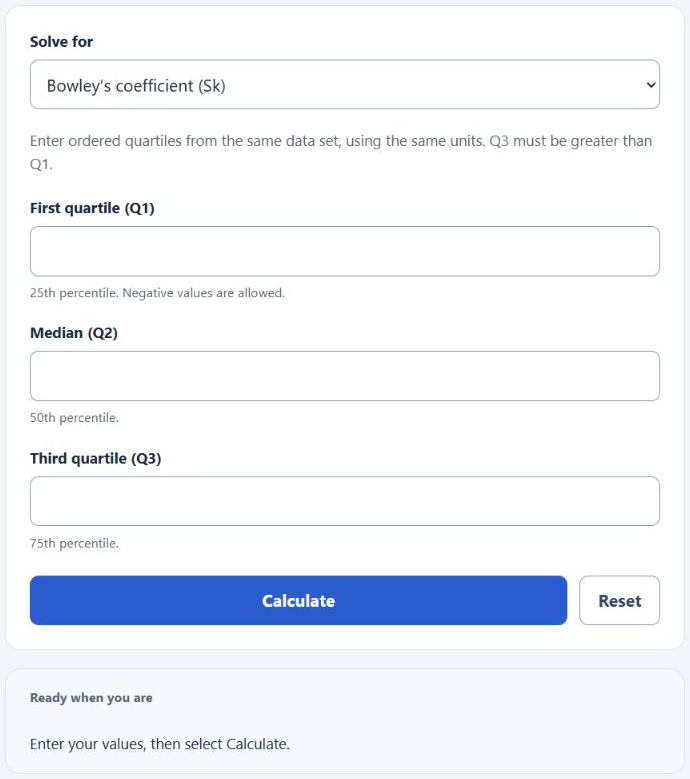
Calculate Bowley’s coefficient of skewness from Q1, median and Q3, or choose a quartile to solve for and enter the other three values.
Related Calculators
- Coefficient of Skewness Calculator
- Modified Z Score Calculator
- Sturges’ Rule Calculator
- 2 Standard Deviation Rule Calculator
- All Statistics Calculators
Bowley’s Coefficient Of Skewness Formula
Bowley’s coefficient of skewness measures skewness using the first quartile, median, and third quartile. It focuses on the middle 50% of the data, so it is less affected by extreme values than skewness formulas based on the mean.
To solve for a missing value, the calculator uses the following related formulas:
- Sk = Bowley’s coefficient of skewness
- Q1 = first quartile, or the 25th percentile
- Q2 = median, or the 50th percentile
- Q3 = third quartile, or the 75th percentile
If you enter Q1, Q2, and Q3, the calculator finds Sk. If you enter Sk and two quartile values, it solves for the missing quartile or median. Q3 must be greater than Q1. When solving Q1 at Sk = -1, Q2 = Q3 gives infinitely many answers; otherwise there is no solution. When solving Q3 at Sk = 1, Q1 = Q2 gives infinitely many answers; otherwise there is no solution.
Bowley Skewness Interpretation
| Sk value | Interpretation | What it means |
|---|---|---|
| Sk > 0 | Positive skew | The median is closer to Q1 than to Q3. |
| Sk = 0 | Symmetric middle spread | The median is halfway between Q1 and Q3. |
| Sk < 0 | Negative skew | The median is closer to Q3 than to Q1. |
| Input check | Expected condition |
|---|---|
| Quartile order | Q1 ≤ Q2 ≤ Q3 is required for a valid ordered data set. |
| Interquartile range | Q3 – Q1 must not equal 0 when calculating Sk. |
| Valid Sk range | For valid quartiles, Bowley’s coefficient falls from -1 to 1, inclusive. |
Example Problems
Example 1: Calculate Bowley’s coefficient of skewness
Suppose Q1 = 20, Q2 = 30, and Q3 = 50.
The coefficient is positive, so the middle 50% of the data is skewed to the right.
Example 2: Calculate the median Q2
Suppose Q1 = 12, Q3 = 28, and Sk = -0.25.
The median is 22.
FAQ
What does Bowley’s coefficient of skewness tell you?
It tells you whether the central part of a data set is symmetric, right-skewed, or left-skewed. A positive value means the upper half of the interquartile range is longer. A negative value means the lower half is longer. A value of 0 means the median is centered between Q1 and Q3.
Why use Bowley’s skewness instead of mean-based skewness?
Bowley’s skewness uses quartiles instead of the mean and standard deviation. This makes it useful when the data has outliers or when you want a simple summary of skewness based on percentiles.
Can Bowley’s coefficient be calculated if Q1 equals Q3?
No. If Q1 equals Q3, then the denominator Q3 – Q1 is 0. That means the interquartile range is 0, and Bowley’s coefficient of skewness is undefined.