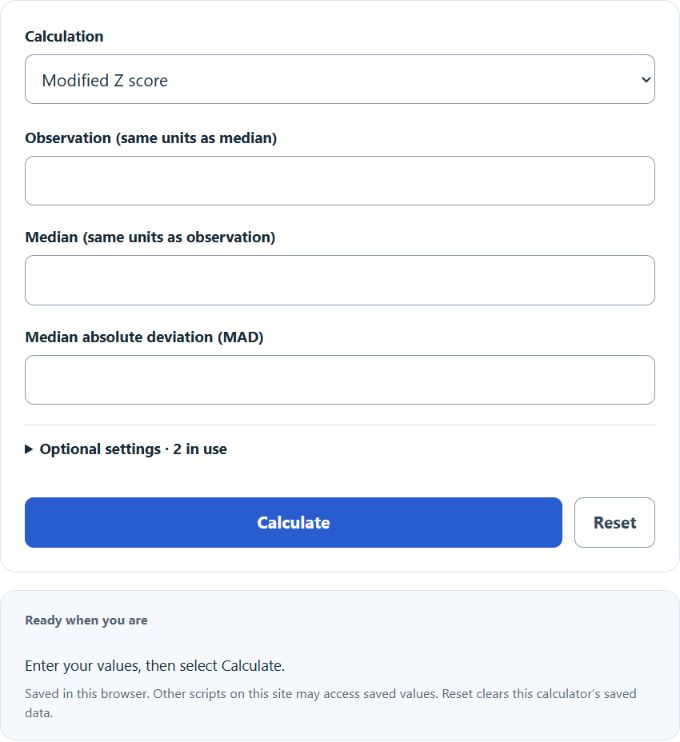
Calculate modified Z scores from observations, median, and MAD, detect outliers, and compare results with IQR bounds for your data.
Related Calculators
- Outlier Calculator
- Sigma To Percentage Calculator
- Coefficient of Skewness Calculator
- Cumulative Percentage Calculator
- All Statistics Calculators
Modified Z Score Formula
The following formula is used to calculate the modified Z score for a given observation.
Variables:
- Z is the modified Z score
- X is the observation
- M is the median
- MAD is the median absolute deviation
To calculate the modified Z score, subtract the median from the observation, divide the result by the median absolute deviation (MAD), and then multiply by 0.6745.
What is a Modified Z Score?
A modified Z score is a statistical measure that equals 0.6745 times the observation’s distance from the median divided by the median absolute deviation (MAD). Unlike the traditional Z score, which uses the mean and standard deviation, the modified Z score uses the median and MAD, making it more robust to outliers. This measure is particularly useful in identifying outliers in a dataset, because median and MAD are less sensitive to extreme observations. Potential-outlier flags require investigation, not automatic removal.
How to Calculate Modified Z Score?
The following steps outline how to calculate the Modified Z Score.
- First, determine the observation (X).
- Next, determine the median (M) of the dataset.
- Next, calculate the median absolute deviation (MAD).
- Finally, calculate the Modified Z Score using the formula Z = 0.6745 * (X – M) / MAD.
- After inserting the values and calculating the result, check your answer with the calculator above.
Example Problem :
Use the following variables as an example problem to test your knowledge.
Observation (X) = 10
Median (M) = 5
Median Absolute Deviation (MAD) = 2