Calculate bowling handicap from your league’s basis score and percentage, with optional adjusted-game and series totals.
Bowling Handicap Formula or Method
League handicap is a percentage of the positive difference between the basis score and the bowler’s whole-pin handicap average. The entered-average fraction is dropped first; then the fractional handicap result is dropped; averages at or above the basis receive zero in this model.
How the Calculation Works
The calculator applies the displayed relationship or scoring method to the visible required inputs and reports one defined result with supporting detail.
How to Use This Calculator
- Choose My handicap or Compare two bowlers.
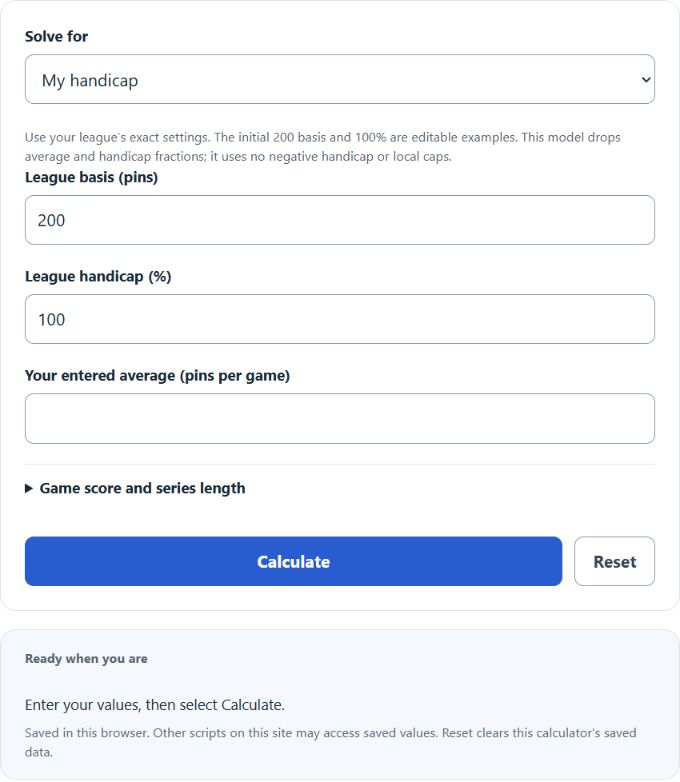
- Enter the league basis, percentage, and average values. In My handicap, expand Game score and series length for optional totals.
- Select Calculate and review the primary answer, supporting values, and steps.
- Use Reset before starting a different game or scenario.
Worked Example
At 90% of a 220 basis, a 155 average produces 58.5 raw pins, so the handicap is 58. A 165 scratch game becomes 223 after handicap.
Input and Result Guide
| Item | How to use it |
|---|---|
| Basis | Use the exact basis score written in the league or tournament rules. |
| Percentage | Use the event’s handicap percentage, such as 90%. |
| Average | Enter the event average; its fractional portion is dropped before the basis difference is calculated. |
| Adjusted game | Optional scratch game plus per-game handicap. |
| Series handicap | Per-game handicap multiplied by the entered series length. |
Interpreting the Result
Compare results only when the scoring format, league settings, units, and sample definitions are consistent.
Assumptions and Limitations
There is no universal basis and percentage for every league. This calculator does not apply caps, negative handicap, team limits, rerates, or other local provisions unless they are already reflected in the values you enter.
Common Questions
Can I use custom league settings?
Yes. Enter the basis and percentage directly, or use the suggested values. The initial 200 basis and 100% are editable examples, not universal league rules.
Will my last successful calculation be restored?
Yes. The calculator saves the last successful input snapshot in this browser and recomputes it when restored. Unsaved edits do not replace that snapshot. Reset clears this calculator’s saved state.
Sources
United States Bowling Congress, Playing Rules, Rule 100d handicap leagues, current 2026-27 season; the league’s adopted rules control the actual basis and percentage.