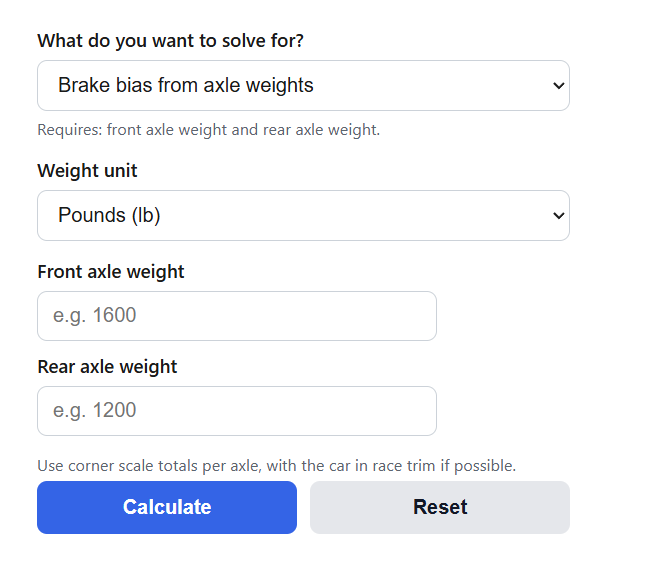
Calculate front and rear brake bias from axle weights, brake hardware, or dynamic weight transfer to find the ideal braking force split for your vehicle.
Brake Bias Formula
The simplest brake bias estimate uses the static weight on each axle:
BB_front = FW / (FW + RW) * 100
For static bias built into the brake hardware, the calculator compares the brake torque each axle produces per unit of pedal force:
T = (A_cal / A_mc) * r_eff * u_pad
BB_front = T_front / (T_front + T_rear) * 100
For the ideal bias under braking, the calculator adds forward weight transfer to the static front axle load:
WT = a * W * h / L
BB_ideal = (W_front,static + WT) / W * 100
- BB_front is the front brake bias (%)
- FW and RW are the front and rear axle weights (lb or kg)
- A_cal is the caliper piston area on one side of the caliper (in² or mm²)
- A_mc is the master cylinder piston area, computed from the bore diameter (in² or mm²)
- r_eff is the rotor effective radius, the distance from the axle centerline to the center of the pad (in or mm)
- u_pad is the brake pad friction coefficient (typically 0.35 to 0.55)
- WT is the weight transferred to the front axle under braking (lb or kg)
- a is the peak deceleration in g
- W is the total vehicle weight, h is the center of gravity height, and L is the wheelbase (h and L in the same unit)
The first mode gives a quick baseline from axle weights alone. The second mode computes the fixed, mechanical bias of the brake system itself, which is what you change when you swap calipers, rotors, master cylinders, or pads. It also reports the front-to-rear line pressure ratio, which is useful when checking dual master cylinder setups. The third mode estimates the bias that would match the dynamic axle loads at a chosen deceleration, which is the target the hardware bias should aim for.
Typical Front Brake Bias by Vehicle Type
Front bias is almost always larger than the static front weight split because braking shifts load forward. The ranges below are common starting points.
| Vehicle type | Typical front bias | Notes |
|---|---|---|
| Front-engine, front-wheel drive road car | 70% to 80% | Heavy front axle plus large weight transfer |
| Front-engine, rear-wheel drive road car | 60% to 75% | Most street and track-day setups fall here |
| Front-engine race car (circle track, road race) | 55% to 65% | Lower CG and softer transfer than street cars |
| Mid- or rear-engine sports car | 50% to 60% | Rear weight keeps the rear axle loaded |
| Formula-style open wheeler | 55% to 62% | Adjusted lap to lap with a balance bar |
Diagnosing Brake Bias From On-Track Behavior
The fastest way to check bias without instrumentation is to read what the car does at the limit of braking. This table maps the symptom to the correction.
| Symptom under hard braking | Likely cause | Adjustment |
|---|---|---|
| Front wheels lock first, car plows straight | Too much front bias | Move bias rearward in small steps (1% to 2%) |
| Rear steps out or car wants to spin entering corners | Too much rear bias | Move bias forward immediately; rear lock-up is unstable |
| Long stopping distance, neither axle locks | System capacity, not bias | Check pad compound, line pressure, and pedal ratio |
| Car is stable braking straight but loose when trail braking | Bias slightly rearward for corner entry | Add a small amount of front bias or adjust brake release |
| Balance changes as fuel burns off | Static weight split shifting during the run | Recheck bias at race weight, not full tanks |
Example Problems
Example 1: bias from axle weights. A car weighs 1600 lb on the front axle and 1200 lb on the rear axle. Total weight is 2800 lb. Front bias is 1600 / 2800 * 100 = 57.1%, so the rear bias is 42.9%. This is the static split; the ideal bias under braking will be higher.
Example 2: ideal bias under braking. A 3000 lb car has 55% static front weight, a CG height of 20 inches, a 105-inch wheelbase, and brakes at 0.9 g. Weight transfer is 0.9 * 3000 * 20 / 105 = 514.3 lb. The static front axle load is 3000 * 0.55 = 1650 lb, so the dynamic front axle load is 1650 + 514.3 = 2164.3 lb and the ideal front bias is 2164.3 / 3000 * 100 = 72.1%. Running the static split of 55% as the brake bias would overwork the rear brakes and risk rear lock-up.
FAQ
Is more front brake bias always safer? Within reason, yes. If the fronts lock first the car keeps traveling straight and remains controllable, which is why production cars are biased well forward of the theoretical ideal. If the rears lock first the car can swap ends with little warning. The cost of excess front bias is longer stopping distances, because the rear tires are not contributing all the braking force they could.
Why does my ideal bias change with track conditions? The weight transfer term depends on deceleration, and deceleration depends on grip. In the rain a car might only brake at 0.6 g instead of 1.1 g, which transfers less weight forward and moves the ideal bias rearward by several percent. This is why racers move the balance bar rearward in low grip conditions and why a single fixed bias is always a compromise.
How do I change the bias on my car? On a dual master cylinder setup, turn the balance bar to shift pedal force between the front and rear cylinders. On a tandem master cylinder system, bias changes require hardware: a smaller rear caliper piston area, a smaller rear rotor, a lower friction rear pad, or an adjustable proportioning valve that limits rear line pressure. The hardware mode of the calculator shows how each of those changes moves the static bias.