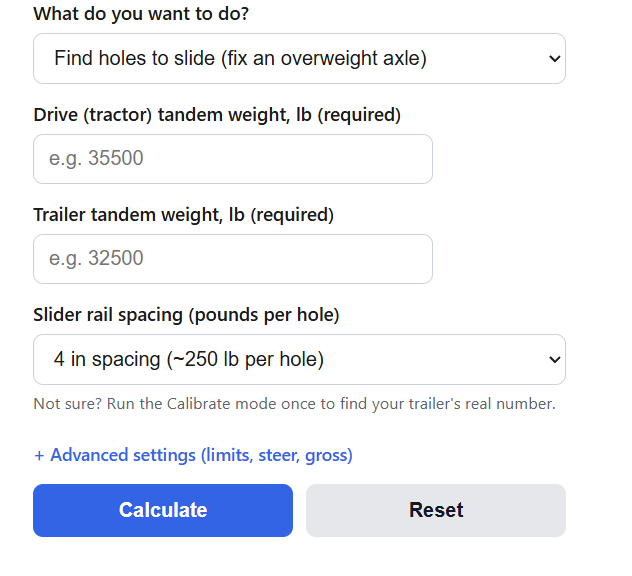
Calculate how many holes to slide your trailer tandems, and which way, to get your drive and trailer axles under the 34,000 lb legal limit.
- All Automotive Calculators
- RPM per Axle Ratio Calculator
- Kingpin-to-Rear-Axle (KPRA) Calculator
- Trailer Offtracking Calculator
Sliding Tandem Axle Weight Formula
The calculator works in three modes. To find how many holes to slide when an axle group is overweight, it divides the amount you are over the limit by the weight each hole moves, then rounds up to a whole hole:
Holes = Overweight / PPH
To predict what a slide does, it multiplies the holes by the per-hole value to get the total weight shifted, then applies that shift to both groups. A forward slide (toward the cab) moves weight onto the trailer tandems, and a backward slide moves it onto the drives:
Shift = Holes * PPH
 New Drive = Drive - Shift (forward slide)
 New Trailer = Trailer + Shift (forward slide)
To calibrate the per-hole value for your own trailer, it takes one axle group’s weight from before and after a known slide and divides the change by the number of holes you moved:
PPH = | Before - After | / Holes
Variables:
- Overweight is how many pounds an axle group sits above its limit
- PPH is the pounds moved per hole (about 250 lb on 4-inch hole spacing, about 400 lb on 6 inch spacing)
- Holes is the number of slider holes the tandems move
- Shift is the total weight moved between the drive group and the trailer group
- Drive and Trailer are the current drive tandem and trailer tandem scale weights
- Before and After are one group’s weight on either side of a calibration slide
Sliding never changes your gross weight. It only changes how that weight splits between the drive axles and the trailer axles. The kingpin acts as the pivot of a seesaw: move the tandems back and less of the load sits over them, so weight shifts to the drives; move them forward and more of the load sits over them, so weight shifts to the trailer. Because it is a seesaw, the “Fix an overweight axle” mode also checks the group you are not worried about, so a slide that fixes one axle does not quietly push the other one over.
Federal Limits and How Each Hole Shifts Weight
Sliding is about staying under the federal group limits on the Interstate system. These are the numbers the calculator checks against by default, though some states set lower limits, so confirm your route.
| Axle group | Federal limit |
|---|---|
| Steer axle | 12,000 lb typical target (higher by tire and axle rating) |
| Drive tandems | 34,000 lb |
| Trailer tandems | 34,000 lb |
| Gross vehicle weight | 80,000 lb |
The next table is the part most tandem guides leave out: what a single slide does to both groups at the same time. Every hole that takes weight off one group puts the same weight on the other. This example starts with the drives at 35,500 lb (1,500 over) and the trailer tandems at 32,500 lb, using 250 lb per hole. Watch the trailer column rise as the drive column falls.
| Holes slid forward | Drive tandems | Trailer tandems |
|---|---|---|
| 0 | 35,500 (over) | 32,500 |
| 1 | 35,250 | 32,750 |
| 2 | 35,000 | 33,000 |
| 3 | 34,750 | 33,250 |
| 4 | 34,500 | 33,500 |
| 5 | 34,250 | 33,750 |
| 6 | 34,000 (legal) | 34,000 (legal) |
At six holes both groups sit right at 34,000 lb. Slide one more and the trailer would go over, which is why sliding toward one limit can create a problem at the other. On a rail with 6 inch spacing each hole moves closer to 400 lb, so the same 1,500 lb fix would take four holes instead of six.
Example Problems
Example 1: fixing an overweight drive axle.
Your scale ticket shows the drives at 35,500 lb and the trailer tandems at 32,500 lb, and your trailer moves about 250 lb per hole. The drives are 1,500 lb over the 34,000 lb limit, so divide: 1,500 / 250 = 6 holes. Slide the tandems forward six holes by holding the trailer brakes and backing the tractor into them. The drives drop to 34,000 lb and the trailer rises to 34,000 lb, both legal.
Example 2: calibrating your own per-hole value.
Before a slide your drives read 35,600 lb. You slide forward 4 holes and reweigh at 34,000 lb. The change is 1,600 lb over 4 holes, so PPH = 1,600 / 4 = 400 lb per hole. Your trailer moves about 400 lb per hole, so use 400 as the custom value next time instead of guessing 250.
Frequently Asked Questions
Which way do I slide to fix overweight drive axles?
Slide the tandems forward, toward the cab. That puts more of the load over the trailer tandems and takes it off the drives. To move the tandems forward you hold the trailer brakes and back the tractor into them. If the trailer tandems are the heavy group instead, slide backward by pulling the tractor forward.
How much weight does each hole move?
It depends on your slider and how the load sits. A rail with 4-inch hole spacing moves roughly 250 lb per hole, and 6 inch spacing moves roughly 400 lb, with a front-loaded trailer pushing that toward 500. Because it varies, the most accurate approach is to calibrate once: note an axle weight, slide a known number of holes, reweigh, and divide the change by the holes moved. Use that number in the calculator going forward.
Does sliding the tandems lower my gross weight?
No. Sliding only shifts weight between the drive axles and the trailer axles, so the gross stays the same. If you are over 80,000 lb gross, or if the drive and trailer groups are both over at once, no slide will make you legal and you have to take off or redistribute cargo.