Calculate trailer offtracking from turn radius and wheelbase for trucks, semitrailers, and doubles, or find the radius that holds offtracking within a limit.
- All Automotive Calculators
- Trailer Gain Calculator
- Trailer Tire Pressure Calculator
- Trailer Load Capacity Calculator
- Sliding Tandem Axle Weight Calculator
Trailer Offtracking Formula
Offtracking is the distance the rearmost axle of a vehicle tracks toward the inside of a turn relative to the path of the front axle. In a steady low-speed turn, each towed unit forms a right triangle with the turn center, so the offtracking of the whole combination follows from the sum of the squares of the wheelbases:
OT = R - sqrt(R^2 - (L1^2 + L2^2 + ... + Ln^2))
When you know the offtracking you want to stay within and need the turn radius that delivers it, the same relationship rearranges to:
R = (L1^2 + L2^2 + ... + Ln^2 + OT^2) / (2 * OT)
Variables:
- OT is the offtracking, the lateral distance between the front axle path and the rearmost axle path
- R is the turn radius measured to the center of the front (steer) axle
- L1, L2, … Ln are the effective wheelbases of each unit in the combination. For a tractor it is the distance from the steer axle to the drive axle. For a semitrailer it is the distance from the kingpin to the center of the rear axle group. For a full trailer it is the distance from the hitch to its axle group
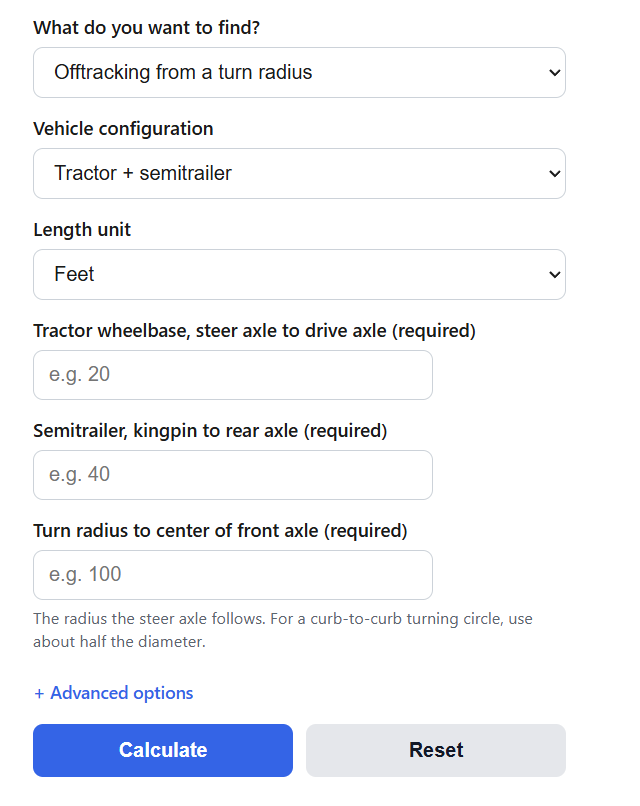
Pick what you want to find at the top of the calculator. In “Offtracking from a turn radius” mode you enter the wheelbases and the turn radius and the tool returns the offtracking, the rear axle path radius, and a swept path width if you add a vehicle width. In “Turn radius for a target offtracking” mode you enter a wheelbase set and a maximum offtracking and the tool returns the smallest radius that stays within it, which is the reverse most simple calculators do not do. The configuration selector controls how many wheelbase fields appear, so a single unit uses one, a semitrailer uses two, and doubles use three.
For gentle turns you can check the result with the small-angle approximation the calculator also reports, where S is the sum of the squared wheelbases:
OT = S / (2 * R)
This estimate is close when the radius is large compared with the wheelbase and drifts high as the turn tightens, which is why the calculator uses the exact square-root form for the reported offtracking.
Offtracking by Vehicle Configuration
Offtracking depends on the sum of the squared wheelbases, not on total length, so a longer rig split into short units can track tighter than one long trailer. The table below compares common configurations at the same 100 ft front-axle turn radius.
| Configuration | Effective wheelbases (ft) | Offtracking at 100 ft radius (ft) |
|---|---|---|
| Single unit truck | 20 | 2.02 |
| Transit bus | 25 | 3.18 |
| Tractor + 53 ft semitrailer | 20 + 40 | 10.56 |
| Tractor + twin 28 ft trailers | 20 + 28 + 28 | 10.38 |
The twin trailers offtrack slightly less than the single 53 ft trailer even though the whole rig is longer, because each short unit contributes its wheelbase squared and two smaller squares sum to less than one large one. This second table shows how offtracking and swept path width fall as the turn opens up, for a tractor plus 53 ft semitrailer (wheelbases 20 ft and 40 ft) at a legal 8.5 ft width.
| Turn radius (ft) | Offtracking (ft) | Swept path width (ft) |
|---|---|---|
| 50 | 27.64 | 36.14 |
| 75 | 14.79 | 23.29 |
| 100 | 10.56 | 19.06 |
| 150 | 6.82 | 15.32 |
| 200 | 5.06 | 13.56 |
| 300 | 3.35 | 11.85 |
Offtracking climbs steeply once the radius drops toward the wheelbase, which is why tight intersection and loading dock turns need extra pavement width for a semitrailer.
Example Problems
Example 1: Find the offtracking of a tractor and 53 ft semitrailer.
The tractor wheelbase is 20 ft and the trailer runs 40 ft from kingpin to rear axle. The rig makes a turn with a 100 ft front-axle radius. First sum the squared wheelbases: S = 20^2 + 40^2 = 400 + 1600 = 2000. Then apply the formula: OT = 100 – sqrt(100^2 – 2000) = 100 – sqrt(8000) = 100 – 89.44 = 10.56 ft. The rear trailer axle tracks about 10.6 ft inside the tractor front axle.
Example 2: Find the turn radius that keeps offtracking within 5 ft.
Using the same rig, S is still 2000. Apply the reverse formula: R = (2000 + 5^2) / (2 * 5) = 2025 / 10 = 202.5 ft. The front axle needs a radius of about 203 ft to hold offtracking to 5 ft, which shows why low-offtracking turns require large radii for a long combination.
Frequently Asked Questions
What is trailer offtracking?
Offtracking is the amount by which the rear axle of a trailer or combination cuts to the inside of the path traced by the front axle during a turn. At low speed it is a geometric effect set by the wheelbases and the turn radius, and it always pulls the rear wheels inward. It matters because the trailer can clip a curb, a sign, or an adjacent lane that the tractor cleared easily.
Why do two short trailers offtrack less than one long trailer?
Because offtracking depends on the sum of the squared wheelbases rather than total length. Splitting a long trailer into two shorter units replaces one large squared term with two smaller ones, and two smaller squares add up to less than the single large square. That is why a set of twin 28 ft trailers can track tighter than one 53 ft trailer even though the doubles rig is longer overall. The kingpin or hitch setting on each unit is what fixes its effective wheelbase.
What is the difference between low-speed and high-speed offtracking?
Low-speed offtracking is the geometric inward tracking this calculator returns, and it grows as the turn tightens. High-speed offtracking is a dynamic effect that appears on fast highway curves, where tire slip angles push the rear of the combination outward instead of inward. High-speed offtracking is usually small, a fraction of the low-speed value, and acts in the opposite direction, so it is treated separately in vehicle and roadway design.