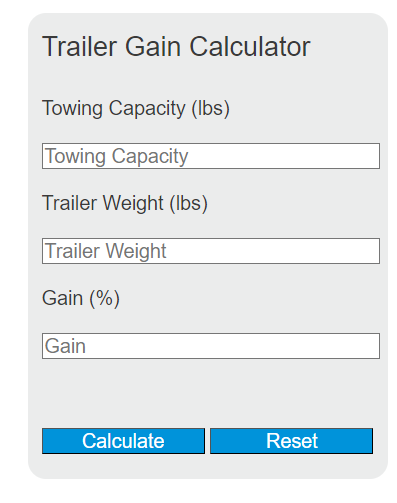
Trailer Gain Calculator for loaded trailer weight versus towing capacity, rating headroom, target trailer weight, and required tow capacity.
- All Automotive Calculators
- Trailer Load Capacity Calculator
- Trailer Tongue Length Calculator
- Trailer Offtracking Calculator
Trailer Weight Percentage (Tow Rating Utilization) Formula
This calculator finds how much of a vehicle’s rated towing capacity is being used by the trailer’s actual loaded weight. On this page, “trailer gain” means tow-rating utilization, not trailer brake controller gain.
Where:
- G = trailer weight as a percentage of towing capacity
- TW = actual loaded trailer weight
- TC = vehicle’s rated towing capacity
Use the same weight unit for both trailer weight and towing capacity. Pounds, kilograms, grams, ounces, or metric tonnes all work as long as the units match.
Rearranged Forms
If you know any two values, you can solve for the third:
How to Use the Calculator
- Enter the vehicle’s rated towing capacity.
- Enter the trailer’s actual loaded weight.
- Calculate the percentage to see how much of the tow rating is being used.
- If solving for a missing value, enter the other two known values and let the calculator compute the third.
How to Interpret the Result
| Result | Meaning |
|---|---|
| Less than 100% | The trailer weighs less than the stated towing capacity. |
| 100% | The trailer weight equals the full rated towing capacity. |
| Greater than 100% | The trailer weight exceeds the rated towing capacity. |
This result is a capacity-use check, not a complete towing approval. A setup can still be overloaded or poorly matched even when this percentage is below 100%.
What Weight Should You Enter?
- Towing Capacity (TC): Use the rated towing capacity for the specific vehicle, engine, drivetrain, axle ratio, hitch setup, and equipment package you actually have.
- Trailer Weight (TW): Use the trailer’s actual loaded weight, including cargo, fluids, batteries, propane, tools, accessories, and anything else carried during towing.
If you only know the trailer’s empty or dry weight, the percentage can be understated once the trailer is loaded. If you do not know the actual loaded weight, a scale reading is the most reliable input.
Example 1
A vehicle is rated to tow 5,000 lb and the loaded trailer weighs 3,000 lb.
The trailer is using 60% of the vehicle’s rated towing capacity.
Example 2
If you want a trailer to represent 75% of a 6,800 lb towing capacity, solve for the target loaded trailer weight.
A loaded trailer weight of 5,100 lb corresponds to 75% tow-rating utilization.
Trailer Gain vs. Brake Controller Gain
In many towing discussions, the word gain refers to the trailer brake controller setting that changes how strongly the trailer brakes apply. This calculator does not calculate brake controller gain. It only calculates trailer weight as a percentage of rated towing capacity.
Why This Percentage Matters
Trailer weight percentage is useful because it gives a quick snapshot of how close the trailer is to the vehicle’s tow limit. It can help with:
- comparing different trailers against the same tow vehicle
- checking how much headroom remains in the tow rating
- estimating whether added cargo could push the setup near or beyond the limit
- planning vehicle and trailer combinations before purchase
Important Limits This Calculator Does Not Replace
Even with a favorable percentage, you should still verify other towing limits and constraints, including:
- payload capacity
- tongue weight
- GVWR
- GCWR
- GAWR
- hitch and ball mount ratings
- tire load ratings
- trailer brake requirements
- cargo placement and axle loading
These limits interact with each other. For example, a trailer may be below the tow rating but still overload payload, rear axle capacity, or hitch components.
Common Input Mistakes
- Mixing units: entering towing capacity in pounds and trailer weight in kilograms without converting first.
- Using dry weight: ignoring cargo, fuel, water, propane, batteries, and installed accessories.
- Using the wrong tow rating: relying on a general model rating instead of the specific configuration of the actual vehicle.
- Ignoring other ratings: assuming a percentage below 100% automatically means the setup is acceptable in every way.
Frequently Asked Questions
Is a lower percentage better?
A lower percentage means the trailer uses less of the vehicle’s rated towing capacity. Mathematically, that leaves more margin within the tow rating, but it still does not replace checking payload, axle, hitch, and trailer limits.
Should I use actual trailer weight or GVWR?
For real-world utilization, use the actual loaded trailer weight. If that number is unknown, using trailer GVWR is a more conservative planning method because it assumes the trailer could be loaded to its maximum rated weight.
Can I compare different trailers with this calculator?
Yes. Enter the same vehicle towing capacity and change the trailer weight to see how each trailer compares as a percentage of that tow rating.
Does this calculator apply to boats, campers, utility trailers, and car haulers?
Yes. The formula works for any trailer type as long as the trailer weight and towing capacity are entered in matching units.