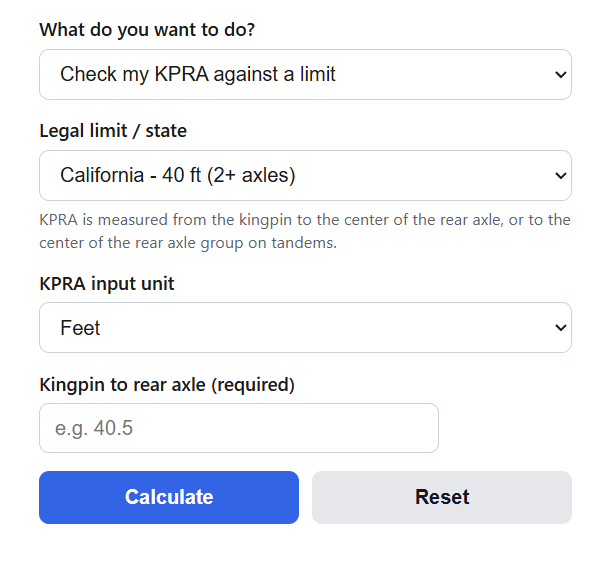
Calculate your kingpin to rear axle (KPRA) distance, check it against state limits like California’s 40 ft, and plan a tandem slide to get legal.
Kingpin to Rear Axle Formula
The calculator works three ways. When you enter trailer dimensions, it finds the kingpin to rear axle distance from the trailer length, the kingpin setback, and the rear overhang:
KPRA = L - (S + O) / 12
When you check a measured distance against a limit, it reports how much room you have:
Margin = (Limit - KPRA) * 12
When you plan a tandem slide, it finds how many holes to move forward and the weight that shifts as you do it:
Holes = roundup( (KPRA - Limit) * 12 / H )
 Weight shift = Holes * W
- KPRA = kingpin to rear axle distance, in feet
- L = trailer length, in feet
- S = kingpin setback, from the front of the trailer to the center of the kingpin, in inches
- O = rear overhang, from the center of the rear axle group to the rear of the trailer, in inches
- Limit = the state or route KPRA limit you must meet, in feet
- Margin = clearance in inches, where a negative value means you are over the limit
- H = slider hole spacing, in inches
- W = weight shifted per hole, in pounds
- Holes = number of holes to slide the tandems forward, rounded up
The first mode turns a tape measure or a spec sheet into a KPRA number. Because the trailer length is in feet and the two offsets are in inches, the formula divides the offsets by 12 before subtracting. The second mode compares that number to a limit and returns the inches of margin, so you can see at a glance whether you pass and by how much. The third mode is the planning step: it divides the amount you are over the limit by the rail hole spacing, rounds up to a whole hole, and multiplies the holes by an approximate per-hole weight to show how the load moves between your drives and your trailer tandems.
State Kingpin to Rear Axle Limits
Every state lets you run a 48 foot semitrailer on the National Network. Once a trailer is longer than 48 feet, many states cap the kingpin to rear axle distance instead of the trailer length. The limits below are the values the calculator uses as presets. Most apply only on interstates and designated highways, and several only apply above a stated trailer length, so confirm the rule for your exact route before you run.
| State or group | KPRA limit | Measured to |
|---|---|---|
| California, 2 or more axles | 40 ft | Center of the rearmost axle |
| California, single axle | 38 ft | Rear axle |
| AL, FL, MD, NJ, NC, PA, RI, SC, TN, VA, VT, NH | 41 ft | Rear axle or midpoint of the rear group |
| CT, IN, ME, MN, NY, WI | 43 ft | Center of the rearmost axle or group |
| Illinois, Class I and II highways | 45 ft 6 in | Center of the rear axle |
| Illinois, Class III highways | 42 ft 6 in | Center of the rear axle |
| Michigan | 40.5 ft (plus or minus 0.5 ft) | Center of the rear axle assembly |
To turn a legal problem into a fix, use the slider hole reference below. Sliding the tandems forward shortens KPRA and moves weight off the drive axles and onto the trailer tandems, so the same move that makes you legal on length also changes your scale weights.
| Rail hole spacing | KPRA change per hole | Approx weight shift per hole |
|---|---|---|
| 4 inch rail | 4 in | About 250 lb |
| 6 inch rail | 6 in | About 400 to 500 lb |
The weight figures are rules of thumb. The real shift depends on how the load sits in the trailer, so re-scale after every move.
Example Problems
Example 1. You have a 53 foot dry van with a 36 inch kingpin setback and an 84 inch rear overhang. The kingpin to rear axle distance is:
KPRA = 53 - (36 + 84) / 12 = 53 - 10 = 43 ft
Against California’s 40 foot limit, 43 feet is 3 feet, or 36 inches, too long.
Example 2. You need that same 43 foot trailer to meet the 40 foot California limit. You must lose 3 feet, which is 36 inches. On a 6 inch rail:
Holes = 36 / 6 = 6 holes forward
 New KPRA = 43 - (6 * 6) / 12 = 40 ft
Sliding forward 6 holes brings you to exactly 40 feet. At about 400 pounds per hole, roughly 2,400 pounds moves off your drive axles and onto your trailer tandems, so check that your tandems still scale legal after the slide.
Frequently Asked Questions
What is a legal kingpin to rear axle distance? There is no single national number. A 48 foot semitrailer is legal on the National Network in every state, so trailers at or under 48 feet rarely trigger a KPRA limit. Once you run a 53 foot trailer, you must meet each state’s KPRA cap on the roads where it applies. California’s 40 foot limit for two or more axles is the tightest one most drivers plan around, which is why many national fleets set their tandems to stay legal there.
How do you measure kingpin to rear axle? Measure in a straight line along the trailer from the center of the kingpin to the center of the rearmost axle if the trailer has a single rear axle, or to the center of the rear axle group if it has a tandem or tridem. The center of a tandem group is the point midway between the two axles. This is the federal definition used in 23 CFR 658.19, and most states follow it, though a few measure to the rearmost axle rather than the group center.
How do you shorten your KPRA to get legal? Slide the trailer tandems forward. Each hole you move forward shortens the kingpin to rear axle distance by the rail spacing, usually 6 inches, so a few holes can cover a few feet quickly. The same move shifts weight off your drives and onto your trailer tandems, so plan the slide and your scale weights together, then weigh again before you leave the yard.