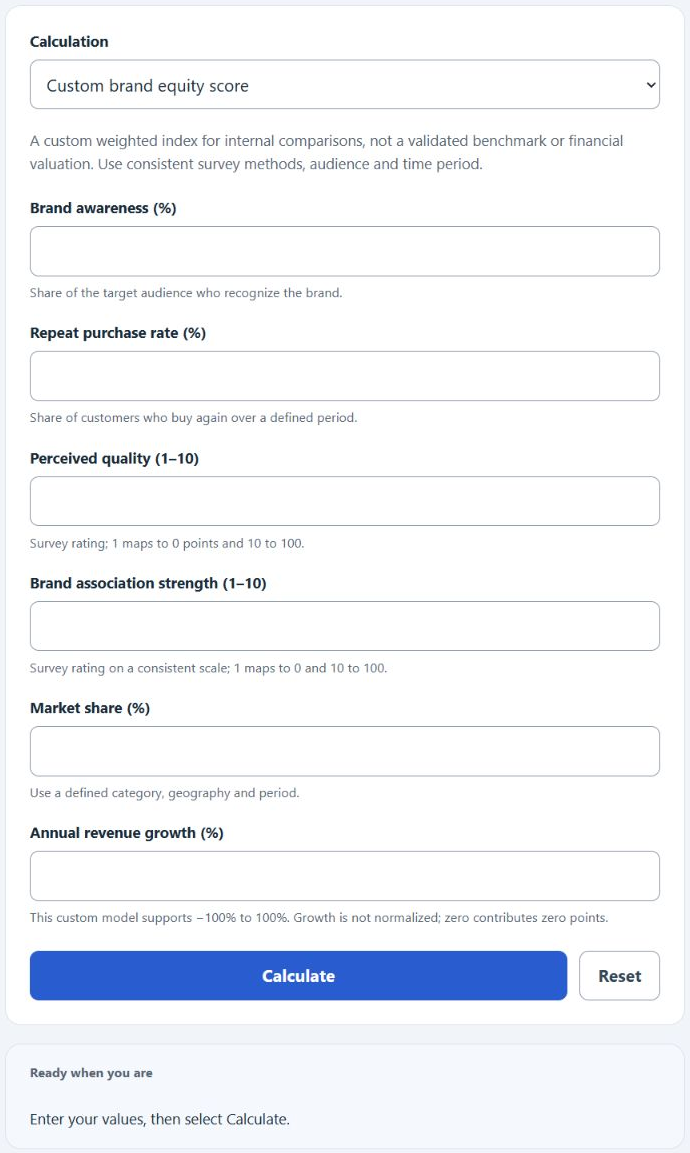
Calculate a custom brand equity score from awareness, repeat purchasing, quality, associations, market share and growth, or explore an illustrative value scenario using revenue and your own contribution and multiple assumptions. Neither method is a validated brand benchmark or appraisal.
- All Business Calculators
- BDI (Brand Development Index) Calculator
- Q Score Calculator
- Reach And Frequency Calculator
Brand Equity Formula
The following formula shows the Brand Equity Score method used by this calculator (a simplified, weighted scoring model on a 0–100 scale).
Variables:
- BE is the Brand Equity Score (0–100)
- A is Brand Awareness (%)
- L is Brand Loyalty (%)
- QN is Perceived Quality normalized to 0–100 from a 1–10 input: QN = ((Q − 1) / 9) × 100
- ASN is Strength of Brand Associations normalized to 0–100 from a 1–10 input: ASN = ((AS − 1) / 9) × 100
- MS is Market Share (%)
- G is Annual Revenue Growth Rate (%) (this calculator allows negative values; very negative growth can reduce the score)
To calculate the Brand Equity Score, convert the 1–10 ratings to 0–100 using the normalization shown above, then apply the weights, add the results and clip the total to 0–100. This score is an internal estimate for comparison and planning; it is not a universally accepted accounting or valuation standard.
Illustrative brand value scenario (choose this calculation): Scenario Value = Revenue × (Brand Contribution / 100) × Assumed Revenue Multiple. The multiple applies to attributed revenue, not profit; it must come from your own supported assumptions. The score does not determine it. This simplified scenario omits discounted cash flows, taxes and legal-rights analysis.
What is Brand Equity?
Brand equity refers to the value and strength of a brand in the market, which is derived from consumers’ perception and experience with the brand. It is the added value that a brand name gives to a product or service, influencing how consumers think, feel, and behave towards the brand. High brand equity can lead to customer loyalty, increased sales, and the ability to charge premium prices. It is built over time through marketing strategies, customer service, product quality, and customer experiences.
How to Calculate Brand Equity?
The following steps outline how to calculate the Brand Equity Score using the scoring formula shown above:
- First, determine Brand Awareness (A) as a percentage (0–100).
- Next, determine Brand Loyalty (L) as a percentage (0–100).
- Next, rate Perceived Quality (Q) on a 1–10 scale, then normalize it to QN = ((Q − 1) / 9) × 100.
- Next, rate Strength of Brand Associations (AS) on a 1–10 scale, then normalize it to ASN = ((AS − 1) / 9) × 100.
- Next, determine Market Share (MS) as a percentage (0–100).
- Next, determine Annual Revenue Growth Rate (G) as a percentage (this can be negative if revenue is shrinking).
- Finally, select Calculate. The calculator normalizes the ratings, applies BE = 0.20A + 0.20L + 0.20QN + 0.15ASN + 0.15MS + 0.10G, and clips the score to 0–100.
Example Problem:
Use the following variables as an example problem to test your knowledge:
Brand Awareness (A) = 70
Brand Loyalty (L) = 85
Perceived Quality (Q) = 9
Strength of Brand Associations (AS) = 8
Market Share (MS) = 25
Annual Revenue Growth Rate (G) = 12
Normalize the 1–10 ratings: QN = ((9 − 1) / 9) × 100 ≈ 88.9 and ASN = ((8 − 1) / 9) × 100 ≈ 77.8.
Then the Brand Equity Score is BE = 0.20(70) + 0.20(85) + 0.20(88.9) + 0.15(77.8) + 0.15(25) + 0.10(12) ≈ 65.4 (rounded; use unrounded normalized ratings in the calculation).