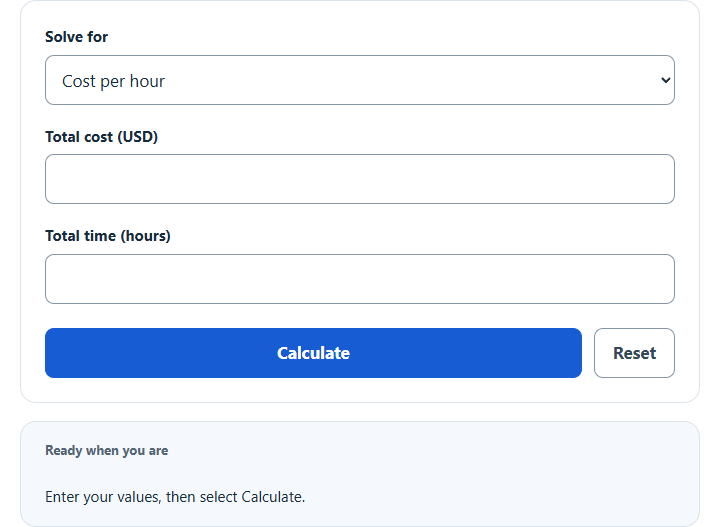
Calculate cost per hour or price per hour by dividing total cost by time, or find the total cost from an hourly rate and the number of hours.
Related Calculators
Calculator Functions
| Function | What it does | What it requires |
|---|---|---|
| Cost per hour | Finds the cost or price per hour of a job from what it cost and how long it took | Requires the total cost and the total time in hours |
| Total cost | Finds what a number of hours costs at an hourly rate | Requires the cost per hour and the total time in hours |
| Time in hours | Finds how many hours a sum of money buys at an hourly rate | Requires the total cost and the cost per hour |
| Hourly cost or charge-out rate from salary | Finds what an employee costs per working hour, and the rate to charge with a profit markup | Requires the annual salary, working hours per week and working weeks per year. Benefits and overhead and the profit markup are optional |
| Ownership cost per hour | Spreads the purchase cost of equipment over the hours it will be used | Requires the one-time ownership cost, hours of use per day, days of use per year and years of use. Salvage value is optional |
Amounts are in US dollars and time is in decimal hours, so 2 hours 15 minutes is entered as 2.25 and 45 minutes as 0.75. The first three functions also show the cost per minute and the cost of an 8-hour day and a 40-hour week at the same rate.
Cost Per Hour Formulas
| CPH | Cost per hour ($/hour) |
| TC | Total cost ($) |
| T | Total time (hours) |
Cost per hour
The total cost is divided by the hours. A project billed at $4,000 that took 8 hours cost $4,000 ÷ 8 = $500 per hour, and $187.50 for 15 hours is $12.50 per hour. The time must be greater than zero.
Total cost
At $125 an hour, 2 hours 15 minutes costs 125 × 2.25 = $281.25. At $95 an hour, 45 minutes costs 95 × 0.75 = $71.25.
Time in hours
A budget of $600 at $80 an hour buys 600 ÷ 80 = 7.5 hours. The hourly rate must be greater than zero.
Hourly cost or charge-out rate from salary
(HW × WY)
LHC is the loaded hourly cost, S is the annual salary, B is benefits and overhead as a percent of salary, HW is working hours per week and WY is working weeks per year. A $60,000 salary with 30% benefits and overhead, worked 40 hours a week for 48 weeks, costs 60,000 × 1.3 ÷ 1,920 = $40.63 per hour. For a charge-out rate, HW should count billable hours only, because unbilled time has to be recovered through the hours that are billed.
LHC × (1 + markup ÷ 100)
A 20% profit markup on $40.63 gives a charge-out rate of $48.75 per hour. In US private industry, benefits averaged 30.0% of employer compensation costs in June 2026, which is about 43% when stated as a percent of wages and salaries [1].
Ownership cost per hour
(HD × DY × Y)
OCH is the ownership cost per hour, C is the one-time ownership cost, SV is the expected salvage value, HD is hours of use per day, DY is days of use per year and Y is years of use. Taking the salvage value off the cost and spreading the rest evenly over the useful life is the straight line method of depreciation [2], applied here per hour of use. A $60,000 machine with a $10,000 salvage value, used 6 hours a day for 200 days a year over 5 years, costs 50,000 ÷ 6,000 = $8.33 per hour to own. The salvage value cannot exceed the cost.
Limits of This Estimate
- Every result is a constant average rate. It does not allow for minimum charges, call-out fees, overtime rates or billing in rounded time blocks.
- The salary function gives an employer’s cost. It is not take-home pay and not a legally required wage.
- Ownership cost per hour leaves out financing, fuel, maintenance, labor and taxes unless they are part of the cost entered, so it is not a full operating or rental rate.
Sources
- U.S. Bureau of Labor Statistics, Employer Costs for Employee Compensation: benefits as a share of private industry compensation costs, June 2026
- Internal Revenue Service, Publication 946 (2025), How To Depreciate Property: straight line method, with salvage value subtracted and the balance spread evenly over the useful life