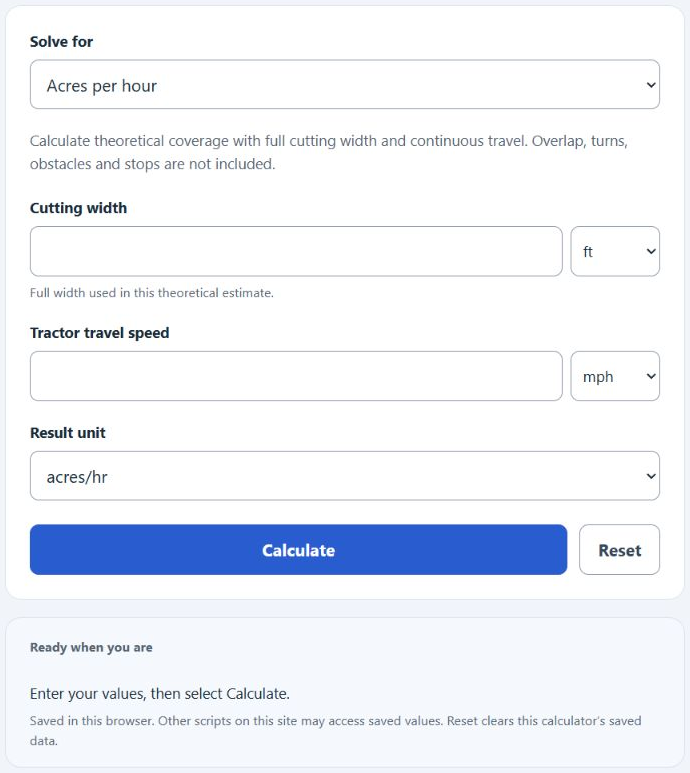
Choose theoretical acres per hour, cutting width, or tractor speed, then enter the two measurements shown. Supports feet, meters, mph, km/h, acres/hr and ha/hr.
- All Unit Converters
- Acres Per Hour (mowing) Calculator
- Mile Per Minute Calculator
- Acres To Linear Feet Calculator
Bush Hog Acres Per Hour Formula
The calculator uses cutting width and tractor speed to estimate how many acres per hour a bush hog can cover. The base calculation uses feet for cutting width, miles per hour for speed, and acres per hour for output.
This can also be simplified to:
To solve for cutting width:
To solve for tractor speed:
- APH = acres per hour
- W = cutting width in feet
- S = tractor speed in miles per hour
- 5280 = feet in one mile
- 43560 = square feet in one acre
If you enter cutting width and tractor speed, the calculator finds acres per hour. If you enter acres per hour and speed, it finds the required cutting width. If you enter acres per hour and cutting width, it finds the required tractor speed.
The calculator also supports meters, kilometers per hour, and hectares per hour by converting those units to the base units before applying the formula.
Typical Bush Hog Coverage Rates
The table below shows estimated acres per hour for common cutter widths and travel speeds. These are theoretical values before allowing for overlap, turns, rough ground, obstacles, or stopping time.
| Cutting Width | 3 mph | 4 mph | 5 mph | 6 mph |
|---|---|---|---|---|
| 4 ft | 1.45 acres/hr | 1.94 acres/hr | 2.42 acres/hr | 2.91 acres/hr |
| 5 ft | 1.82 acres/hr | 2.42 acres/hr | 3.03 acres/hr | 3.64 acres/hr |
| 6 ft | 2.18 acres/hr | 2.91 acres/hr | 3.64 acres/hr | 4.36 acres/hr |
| 8 ft | 2.91 acres/hr | 3.88 acres/hr | 4.85 acres/hr | 5.82 acres/hr |
| 10 ft | 3.64 acres/hr | 4.85 acres/hr | 6.06 acres/hr | 7.27 acres/hr |
Field Conditions and Practical Output
Actual mowing output is usually lower than the calculated value because you lose time to turning, overlap, rough terrain, gates, trees, and slowing down in heavy growth. The following percentages are illustrative assumptions, not measured or recommended ranges for particular field conditions. Use efficiency established from your own operation.
| Condition | Illustrative Efficiency | How to Estimate Actual Acres/hr |
|---|---|---|
| Example A | 80% to 90% | Calculated acres/hr × 0.80 to 0.90 |
| Example B | 65% to 80% | Calculated acres/hr × 0.65 to 0.80 |
| Example C | 45% to 65% | Calculated acres/hr × 0.45 to 0.65 |
Example Calculations
Example 1: Find acres per hour
You are using a 6 ft bush hog and driving 5 mph.
The result is about 3.64 acres per hour before field efficiency losses.
Example 2: Find required tractor speed
You want to cover 4 acres per hour with an 8 ft cutter.
You would need to travel about 4.13 mph under the theoretical formula.
FAQ
Does this calculator account for overlap and turning?
No. The main formula gives theoretical acres per hour based only on cutter width and travel speed. For a more realistic estimate, multiply the result by an efficiency factor. For example, if the calculator gives 4 acres per hour and your field efficiency is about 75%, the practical output is:
What speed should you use for bush hogging?
Use an operating speed permitted by the tractor and cutter instructions and suited to the actual terrain and vegetation. The calculator cannot determine a safe speed; rough ground, brush, rocks, slopes and hidden obstacles affect operating limits.
Why does a wider cutter not always mean the same increase in actual acres per hour?
A wider cutter increases theoretical coverage, but actual output also depends on tractor power, terrain, vegetation thickness, maneuvering room, and safe travel speed. If a larger cutter forces you to slow down or make more careful turns, the real gain may be smaller than the formula suggests.