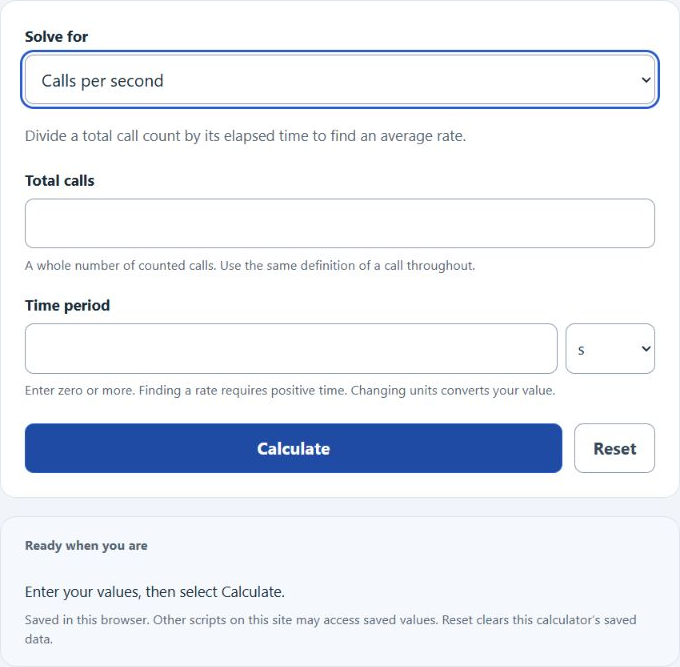
Enter the total number of calls and the time period in seconds into the calculator to determine the calls per second. This calculator helps evaluate call traffic for telecommunication networks, VoIP systems, SIP trunks, and call centers.

Calls Per Second Calculator

Enter any 2 values to calculate the missing variable

Calls Per Second Formula

The following formula is used to calculate the calls per second.

CPS = TC / TP

Variables:

  • CPS is the calls per second
  • TC is the total number of calls
  • TP is the time period in seconds

To calculate calls per second, divide the total number of calls by the time period in seconds.

What is Calls Per Second (CPS)?

Calls per second (CPS) is a teletraffic engineering metric that quantifies the rate at which new telephone calls are initiated or processed within a one-second interval. In VoIP and SIP-based networks, CPS specifically measures how many new call setups (SIP INVITE transactions) a trunk, softswitch, or proxy server can handle per second. This is distinct from concurrent call capacity, which measures how many calls can be active simultaneously. A system might support 10,000 concurrent calls but only process 200 new call setups per second.

CPS is a critical bottleneck metric because call setup is the most resource-intensive phase of a voice call. Each new call requires SIP signaling, authentication, route lookup, codec negotiation, and RTP session establishment. Once a call is connected, it consumes far fewer processing resources, primarily forwarding media packets at a steady rate of roughly 50 RTP packets per second per direction.

CPS vs. CAPS vs. Concurrent Calls

Three related but distinct metrics are used to dimension voice networks. CPS (calls per second) counts only successfully connected calls per second. CAPS (call attempts per second) counts all call setup attempts, including failed, rejected, and busy outcomes. The ratio of CPS to CAPS is the answer seizure ratio (ASR), which typically falls between 40% and 60% on wholesale VoIP routes. A network handling 100 CAPS with a 50% ASR is effectively processing 50 CPS of completed calls.

Concurrent calls (CC) measure how many active calls exist at any point in time. The relationship between CPS and CC depends on average call duration. If a system processes 10 CPS and the average call lasts 180 seconds, the steady-state concurrent call count is 10 x 180 = 1,800 simultaneous calls. This relationship is formalized in Erlang traffic theory, where traffic intensity in Erlangs equals the call arrival rate multiplied by the mean holding time.

CPS in Erlang Traffic Engineering

The Erlang is the fundamental unit of teletraffic intensity, representing continuous use of one circuit. One Erlang equals 3,600 call-seconds per hour, or equivalently 36 CCS (centum call-seconds, where 1 CCS = 100 call-seconds). CPS connects directly to Erlang calculations through the busy hour call attempts (BHCA) metric:

CAPS = BHCA / 3600

BHCA is the number of call attempts during the busiest sliding 60-minute window in a 24-hour period. For network dimensioning, engineers estimate BHCA from the active user population (N), expected calls per user per day (U), and the busy-hour concentration ratio (C, typically 0.15 to 0.20 for business traffic):

BHCA = N \times U \times C

From BHCA and the mean holding time (MHT), offered traffic in Erlangs is calculated as (BHCA x MHT) / 3600. This traffic figure is then fed into Erlang B (for loss systems with no queuing) or Erlang C (for call center queuing models) to determine the required number of trunks or agents.

SIP Server and VoIP Provider CPS Benchmarks

CPS capacity varies enormously depending on hardware, software, and whether the system is acting as a signaling proxy or a full media-handling PBX. Dedicated SIP proxy servers like Kamailio can handle thousands of CPS on commodity hardware because they only process signaling. Full-featured PBX platforms like Asterisk, which also handle media transcoding, typically peak around 200 to 250 CPS under load before CPU saturation becomes the limiting factor.

Cloud VoIP providers impose CPS limits per trunk or per account to protect shared infrastructure. Twilio defaults to 1 CPS per SIP trunk per region. Plivo’s Zentrunk allows 2 CPS per account and 1 CPS per individual trunk. These limits can typically be increased by contacting the provider and requesting a capacity upgrade, but they reflect the reality that unthrottled call bursts from a single customer can destabilize shared switching platforms.

CPS in Call Center Operations

In the call center context, CPS takes on a different practical meaning. With an industry-average handle time (AHT) of approximately 6 minutes and 10 seconds per call, a single agent processes roughly 8 to 10 calls per hour, or about 0.0025 CPS. A 100-agent call center handling 800 to 1,000 calls per hour operates at roughly 0.22 to 0.28 CPS aggregate.

These numbers are far below the signaling capacity of the underlying telephony infrastructure, which means that for call centers, the human bottleneck (agent availability and AHT) is always the binding constraint, not equipment CPS. The Erlang C formula is the standard tool for calculating how many agents are needed to meet a target service level (e.g., 80% of calls answered within 20 seconds) given a known arrival rate and average handle time.

Factors That Affect CPS Capacity

Several factors determine how many calls per second a given system can handle. SIP authentication adds cryptographic overhead to every call setup; disabling authentication on trusted internal trunks can double effective CPS. Codec selection matters when the system performs transcoding: converting between G.711 and G.729 consumes significantly more CPU than passing through a single codec. NAT traversal, SRTP encryption, and call recording each add incremental processing load.

Database lookups during call routing (least-cost routing tables, number portability queries, CNAM dips) introduce latency that directly reduces achievable CPS. Distributed architectures that separate the signaling plane from the media plane allow each layer to scale independently, which is why carrier-grade softswitches can achieve 10,000+ CPS while a monolithic Asterisk box tops out around 250.

calls per second calculator