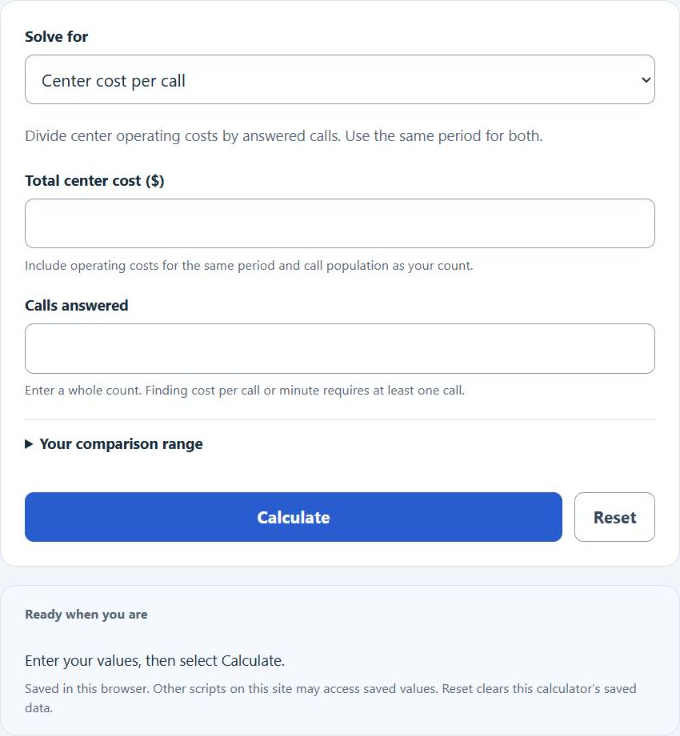
Calculate a call center’s cost per call by dividing total center cost by calls answered, or find campaign cost per call and cost per handling minute.
- All Business Calculators
- Call Recording Storage Calculator
- AHT (Average Handle Time) Calculator
- Holding Time Calculator
Calls Rate Formula
Variables:
- CR is the Calls Rate ($/call)
- TC is the total center cost ($)
- C is the number of calls answered
To calculate the Calls Rate, divide the total center cost by the number of calls answered.
How to Calculate Calls Rate?
The following steps outline how to calculate the Calls Rate.
- First, determine the total center cost ($).
- Next, determine the number of calls answered.
- Next, gather the formula from above = CR = TC / C.
- Finally, choose Center cost per call and select Calculate. A positive whole call count is required.
- After inserting the variables and calculating the result, check your answer with the calculator above.
Example Problem :
Use the following variables as an example problem to test your knowledge.
total center cost ($) = 5000
number of calls answered = 2000; cost per call = $5000 / 2000 = $2.50
Calls Per Hour and Per Agent-Hour
Choose Calls per hour to measure throughput rather than cost. Enter calls handled and elapsed working time for the same person or team. Calls per hour = calls handled ÷ elapsed hours. The time selector also accepts minutes or seconds.
If every agent worked the full interval, optionally enter the agent count: agent-hours = elapsed hours × agents, and calls per agent-hour = calls handled ÷ agent-hours. For example, 240 calls over 8 hours is 30 calls per hour. With 4 agents each working those 8 hours, the total is 32 agent-hours and the rate is 7.5 calls per agent-hour.
The result also shows elapsed minutes per handled call (elapsed hours × 60 ÷ calls) and, when agents are entered, agent working minutes per handled call (agent-hours × 60 ÷ calls). In the example these are 2 and 8 minutes per call. Neither is measured average handle time: concurrent calls, idle time and other work affect these ratios. With zero calls, throughput is zero and minutes per call is undefined. If agents worked different hours, do not use the equal-hours agent count.
For the cost of an individual phone call at a known constant per-minute price, use the Cost Per Minute Calculator and choose Total cost. Rate × duration estimates the call cost; provider billing increments, connection fees and minimum charges must be accounted for separately.
FAQs
What is the importance of calculating the Calls Rate in a call center?
Calculating the Calls Rate helps in understanding the cost efficiency of a call center’s operations. It allows managers to analyze how effectively resources are being utilized in answering calls and can guide decisions on staffing, budgeting, and process improvements.
How can improving Average Handle Time (AHT) impact the Calls Rate?
Shorter Average Handle Time may affect capacity and staffing, but it does not automatically reduce cost per call. With total cost and call count fixed, cost per call remains unchanged. Cost per handling minute equals total cost divided by calls multiplied by AHT in minutes.
Are there any tools or software recommended for tracking these call center metrics?
Yes, there are various call center software solutions available that offer real-time analytics and reporting features. These tools can track AHT, Calls Rate, call volumes, and other key performance indicators, helping managers to make informed decisions.
Can the Calls Rate formula be applied to other types of customer service centers, such as technical support or sales?
Absolutely. The Calls Rate formula is versatile and can be applied to any operation that involves handling calls, regardless of the industry. It’s a fundamental metric that can help assess the cost-effectiveness of customer service, technical support, sales, and other telephony-based services.