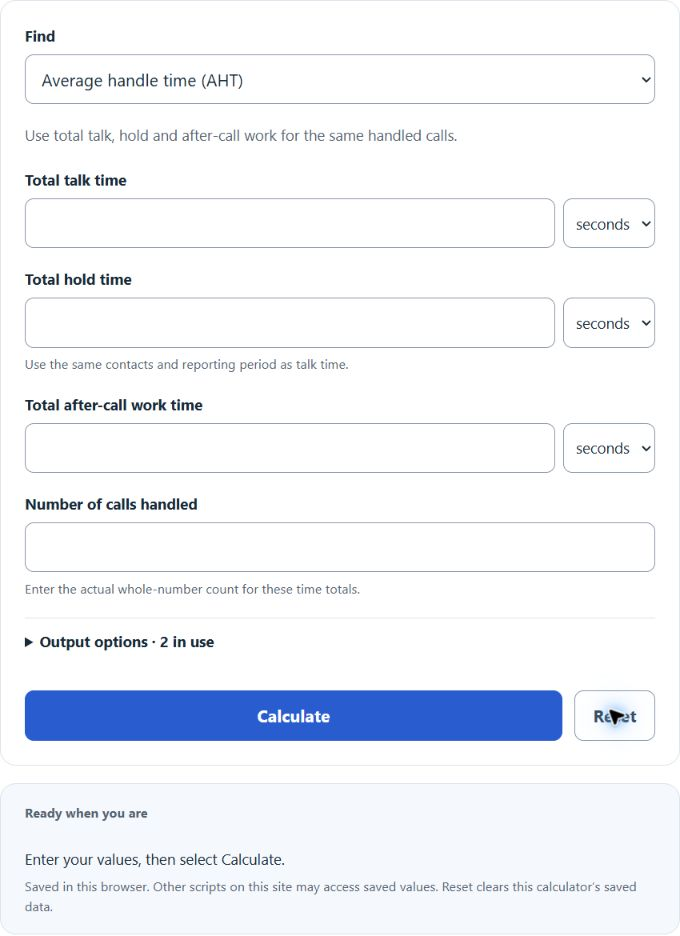
Calculate average handle time from total talk, hold and after-call work for handled calls, or solve for equivalent call count or total handle time. Choose seconds, minutes or hours for each time input.
- All Business Calculators
- Average Time Calculator
- Holding Time Calculator
- Service Level Calculator
- Average Call Length Calculator
- Call Abandonment Rate Calculator
- Calls Per Hour Calculator
- Waiting Time Calculator
AHT Formula
The following formula is used to calculate the average handle time in a contact center:
- Where AHT is the average handle time (seconds)
- TT is the total talk time (seconds)
- HT is the total time on hold (seconds)
- ACWT is the total after-call work time (seconds)
- C is the total number of calls handled
What is AHT?
AHT (average handle time) is a contact center KPI that measures the average duration of a single customer interaction from start to finish. It encompasses three distinct phases: the time an agent spends actively speaking with the customer (talk time), any periods where the customer is placed on hold while the agent researches or consults (hold time), and the post-interaction wrap-up work such as logging notes, updating CRM records, or sending follow-up communications (after-call work).
This calculator uses a three-component phone model: talk, hold and after-call work for handled calls. Queue waiting and ring time are not inputs here. Contact-center platforms can include additional components, so use consistent reporting definitions when comparing AHT.
AHT Components Breakdown
Talk Time is the live conversation between agent and customer. Its share of handle time depends on the work and contact population; a percentage alone does not establish whether an issue was resolved.
Hold Time covers periods when an agent places a customer on hold, such as research or consultation. Compare hold time with the contact context and platform definition rather than treating a fixed percentage as proof of a knowledge or tooling problem.
After-Call Work (ACW) includes post-call tasks such as disposition coding, notes, CRM updates and follow-up. Its share of AHT varies; use measured data from the same reporting period.
AHT Examples by Industry
The following times are illustrative planning examples, not verified industry benchmarks or performance targets. Compare contacts of similar complexity and reporting scope using your own measured baseline.
| Industry | Illustrative AHT | Primary Driver |
|---|---|---|
| Retail / E-commerce | 3 to 5 minutes | Order status, returns, simple product inquiries |
| IT / Tech Support | 4 min 40 sec | Troubleshooting, account access, software guidance |
| Telecommunications | 8 to 10 minutes | Billing disputes, plan changes, technical troubleshooting |
| Financial Services / Banking | 5 to 6 minutes | Account inquiries, fraud verification, loan applications |
| Insurance | 7 to 10 minutes | Claims processing, policy explanations, coverage changes |
| Healthcare | 6 to 8 minutes | Appointment scheduling, insurance verification, prescription refills |
| Government Services | 8 to 12 minutes | Eligibility verification, multi-step application processes |
| Utilities | 4 to 6 minutes | Billing questions, service start/stop, outage reporting |
AHT by Communication Channel
AHT varies substantially depending on the communication channel. Each channel has its own formula variant because the interaction mechanics differ.
Phone: The three-component formula applies when talk, hold and after-call work use the same handled-call population. No single cross-industry duration is assumed by this calculator.
Live Chat: Handle-time definitions and concurrency settings vary by platform. Distinguish elapsed conversation time from active agent work and use the platform’s documented metric definition.
Email: Active agent working time differs from elapsed calendar resolution time, which can include waiting between replies. Use a consistent definition when calculating or comparing email handle time.
AHT and First Call Resolution: The Tradeoff
AHT and first call resolution (FCR) should be evaluated together. Rushing an interaction can create repeat contacts. The percentages below are hypothetical examples, not measured research or a general relationship between call duration and resolution.
| Call Duration | Illustrative FCR (not measured data) |
|---|---|
| 1 to 3 minutes | 73% |
| 3 to 5 minutes | 71% |
| 5 to 9 minutes | 69% |
| 10 to 15 minutes | 67% |
| Over 15 minutes | 62% |
These example rows do not establish a causal effect or a nine-minute escalation threshold. Use measured FCR and contact complexity to evaluate the relationship in your operation.
What is Excluded from AHT
Queue waiting before an agent answers is separate from this calculator’s handling-time inputs. Breaks, meetings and training are also outside the three-component total. Transfer and consult treatment varies by platform; for example, Amazon Connect customer hold duration includes hold during transfers. Check your reporting definition instead of assuming all transfer waiting is excluded.
Related Contact Center Metrics
AHT does not exist in isolation. It connects directly to several other operational and quality metrics that together form a complete picture of contact center performance.
Occupancy Rate compares time handling contacts with eligible handling-plus-idle time. It is not universally total handle time divided by all logged-in time; platform definitions and status exclusions matter. Low occupancy alone does not establish overstaffing.
Cost Per Contact (CPC) can include a handling-time labor estimate. At $25/hour, six minutes represents $2.50 of time cost per contact. Reducing time by 30 seconds across 100,000 contacts releases about 833.33 handle-hours, equivalent to $20,833.33 at that rate; it does not by itself prove payroll savings.
Customer Satisfaction (CSAT) should be evaluated alongside AHT and resolution quality. AHT alone does not measure satisfaction, and these inputs do not establish which metric is its strongest predictor.
Service Level (the percentage of calls answered within a target time, commonly 80% within 20 seconds) is affected by AHT because longer handle times reduce agent availability and increase queue times. Erlang C workforce planning models use AHT as a primary input for calculating staffing requirements.
Staffing Impact of AHT Changes
At 1,000 calls per day, a six-minute AHT represents 100 handle-hours; five minutes and 30 seconds represents about 91.67 handle-hours. That is about 8.33 handle-hours less each day. Agent staffing cannot be determined from daily volume and AHT alone: an Erlang C estimate also needs arrival volume by interval and the service-level target, with operating hours, occupancy and shrinkage considered for schedules.