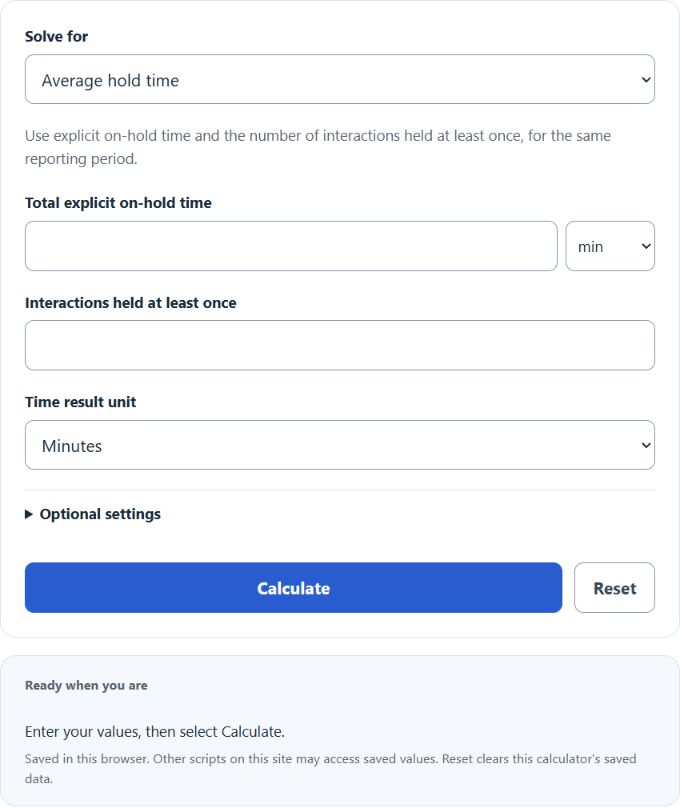
Calculate average or total explicit customer hold time, or the interaction count implied by those times. Optional target and offered-count comparisons use the same reporting population; accumulated hold hours are not elapsed queue time or staffing capacity.
- All Food and Cooking Calculators
- AHT (Average Handle Time) Calculator
- Calls Per Hour Calculator
- Cost Per Call Calculator
Average Hold Time Formula
Variables:
- AHT here means average explicit hold time (min per interaction held at least once), distinct from average handle time
- THT is the sum of all explicit hold segments in those held interactions (min)
- C is the number of interactions held at least once, counted once each
Divide total explicit hold time by interactions held at least once. Exclude queue waiting, talk time and after-call work; definitions vary by reporting system. A rounded mean may imply a fractional inverse count.
How to Calculate Average Hold Time?
The following steps outline how to calculate the Average Hold Time.
- First, determine the total hold time of all customers.
- Next, determine the number of interactions held at least once in the same period.
- Next, gather the formula from above: AHT = THT / C.
- Finally, calculate the Average Hold Time.
- After inserting the variables and calculating the result, check your answer with the calculator above.
Example Problem :
Use the following variables as an example problem to test your knowledge.
total hold time of all customers (min) = 1200
held interactions = 300
AHT = 1200 / 300 = 4 min per held interaction
FAQ
What is the importance of calculating Average Hold Time in customer service?
Average Hold Time measures how long customers spend placed on hold during live interactions (most commonly phone calls). Monitoring it helps identify staffing or routing bottlenecks and is closely tied to customer satisfaction, abandonment rates, and perceived service quality.
How can businesses reduce their Average Hold Time?
Common ways to reduce hold time include improving forecasting and staffing, smoothing demand (callbacks or virtual hold), optimizing call routing/skills-based routing, and equipping agents with better tools and knowledge so they can resolve issues without repeatedly placing customers on hold.
Are there any downsides to focusing too much on reducing hold time?
Yes. If teams avoid using hold when it is genuinely needed to research or verify information, they may provide incomplete answers or increase transfers and repeat contacts. Hold time should be balanced with outcomes like first-contact resolution and overall customer experience.
Can Average Hold Time be applied to other forms of customer service outside of phone calls?
Average Hold Time is mainly a metric for real-time channels where customers can be explicitly put “on hold” (such as phone and sometimes live chat). For email or social media, similar concepts are typically measured using response time, time to first reply, or time to resolution rather than “hold time.”