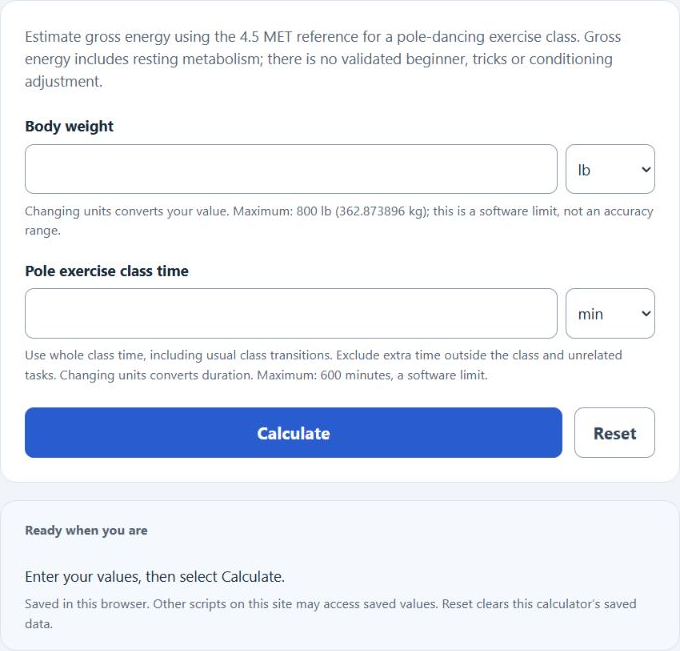
Estimate gross calories for a pole-dancing exercise class using body weight and class duration. Gross energy includes resting metabolism.
Calories Burned Pole Dancing Formula
The calculator uses the 4.5 MET reference for pole-dancing exercise classes from the 2024 Compendium Conditioning Exercise table, code 02108. This is a population activity reference for adults aged 19–59, not a measurement of your metabolism or every pole-dancing technique.
Gross calories (kcal) = 4.5 × 0.0175 × Weight (kg) × Class duration (minutes)
- Weight (kg) = body weight in kilograms; multiply pounds by 0.45359237 to convert
- Class duration (minutes) = matching exercise-class time, including usual transitions; exclude extra time outside the class or unrelated tasks. Multiply hours by 60 to convert.
- MET reference = 4.5 for a pole-dancing exercise class. The oxygen-based conversion uses 0.0175 kcal/kg/min per MET; gross energy includes resting energy.
Typical Pole Dancing Burn Rate
For a 150 lb person and 30 minutes of a matching exercise class at the fixed reference, the estimates are:
- Estimated gross energy: 160.74 kcal
- Estimated gross energy rate: 5.36 kcal/min
- Reference used: 4.5 MET for a pole-dancing exercise class; no separate beginner, flow, or tricks factors
What Affects Calories Burned During Pole Dancing?
- At the fixed reference, estimated gross energy increases with class duration. Longer sessions are linear extrapolations, not evidence that effort stays constant.
- At the same 4.5 MET reference and class duration, the model gives a larger estimate for higher body weight.
- Technique and the mix of climbs, spins, holds, and choreography can change actual effort; this calculator does not separately calibrate them.
- Include usual class transitions, and exclude extra time outside the class or unrelated tasks. The result is gross energy during class time, not additional calories above rest or a weight-loss prediction.
What is Pole Dancing?
Pole dancing combines dance, strength work, climbing, spinning, and controlled holds around a vertical pole. These movements use grip, upper-body and core control; the mix varies by class.
How to Calculate Calories Burned Pole Dancing
- Enter body weight and select pounds or kilograms. Changing units converts the entered value.
- Enter pole-dancing class duration and select minutes or hours. Include usual class transitions; exclude extra time outside the class or unrelated tasks. Changing units converts the duration.
- Use the fixed 4.5 MET exercise-class reference. The 800 lb (362.873896 kg) and 600-minute caps are software limits, not validated accuracy ranges.
- Select Calculate to see estimated gross kcal and kcal per minute. Calculation details show the formula and source assumptions.
Example
Weight: 150 lb
Class duration: 45 minutes
Activity reference: Pole-dancing exercise class, 4.5 MET
Estimated gross calories: 150 lb × 0.45359237 = 68.0388555 kg; 4.5 × 0.0175 × 68.0388555 × 45 = 241.112694178125 kcal ≈ 241.11 kcal. The total uses the unrounded rate of 5.358059870625 kcal/min.