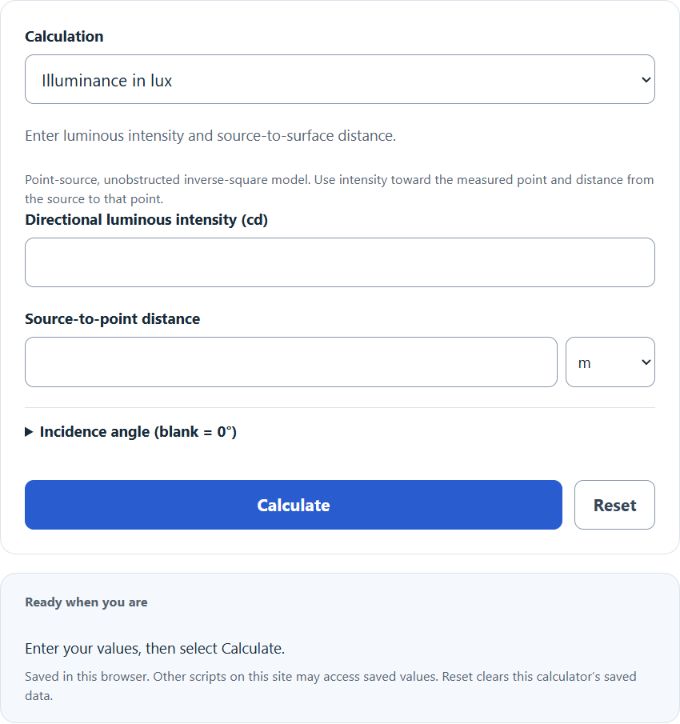
Convert directional luminous intensity in candela to surface illuminance in lux using distance and incidence angle. You can also reverse the relationship to find intensity or distance.
Photometry formula
E = I cos(θ) / r², where E is illuminance in lux, I is luminous intensity toward the measured point in candela, r is source-to-point distance in meters, and θ is the angle between the incoming light and the receiving-surface normal.
The inverse relationships are I = Er²/cos(θ) and r = √(I cos(θ)/E). This uses a point-source or suitable far-field approximation with an unobstructed path.
Example
A 100 cd source at a distance of 2 m gives E = 100/2² = 25 lux at normal incidence. At a 60° incidence angle, cos(60°) = 0.5, so the same source gives 12.5 lux.
Frequently asked questions
Can candela be converted to lux without a distance?
No. Candela describes directional intensity; lux describes illumination per surface area. Distance and receiving geometry connect them.
Why does 90° give zero illuminance?
At grazing incidence, the ideal surface receives no normal light component. An inverse intensity or distance calculation at that angle is not uniquely determined by this model.
Will this predict room lighting accurately?
Only where the stated approximation applies. Extended sources, reflections, obstruction, absorption and the actual directional beam distribution can change illumination.
References