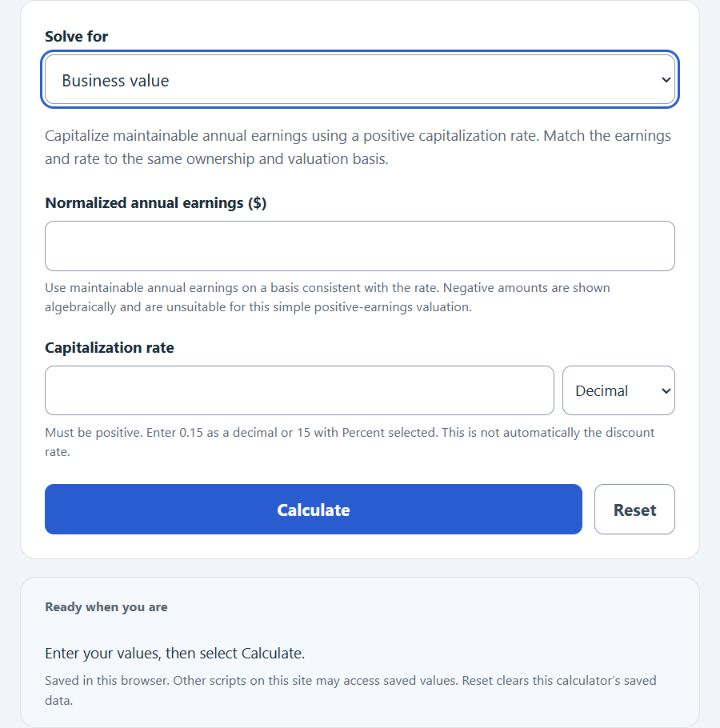
Calculate business value, earnings, or capitalization rate with the capitalization of earnings method by selecting the quantity to calculate and entering its two required values.
Related Calculators
- Debt Constant Calculator
- Market Value Of Debt Calculator
- Share Price Calculator
- Business Growth Percentage Calculator
- All Business Calculators
Capitalization of Earnings Method Formula
The capitalization of earnings method estimates business value by converting a stable earnings amount into value using a capitalization rate. The calculator can solve for business value, earnings, or capitalization rate when you enter the other two values.
- Value = estimated value of the business in dollars
- Earnings = normalized annual earnings of the business in dollars
- Capitalization Rate = positive capitalization rate consistent with the earnings and valuation basis, entered as a decimal or percent using the unit selector
To solve for earnings, the formula is rearranged:
To solve for the capitalization rate, the formula is rearranged:
- Calculate value: enter earnings and the capitalization rate. The result is the estimated business value.
- Calculate earnings: enter business value and capitalization rate. The result is the earnings level implied by those inputs.
- Calculate capitalization rate: enter earnings and business value. The result is the cap rate implied by the valuation.
Capitalization Rate Reference Table
The table shows decimal entries: 20% is 0.20. The calculator also accepts 20 with Percent selected. These illustrative rates do not determine risk by themselves.
| Capitalization Rate | Decimal Entry | Implied Multiple | General Interpretation |
|---|---|---|---|
| 10% | 0.10 | 10.0x earnings | Illustrative rate; risk requires supporting valuation analysis |
| 15% | 0.15 | 6.67x earnings | Illustrative rate; earnings and rate must share the same basis |
| 20% | 0.20 | 5.0x earnings | Illustrative rate; may include risk and growth assumptions |
| 25% | 0.25 | 4.0x earnings | Illustrative rate; not a business-size or risk classification |
Earnings and Value Relationship
The same earnings produce a higher valuation when the capitalization rate is lower, and a lower valuation when the capitalization rate is higher.
| Annual Earnings | Value at 10% | Value at 15% | Value at 20% |
|---|---|---|---|
| $100,000 | $1,000,000 | $666,666.67 | $500,000 |
| $250,000 | $2,500,000 | $1,666,666.67 | $1,250,000 |
| $500,000 | $5,000,000 | $3,333,333.33 | $2,500,000 |
Example
Example 1: Calculate business value
You have normalized annual earnings of $300,000 and a capitalization rate of 0.15.
The estimated business value is $2,000,000.
Example 2: Calculate capitalization rate
A business is valued at $1,250,000 and has annual earnings of $250,000.
The implied capitalization rate is 0.20, or 20%.
FAQ
What earnings should you use in the capitalization of earnings method?
You should use normalized annual earnings that reflect the business's expected ongoing performance. This often means adjusting for unusual, one-time, or non-operating items. The method is most useful when earnings are reasonably stable.
How do you enter the capitalization rate?
With Decimal selected, enter 12% as 0.12, 18% as 0.18, and 25% as 0.25. With Percent selected, enter 12, 18, or 25 instead. Changing units converts the entered quantity.
What does a higher capitalization rate do to business value?
For the same positive earnings, a higher capitalization rate lowers the estimated value. The rate may reflect both required return and growth assumptions; it is not a risk measure by itself. For the same earnings, a business valued at a 20% cap rate will be worth less than one valued at a 10% cap rate.