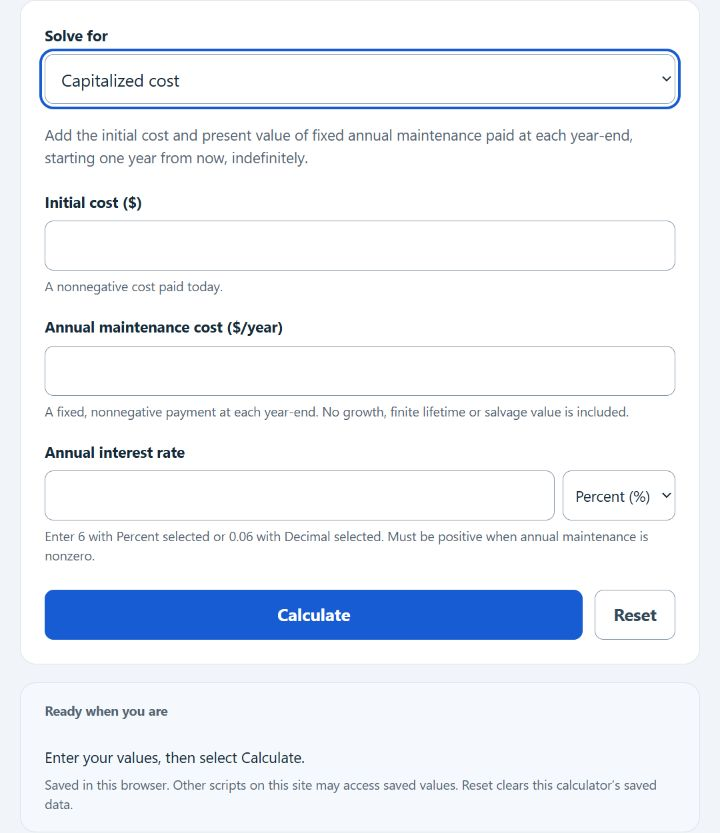
Calculate capitalized cost, initial cost, annual maintenance cost, or interest rate from any three values in a perpetuity model with ongoing maintenance.
- All Cost Calculators
- Capitalized Interest Calculator
- Annual Holding Cost Calculator
- All Business Calculators
Capitalized Cost Formula
The capitalized cost model used here treats annual maintenance cost as a perpetual annual cost. The main formula is:
- CC = capitalized cost, in dollars
- IC = initial cost, in dollars
- MC = annual maintenance cost, in dollars per year
- R = annual interest rate, as a percent
To solve for initial cost:
To solve for annual maintenance cost:
To solve for interest rate:
Select the quantity to calculate and enter its three required values. Capitalized cost adds initial cost and present maintenance cost; initial cost subtracts present maintenance cost from the total; annual maintenance is (CC − IC) × r; and the annual rate is MC ÷ (CC − IC), where r is a decimal. The rate unit selector accepts either percent or decimal entries.
Interest Rate Factors for Capitalizing Annual Maintenance
The factor below shows how many dollars of capitalized cost are created by each $1 of annual maintenance cost.
| Interest Rate | Capitalization Factor, 1 / (R / 100) | Capitalized Value of $1,000/year |
|---|---|---|
| 2% | 50.00 | $50,000 |
| 3% | 33.33 | $33,333 |
| 5% | 20.00 | $20,000 |
| 8% | 12.50 | $12,500 |
| 10% | 10.00 | $10,000 |
Typical Input Checks
| Input Situation | What It Means |
|---|---|
| Interest rate is greater than 0 | The standard perpetuity formula can be used. |
| Capitalized cost is greater than initial cost | The difference represents the capitalized value of future maintenance. |
| Capitalized cost equals initial cost | This usually implies zero annual maintenance cost in this model. |
| Capitalized cost is less than initial cost | The inputs usually imply a negative maintenance cost, so the values should be checked. |
Example Problems
Example 1: Calculate capitalized cost
Suppose the initial cost is $80,000, annual maintenance is $3,000, and the interest rate is 6%.
The capitalized cost is $130,000.
Example 2: Calculate annual maintenance cost
Suppose the capitalized cost is $250,000, the initial cost is $150,000, and the interest rate is 5%.
The annual maintenance cost is $5,000 per year.
FAQ
What is capitalized cost?
Capitalized cost is the total present cost of an asset when you include both the initial cost and the present value of ongoing annual costs. In this calculator, maintenance is a fixed annual payment made at each year-end, starting one year from now, indefinitely. The discount rate is fixed and positive for a nonzero maintenance stream. Growth, replacements, salvage value and a finite service life are not included.
Why does a lower interest rate increase capitalized cost?
A lower interest rate makes future annual costs worth more in present-value terms. For example, $1,000 per year capitalized at 5% is $20,000, but the same $1,000 per year capitalized at 2% is $50,000.
Can the interest rate be zero?
For a nonzero annual maintenance cost, the interest rate must be greater than 0 because the perpetuity formula divides by the interest rate. If the annual maintenance cost is $0, then the capitalized cost equals the initial cost in this model.